|
1. |
All aircraft flying in air space above the Indian Territory, including territorial waters adjacent thereto are required to follow, the established ATS routes as promulgated by Notam or Aeronautical nformation Publication or any other route over which the flight is specifically permitted. Pilots are cautioned not to fly in the air space over Indian Territory within 15NM of the border of India except when following an ATS or specifically permitted route or when operating to or from any aerodrome situated within 15NM of border of India. |
|
2. |
Occasions may arise when due to circumstances beyond the control of the Pilot-in-command a deviation from the ATS/specifically permitted route may have been/to be made. When such a situation arises, the Pilot-in-command of the aircraft shall inform the appropriate Air Traffic Control Centre (ATCC) by the quickest means available of the following : |
|
|
i) Present position-direction and flight level of the aircraft. |
|
|
ii) Position, flight level and time at which the deviation from the route was/is expected to be made. |
|
|
iii) Direction and distance the aircraft has deviated/is likely to deviate from the route. |
|
|
iv) Position, time and flight level of entry likely reentry into the route. |
|
3. |
If an aircraft penetrates into/operates within an ADIZ without Air Defence Clearance, strays into a restricted area/prohibited area/danger area or fails to inform the Air Traffic Control Centre about its deviation/intended deviation from the route, it will be liable to interception by fighter aircraft. |
|
4. |
The interception will be carried out with every regard to the safety of the intercepted aircraft and in a manner which will ensure that the occupants are not disturbed. An aircraft which is intercepted by another aircraft shall immediately |
|
|
i) Attempt to establish radio telecommunication with intercepting aircraft or with the appropriate intercept control unit, by making a general call on the emergency frequency 121.5 MHZ giving the identity of the intercepted aircraft and the nature of the flight. |
|
|
ii) Follow instructions given by the Intercepting aircraft, interpreting and responding to visualsignals in accordance with the specifications given in para 9. These visual signals will normally be used on instructions from responsible Air Defence Authority when all other means of communication with the aircraft fail. |
|
|
iii) Notify, if possible, the appropriate air traffic service unit. |
|
|
iv) If equipped with SSR transponder select Mode A, Code7700, unless otherwise instructed by the appropriate Air Traffic Services Unit. |
|
5. |
If radio contact is established during interception but communication in a common language is not possible, attempts shall be made to convey instructions, acknowledgement of instructions and essential information by using the following phrases and pronunciations and transmitting each phrase twice. |
|
6. |
If any instructions received by radio from any sources conflict with those given by the intercepting aircraft by visual/radio signals, intercepted aircraft shall request immediate clarification while continuing to comply with the visual/radio instructions given by the intercepting aircraft. |
|
7. |
The possibility of interception and recourse to the visual signals in para 9 would not normally arise if there is strict compliance with requirements of Air Defence Clearance, avoiding restricted, prohibited/ danger areas and no deviation is made from flight plan route and a listening watch is being maintained on appropriate ATS frequency. Pilots are warned, however, that should the occasion arise they must comply with the visual signals/radio instructions given by the intercepting aircraft. |
|
8. |
Phrases |
|
8.1. |
Phrases for use by INTERCEPTED aircraft
|
|
Series |
INTERCEPTING Aircraft Signals |
Meaning |
INTERCEPTED Aircraft Responds |
Meaning |
|
1
|
DAY or NIGHT -Rocking aircraft and flashing navigational lights at irregular intervals (and landing lights in the case of a helicopter) from a position slightly above and ahead of, and normally to the left of, the intercepted aircraft (or to the right if the intercepted aircraft is a helicopter) and, after acknowledgement a slow level turn, normally to the left (or to the right in the case of a helicopter) on the desired heading.
NOTE
(1) Meteorological conditions or terrain may require the intercepting aircraft to reverse the positions and direction of turn given above in series 1.
(2) If the intercepted aircraft is not able to keep pace with the intercepting aircraft, the latter is expected to fly a series of racetrack patterns and to rock the aircraft each time it passes the intercepted aircraft.
|
You have been intercepted follow-us
|
DAY or Night - Rocking aircraft. Flashing navigational lights at irregular intervals and following.
NOTE
Additional action required to be taken by intercepted aircraft is prescribed in Annex 2, Chapter 3.3.8.
|
Understood, will comply
|
|
2 |
DAY and NIGHT - An abrupt maneuver from the intercepted aircraft consisting of climbing turn of 900 or more without crossing the line of flight of the intercepted aircraft |
You may proceed |
DAY and NIGHT - Rocking the aircraft. |
Understood, will comply |
|
3 |
DAY or NIGHT-Lowering landing gear (if fitted), showing steady landing lights and over-flying runway in use or, if the intercepted aircraft is a helicopter, over-flying the helicopter landing area. In the case of helicopters, the intercepting helicopter makes a landing approach, coming to hover near to the landing area. |
Land at this aerodrome |
Day or Night-Lowering landing gear, (if fitted), showing steady landing lights and following the intercepting aircraft and if, after overflying the runway in use or helicopter landing area, landing is considered safe, proceeding to land. |
Understood, will comply |
|
Series |
INTERCEPTING Aircraft Signals |
Meaning |
INTERCEPTED Aircraft Responds |
Meaning |
|
4 |
DAY or NIGHT - Raising landing gear (if fitted) and flashing landing lights while passing over runway in use or helicopter landing area at a height exceeding 300M (1000ft) but not exceeding 600M (2000ft) in the case of a helicopter, at a height exceeding 50M (170ft) but not exceeding 100M (330ft) above the aerodrome level, and continuing to circle runway in use or helicopter landing area. If unable to flash landing lights, flash any other lights available. |
Aerodrome your have designated is inadequate |
DAY or NIGHT - if it is desired that the intercepted aircraft follow the intercepting aircraft to an alternate aerodrome, the intercepting aircraft raises its landing gear if fitted) and usesthe series 1 signals prescribed for intercepting aircraft.
If it is decided to release the intercepted aircraft, the intercepting aircraft uses the series 2 signals prescribed for intercepting aircraft. |
Understood Follow me
Understood you may proceed |
|
5 |
DAY or NIGHT - Regular switching on and off of all available lights but in such manner as to be distinct from flashing lights. |
Cannot comply |
DAY or NIGHT - Use series 2 signals prescribed for intercepting aircraft |
Understood |
|
6 |
DAY or NIGHT - Irregular flashing of all available lights. |
In distress |
DAY or NIGHT - Use series 2 signals prescribed for intercepting aircraft. |
Understood |
|
10. |
Establishment of Air Defense Identification Zone and procedures
|
|
10.1. |
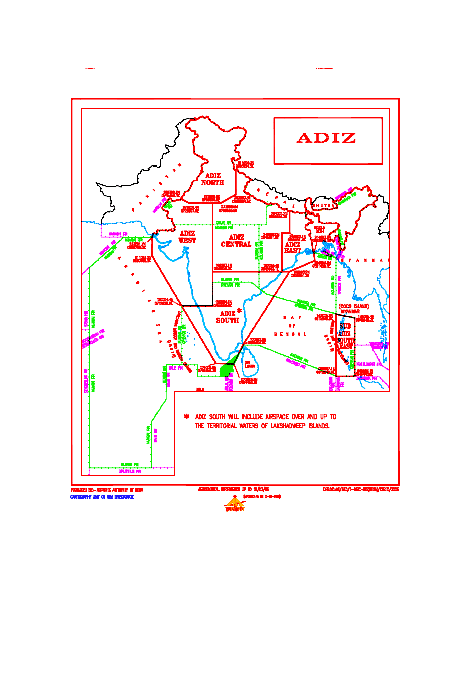
Air Defense Identification Zones (A.D.I.Z) as indicated here under have been established for air defense clearance |
|
|
|
|
10.1.1. |
A.D.I.Z North: The entire airspace over the area bounded by coordinates 311959.3N 0785954.3E, 283000.3N 0785954.5E, 273000.5N 0765955.5E, 273000.4N 0725957.6E, 280300.2N 0715458.1E (Over the International Border) then along the International Border / Line Of Control with Pakistan and Line of Actual Control with China till 311959.3N 0785954.3E. |
|
|
|
|
10.1.2. |
A.D.I.Z. West - The entire airspace over the area bounded by coordinates 280300.2N 0715458.1E, 273000.4N 0725957.6E, 273000.5N 0755956.0E, 150004.4N 0755956.4E, 150004.4N 0715957.3E, 211502.5N 0680700.0E, 233601.7N 0680700.0E then along the International Border with Pakistan up to 280300.2N 0715458.1E. |
|
|
|
|
10.1.3. |
A.D.I.Z Central: The entire airspace over the area bounded by coordinates 311959.3N 0785954.3E, 283000.3N 0785954.5E, 273000.5N 0765955.5E, 273000.5N 0755956.0E, 192003.1N 0755956.3E, 192003.4N 0845952.1E, 240002.0N 0845951.9E, 240002.1N 0855951.4E, 264001.2N 0855951.2E (A point over the International border with Nepal) and then line along the Indo-Nepal boundary and Line of Actual Control with China up to 311959.3N 0785954.3E. |
|
|
|
|
10.1.4. |
A.D.I.Z East : The entire airspace over the area East of line joining the coordinates 264001.2N 0855951.2E, 240002.1N 0855951.4E, 240002.0N 0845951.9E, 192003.4N 0845952.1E, 192003.5N 0855951.7E, 204003.3N 0891450.1E, 214003.0N 0890950.1E and along the borders of India in the East excluding the airspace covered by territories of Bangladesh, Bhutan and part of Nepal up to 264001.2N 0855951.2E. |
|
|
|
|
10.1.5. |
A.D.I.Z South: The entire airspace over the area bounded by coordinates 192003.1N 0755956.3E, 150004.4N 0755956.4E, 150004.4N 0715958.2E, 074006.5N 0762456.3E, 073506.5N 0784455.3E, 100005.9N 0795454.7E, 192003.5N 0855951.7E, 192003.1N 0755956.3E. A.D.I.Z South also includes airspace over and upto the territorial waters of Lakshadweep Islands. |
|
10.1.6. |
Sub ADIZ South-East: The entire airspace over the area bounded by coordinates 060007.1N 0915949.6E, 060007.1N 0942448.6E, 133005.4N 0942448.3E, 140005.2N 0915949.3E, 060007.1N 0915949.6E. It would be sub-ordinate organisation under ADIZ South. |
|
11. |
Requirement for Air Defense Clearance (ADC) |
|
11.1. |
No flight of aircraft civil/military, Indian or foreign originating within the ADIZ defined under para.1 above and those penetrating into these ADIZ are permitted without Air Defense Clearance. The procedures for issue of Air Defense Clearance are outlined in the succeeding paragraphs. Aircraft flying without an air defense clearance or failing to comply with any restriction or deviating from flight plan will be liable to identification and interception procedures promulgated in this chapter. |
|
12. |
Procedures for the issue of Air Defense Clearance (ADC) |
|
12.1. |
General |
|
12.1.1. |
Except the local flights conducted within airspace of 5NM radius centered at ARP and vertical limits of 1000ft.AGL of an aerodrome; aircraft when operating to, through or within the ADIZ shall obtain Air Defense Clearance before take off, through the ATC concerned. |
|
12.1.2. |
ADC shall be valid for the entire route, irrespective of intermediate halts for flight originating in one ADIZ/FIR and transiting through other ADIZ/FIR. |
|
12.1.3. |
All flights shall obtain Air Defense Clearance before entering ADIZ from respective FIC ten minutes prior to entering Indian Airspace. |
|
12.1.4. |
ADC shall be obtained before departure and in the event of departure being delayed for more than 60 minutes at the aerodrome of departure or at intermediate halts; a fresh ADC shall be obtained. In the case of communication difficulty or delay in receipt of ADC, or non-existence of communication at the place of departure, the aircraft equipped with radio may be allowed to take off with instructions to obtain ADC immediately after airborne from the FIC concerned. |
|
12.1.5. |
Flying club aircraft intending to operate beyond immediate vicinity of an aerodrome where no ATC is functioning may obtain ADC from the nearest IAF ATC Unit. The IAF ATC Unit will advise the FIC concerned regarding the movement of the Flying club aircraft. |
|
12.1.6. |
Scheduled aircraft or flying club aircraft returning to the Aerodrome of departure on the same daymay be issued with Air Defense Clearance for return flight also, if so desired, provided that a fresh ADC will have to be obtained in the event of the delay for more than thirty minutes in excess of the estimated departure time for the return flight. |
|