AD 2 AERODROMES

VOHS

VOHS
AD 2.2

AERODROME GEOGRAPHICAL AND ADMINISTRATIVE DATA

1

Aerodrome reference point coordinates and its site

171426N 0782544E

North of PTB,ARP elev. 601M/1972ft

2

Direction and distance of aerodrome reference point from the center of the city or town which the aerodrome serves

Bearing 210 DEG/20 KM from Husain Sagar

3

Aerodrome elevation and reference temperature

2028 FT / 39.0 DEG C

4

Magnetic variation, date of information and annual change

1.00 DEG W (1995) /0.016 DEG E

5


Name of aerodrome operator, address, telephone, telefax, e-mail address, AFS address, website (if available)

GMR Hyderabad International Airport Ltd. Shamshabad, Ranga Reddy- Dist,

Telangana, PIN-500108,


Telephone:

+91-40-67394129

Fax:

+91-40-67395559

AFS:

----

Email:

ceo.ghial@gmrgroup.in

6

Types of traffic permitted (IFR/VFR)

IFR/VFR

7

Remarks

Air Traffic Services:

General Manager (ATM)

Airports Authority of India,

Shamshabad, Ranga Reddy- Dist,

Telangana. PIN-500108

Tel: +91-40-24008303;

Fax: +91-40-24008307

Email: gmatmhial@aai.aero


AD Reference Code: 4F

VOHS

AD 2.3

OPERATIONAL HOURS

1

Aerodrome Operator

Mon to Fri: 0330-1230 UTC ( 0900-1800 IST )

Sat: 0330-0730 UTC ( 0900-1300 IST )

Sun & Holiday: Closed

2

Custom and immigration

H24

3

Health and sanitation

H24

4

AIS briefing office

H24

5

ATS reporting office (ARO)

H24

6

MET Briefing office

H24

7

Air Traffic Service

H24

8

Fuelling

H24

9

Handling

H24 Prior Arrangement

10

Security

H24

11

De-icing

NIL

12

Remarks

The approved hourly RWY traffic handling capacity is as follows:

For RWY 27L/09R:

MAX NR of ARR and DEP--33

MAX NR of ARR only --24

MAX NR of DEP only --24

For RWY 27R/09L when RWY 27L/09R is taken for schedule maintenance:

Case 1-

When RWY27L/09R is not available for taxiing purpose:

MAX NR of ARR and DEP --18

MAX NR of ARR only --10

MAX NR of DEP only --15

Case 2-

When RWY 27L/09R is available for taxiing purpose between taxiways A1 and A3 and between taxiways A8 and A10:

MAX NR of ARR and DEP --22

MAX NR of ARR only --15

MAX NR of DEP only --18

VOHS

AD 2.4

HANDLING SERVICES AND FACILITIES

1

Cargo-handling facilities

By Hyderabad Menzies Air Cargo Private Ltd.

2

Fuel and Oil types

JET A1

3

Fuelling facilities and capacity

Hydrant and bowzer (12 Dispensers + 06 Refuellers)

4

De-icing facilities

NIL

5

Hangar space for visiting aircraft

NIL

6

Repair facilities for visiting aircraft

Available with AIESL & GMRATL with Hanger facility

7

Remarks

NIL

VOHS

AD 2.5

PASSENGER FACILITIES

1

Hotel(s) at or in the vicinity of aerodrome

Novotel Business Brand Hotel with 305 rooms at a distance of 2.75km from PTB and hotels in Hyderabad city. Plaza Premium Transit Lounge at Level C

(27 rooms) , Airport Dormitory Near PTC (49 beds & 7 rooms single/ double)

2

Restaurant(s) at or in the vicinity of aerodrome

Level C: KFC, McDonalds, Coffee Hut, Food street (Multi cuisine Restaurant). Level D: Cafe Coffee Day, Subway, Karachi Bakery, McDonalds, Coffee Hut,

Hatti kapi

Level F: At visitors’ gallery- Coffee Hut, Forecourt : Coffee Café, Check In- Coffee club, Domestic SHA: Monsoon Bar, Barista coffee, Indian Paradise, KFC, Taste of India Domestic bus gates: Coffee club International SHA: Dosa Factory, Indian Paradise, Grab and Fly, Khao Gali, Coffee club

Level B & E: Canteen (for Employees of GMR & Airlines)

3

Transportation possibilities

Taxi (Prepaid & Metered) Bus services (TSRTC Town- Volvo, TSRTC

Pushpak), Free shuttle bus from Airport to PTC

4

Medical Facilities

24 hrs Medical and Dental facilities provided by Apollo Hospital Enterprises

Limited (One full-fledged medical centre housing minimum 17 beds), First Aid

counters at Level D, E and F.

5

Bank and post office at or in the vicinity of

aerodrome

Banks: Canara Bank at Level C and State Bank of India at Level F

ATM: Total 13 Nos. (Level C- 2, Level D- 6 & Level F- 5) Foreign exchange counters: Total 5 Nos. (Level F- 2,Level E- 1 & Level D- 2)

6

Tourist office

TSTDC (Telangana State Tourism Development Corporation at Level D)

7

Remarks

APTDC (Andhra Pradesh Tourism Development Corporation at Level D)

VOHS

AD 2.6

RESCUE AND FIRE FIGHTING SERVICES

1

Aerodrome category for fire fighting

Within ATS HR: CAT-9 (can be upgraded to CAT- 10 with 01 Hour prior notice)

2

Rescue equipment

Available as per Airport Services Manual Part1 for CAT- 9

3

Capability for removal of disabled aircraft

With prior arrangement with Air India Mumbai

4

Remarks

NIL

VOHS

AD 2.7

SEASONAL AVAILABILITY CLEARING

1

Type(s) of clearing equipment

NIL

2

Clearance priorities

NIL

3

Remarks

NIL

VOHS

AD 2.8

APRONS, TAXIWAYS AND CHECK LOCATIONS/POSITIONS DATA

1

Designation, surface and strength of aprons

Surface: Rigid

Strength: See AD 2.23

2

Designation, width, surface and strength of

taxiways

See AD 2.23

3

Location and elevation of altimeter checkpoints

Location All aircraft stands on the passenger terminal apron. Elevation ---

4

Location of VOR checkpoints

At Runway holding positions on TWYs A1, A2, A3 & A9.

5

Position of INS checkpoints

NIL

6

Remarks

Refer Aircraft Parking / Docking for Details

VOHS

AD 2.9

SURFACE MOVEMENT GUIDANCE AND CONTROL SYSTEM AND MARKINGS

1

Use of aircraft stand identification signs, taxiway guidelines and visual docking/parking guidance system at aircraft stands

Aircraft Stand ID signs: All stands are provided with stand identification sign and straight lead-in lines Taxiing guidance signage are provided at all intersections and straight sections as recommended by ICAO annex 14.

Air Bridges: 10 (Total ) -Stand No.50, 51, 52, 53, 54L, 54R, 55L, 55R, 56L, 56R

Visual Docking Guidance Systems: 22 (Total) From Stand no. 45 to 53, 54L, 54, 54R, 55L, 55,55R, 56L, 56, 56R, 57, 57R, 58, 58R

For proper response from VDGS pilots are advised not to exceed taxi speed of 4m per sec while docking

2

Runway and taxiway markings and lights

RWY

Markings

RWY 09R/27L : Designation /THR / TDZ / CL / Aiming Point / Side strip

RWY 09L/27R: Designation / THR / TDZ / CL / Aiming Point / Side strip / Displaced THR

Lights

RWY 09R/27L: THR/EDGE/CL/END AND CAT-1 APP RWY 09L/27R: THR/THR IDENT LGT/CL/END & SALS

Marking

CL / EDGE / RHP / Enhanced TWY CL / Intermediate Holding PSN Markings. Enhanced taxiway centerline marking provided on taxiways A1, A2, A3, A8, A9, A10, B2, B3, B4 and B5 Mandatory instruction marking provided on Taxiways B2, B3, B4 and B5

Lights

TWY A1 to A10, B3, B4 & B5 with Inset CL LGT & Elevated Edge LGT.

TWY B, B1, B2, B6, E, M, K, K1, K2 & K3 with Elevated Edge LGT only.

Additionally TWY Edge LGT AVBL for RWY 09L / 27R when used for Taxi Purpose

3

Stop bars (if any)

Provided on TWY A1, A2, A3, A8, A9 & A10 Runway Guard Lights: At every runway holding position point, both sides of taxiway with a pair of elevated guard lights flashing alternate yellow facing the taxiways (A1, A2, A3, A8, A9, A10, B2, B3, B4 & B5)

4

Remarks

Surface Movement Guidance and Control radar has been provided

VOHS

AD 2.10

AERODROME OBSTACLES

In Approach/Take-off/Circling Area and at AD

1

2

3

4

5

6

RWY/Area affected

Obstacle type

Coordinates

Elevation

Marking/LGT

Remarks

In circling area and at AD

TOWER

171406.0N

0782518.0E

2224 FT

NIL

ATC Tower

VOHS

AD 2.11

METEOROLOGICAL INFORMATION PROVIDED

1

Name of the associated meteorological office

VOHS International (AMO)

2

Hours of service and, where applicable, the designation of the responsible meteorological office outside these hours

H24

3

Office responsible for preparation of TAFs and periods of validity and interval of issuance of the forecasts

AMO Shamshabad (VOHS)

09 HRS & 30

HRS

4

Availability of the trend forecast for the aerodrome and interval of issuance

Trend

H24. Half hourly

5

Information on how briefing and/or consultation is provided

Personal ConsultationH24. Briefing provided mainly OLBS,Partial self-briefing and Telephone to Forecaster.


6

Types of flight documentation supplied and language(s) used in flight documentation

Charts, abbreviated plain language text.

ENGLISH

7

Charts and other information displayed or available for briefing or consultation

SWH (National), SWM (National), SW International, Wind/Temp Charts (FL 050 to FL 530), SIGMET charts from OLBS

8

Supplementary equipment available for providing information on meteorological conditions, e.g. weather radar and receiver for satellite images;

TELE 040-24005219/24008233,FAX 040- 24008269


9

The air traffic services unit(s) provided with meteorological information

Shamshabad / Begumpet ATC and ACS

10

Additional information, e.g. concerning any limitation of service.

Integrated WX system RWY 09R/27L AVBL for OPR purpose. RVR INSTR RWY 09R/27L available.

VOHS

AD 2.12

RUNWAY PHYSICAL CHARACTERISTICS

Designations


TRUE Bearings

Dimensions of RWY (M)

Strength of pavement

(PCN) and associated

data) and surface of runway and associated stopways

Geographical

coordinates for

threshold and

runway end

1

2

3

4

5

09R

88.91 DEG

4260 x 60 M

77/F/B/W/T


88/ R/C/W/T

THR:

171342.90N

0782446.17E

RWY END:


27L

268.91 DEG

4260 x 60 M

77/F/B/W/T


88/ R/C/W/T

THR:

171344.89N

0782710.33E

RWY END:


09L

88.91 DEG

3707 x 45 M

77/F/B/W/T

THR:

171350.35N

0782454.83E

RWY END:


27R

268.91 DEG

3707 x 45 M

77/F/B/W/T

THR:

171352.08N

0782700.31E

RWY END:


THR elevation

and highest

elevation of

TDZ of

precision APP

RWY

Slope of

runway and

associated

stopway

Dimensions of

stopway

(M)

Dimensions of

clearway

(M)

Dimensions of

strips

(M)

6

7

8

9

10

THR: 1968.5FT

TDZ: 1975.1FT

0.95%

NIL

NIL

4380 x 300 M

THR: 2024.3FT

TDZ: 2024.3FT

0.95%

NIL

NIL

4380 x 300 M

THR: 1971.8FT

TDZ: 1978.3FT

0.92%

NIL

NIL

3827 x 150 300 M

THR: 2027.5FT

TDZ: 2027.5FT

0.92%

NIL

NIL

3827 x 150 300 M

Dimensions of

runway end

safety areas

Location and

description of

arresting system

(if any)

Existence of an

obstacle-free

zone

Remarks.

11

12

13

14

285M x 150M


Existing

0.029% (Min) 0.95% (Max) from RWY09R towards RWY27L Transverse

slope 1.50% (throughout)

285M x 150M


Existing

0.029% (Min) 0.95% (Max) from RWY09R towards RWY27L Transverse

slope 1.50% (throughout)

283M x 90M

Displacement 310 M


NIL

Instrument non- precision approach runway

0.084% (min) 0.918% (max) from RWY09L towards RWY27R transverse

slope1.5% (throughout)

250M x 90M

Displacement 343 M


NIL

Instrument non- precision approach runway

0.084% (min) 0.918% (max) from RWY09L towards RWY27R transverse

slope1.5% (throughout)

VOHS

AD 2.13

DECLARED DISTANCES

RWY Designator

Take-off

run

available

TORA

(M)

Take-off

distance

available

TODA

(M)

Accelerate

distance

available

ASDA

(M)

Landing

distance

available

LDA

(M)

Remarks

(including runway

entry or start point

where alternative

reduced declared

distances have

been declared)

1

2

3

4

5

6

09R

4260

4260

4260

4260


27L

4260

4260

4260

4260


09L

3707

3707

3707

3707

The displaced portion of RWY 09L and 27R, shall not be available as part of TORA

27R

3707

3707

3707

3707

The displaced portion of RWY 09L and 27R, shall not be available as part of TORA

VOHS

AD 2.14

APPROACH AND RUNWAY LIGHTING

Runway

Designator

Type, length and

intensity of

approach lighting

system

Runway threshold

lights, colour and

wing bars

Type of visual

slope indicator

system

Length of runway

touchdown zone

lights

1

2

3

4

5

09R

CAT I

900 M

LIH

Green

PAPI

LEFT/3.00 DEG

MEHT

(73.82FT)


27L

CAT I

900 M

LIH

Green

PAPI

LEFT/3.00 DEG

MEHT

(73.82FT)


09L

SALS

420 M

LIH

Green

PAPI

LEFT/3.00 DEG

MEHT

(73.82FT)


27R

SALS

420 M

LIH

Green

PAPI

LEFT/3.00 DEG

MEHT

(73.82FT)


Length, spacing,

colour and

intensity of

runway centre line

lights

Length, spacing,

colour and

intensity of

runway edge lights

Colour of runway

end lights and

wing bars

Length and colour

of stopway lights

Remarks

6

7

8

9

10

4260 M

30 M

LIH

White

4260 M

60 M

White

LIH

Red


1.Runway centerline lights variable white from the THR to the point 900 m

from the runway end; alternate red and variable white from 900 m to 300

m from the runway end; and red from 300 m to the runway end

2.Runway edge lights variable white, Last 600m yellow towards the landing

direction

3. RWY 09R PAPI aligned with ILS GP

4260 M

30 M

LIH

White

4260 M

60 M

White

LIH

Red


1.Runway centerline lights variable white from the THR to the point 900 m

from the runway end; alternate red and variable white from 900 m to 300

m from the runway end; and red from 300 m to the runway end

2.Runway edge lights variable white, Last 600m yellow towards the landing

direction

3. RWY 09R PAPI aligned with ILS GP

3707 M

30 M

LIH

White

3707 M

60 M

White

LIH

Red


1.Runway centerline lights variable white from the THR to the point 900 m

from the runway end; alternate red and variable white from 900 m to 300

m from the runway end; and red from 300 m to the runway end

2.Runway edge lights variable white, Last 600m yellow towards the landing

direction

3.Threshold identification light available (flashing white)

3707 M

30 M

LIH

White

3707 M

60 M

White

LIH

Red


1.Runway centerline lights variable white from the THR to the point 900 m

from the runway end; alternate red and variable white from 900 m to 300

m from the runway end; and red from 300 m to the runway end

2.Runway edge lights variable white, Last 600m yellow towards the landing

direction

3.Threshold identification light available (flashing white)

VOHS

AD 2.15

OTHER LIGHTING, SECONDARY POWER SUPPLY

1


Location, characteristics and hours of operation of aerodrome beacon/identification beacon (if any)

ABN

On top of ATC Tower, 24FPM, white and green, 400,000cd Switched on only during the operation of AD Ground LGTs.

IBN

NIL

2


Location and lighting (if any) of anemometer/landing direction indicator;

LDI

Illuminated, white light between runways 09R/27L & 09L/27R, 80m east of TWY A6 & 140M north of runway 09R-27L centerline (171348.57N, 782548.14E) Horizontal and perpendicular segment are of 4m length with 11 lights each spaced equidistant. Each bulb is of 50W halogen with white lens

Anemometer

NIL

3


Taxiway edge and taxiway centre line lights;

Edge

Elevated blue lights placed at 3m from taxiway edge. The lateral distance between lights are 60m on straight section and on curved portion varies on the radius of the curve.

Centre Line

Inset Bidirectional Green Lgt with the Gap Of 30m on Straight Sections. On Rapid Exit TWY The CL LGT Are Unidirectional LGT Showing Green Towards The Runway. TWY Edge LGT Are Elevated Blue LGT Instl At

3m Fm The TWY Edge with the Gap of 60m on Straight Sections

4

Secondary power supply including switch-over time;

DG power as standby, 15 sec switchover time. Critical circuits provided with UPS for zero percent switchover time (Threshold/End/Rwy center line/Edge lights)

5

Remarks

WDI: Three (i) North of RWY 27L Beginning

(ii) South of RWY 27L Beginning

(iii) North of RWY 09R Beginning.

Colors: Orange & white bands & Illuminated.

VOHS

AD 2.16

HELICOPTER LANDING AREA

1

Geographical coordinates of the geometric centre of touchdown and lift-off (TLOF) or of each threshold of final approach and take-off (FATO) area

Not Established

2

TLOF and/or FATO area elevation:

Not Established

3

TLOF and FATO area dimensions to the nearest metre or foot, surface type, bearing strength and marking;

Not Established

4

True bearings of FATO;

Not Established

5

Declared distances available

Not Established

6

Approach and FATO lighting;

Not Established

7

Remarks

Not Established

VOHS

AD 2.17

AIR TRAFFIC SERVICE AIRSPACE

1

Airspace designation, geographical

coordinates and lateral limits

CTR: Circular area centered on VOR HIA (171340N 0782421E) within a 25NM radius.

2

Vertical limits

5500 FT

3

Airspace classification

D

4

Call sign and language(s) of the air

traffic services unit providing service;

Shamshabad TWR, English

5

Transition altitude

7000 FT

6

Hours of applicability

H24

7

Remarks

NIL

VOHS

AD 2.18

AIR TRAFFIC SERVICES COMMUNICATION FACILITIES

Service Designation


Call sign


Channel(s)


SATVOICE Number(s),

if available


1

2

3

4

OTHER

Hyderabad Control/ Radar

120.950 MHZ


OTHER

Hyderabad Control/ Radar

128.350 MHZ


OTHER

Shamshabad Delivery

121.625 MHZ


TWR

Shamshabad TWR

118.200 MHZ


TWR

Shamshabad TWR

118.450 MHZ


ATIS

----

126.475 MHZ


ALRS

----

121.500 MHZ


RADAR

Hyderabad APP/Radar

120.250 MHZ


RADAR

Hyderabad APP/Radar

125.550 MHZ


SMC

Shamshabad GND

118.200 MHZ


SMC

Shamshabad GND

121.850 MHZ


Logon

address, as

appropriate

Hours of operation


Remarks


5

6

7


H24

200 NM Coverage


H24

200 NM Coverage


H24

5 NM Coverage


H24

(ALTN Frequency) 25 NM coverage


H24

25 NM coverage


H24

75NM Coverage


H24

50 NM Coverage


H24

75NM Coverage


H24

75 NM Coverage


H24

ALTN Frequency 5 NM Coverage


H24

5 NM Coverage

VOHS

AD 2.19

RADIO NAVIGATION AND LANDING AIDS

Type of aids, magnetic variation and type of supported operation for ILS/MLS, basic GNSS, SBAS and

GBAS, and for

VOR/ILS/MLS station

used for technical lineup of the aid

Identification

Frequency(ies),

Channel number(s),

Service provider, and

reference path

identifier(s) (RPI), as

appropriate

Hours of operation, as

appropriate;

1

2

3

4

LOC 09R

IHBD

108.500 MHz

H24

LOC 27L

ISAM

110.900 MHz

H24

GP 09R

IHBD

329.900 MHz

H24

GP 27L

ISAM

330.800 MHz

H24

DME ILS 09R

IHBD

CH22X


DME ILS 27L

ISAM

CH46X

H24

VOR/DME

HIA

113.800 MHz

CH85X

H24

Geographical

coordinates of the

position of the

transmitting

antenna

Elevation of

transmitting

antenna of

DME/

elevation of

GBAS

reference point

Service volume radius

from the GBAS

reference point

Remarks

5

6

7

8

171345.1N

0782725.2E


25NM Coverage

171342.7N

0782431.3E


25 NM Coverage

171339.1N

0782457.7E


10 NM Coverage

171340.7N

0782658.1E


10 NM coverage

171339.1N

0782455.6E

2014 FT


25 NM Coverage

171340.7N

0782658.1E

2067 FT


25 NM Coverage

171340.1N

0782420.9E

1985 FT


VOHS

AD 2.20

LOCAL AERODROME REGULATIONS

1. RWY 09L/27R AVBL only for day ops and is a dependent RWY i.e. at a time RWY 09L/27R or RWY 09R/27L can be used for LDG or TKOF.

2. ATC initiated continuous descent OPR (CDO) in vogue WI Hyderabad TMA, whenever feasible, DIST to touchdown and CLR limit will be specified by ATC for continuous descent OPR. Pilots are required to REP fuel saving for the CDO after LDG on 121.850 MHZ and send a detail debrief to email: vohs.op@aai.aero


3. Runway Capacity Enhancement Measures:

3.1 Departure Procedure

3.1.1 Taxiing aircraft should maintain a minimum taxiing speed of not less than 15 knots on the straight portion of taxiways and between 8-12 knots during turning manoeuvres during fair weather conditions.

3.1.2 ATC may alter the departure sequence of an aircraft, which is not adhering to the procedure enumerated in sub para 1.1 to optimize the runway utilization.

3.1.3 Based on the aircraft type and its performance characteristics, SMC will issue taxi instructions so as to depart from the nearest runway intersection from where adequate take-off run is available for departure. Pilots unable to accept departure from intersection may request SMC for alternate take off position.

3.1.4 Pilots shall complete all mandatory pre-departure checks before entering the active runway for departure so that the aircraft is in a position to take off immediately upon receipt of take-off clearance. Pilots not able to comply with this requirement must notify SMC/TWR before reaching the holding point.

3.1.5 When the aircraft is issued with a line-up and take-off clearance at the taxi holding position it shall be in a position to line up and initiate an immediate take-off in one continuous movement, if unable advise ATC.

3.1.6 When the aircraft is issued with a take-off clearance after lining up on the runway it shall commence take-off roll immediately. If the Controller observes a delay in respect of the departing aircraft commencing its take off run after issuance of take-off clearance, the take- off clearance shall be cancelled and the aircraft shall be advised to vacate the runway immediately at the nearest taxiway to make way for the subsequent arrival or departure. Necessary entries in this regard shall be recorded in the Log Book.

3.2 Arrival Procedure

3.2.1 The speed control measures published in ENR 1.6 EAIP INDIA shall be followed by flight crew.

3.2.2 Pilots are reminded that rapid exit from the runway enables ATC to apply minimum spacing on final approach that will achieve maximum runway utilisation and will minimise the occurrences of ‘go around’.

3.2.3 Aircraft are expected to vacate the runway via first available RET depending on aircraft performance in order to reduce delays and maximise utilisation. Pilots not able to comply with this requirement/request should notify APP/TWR as early as feasible.

4. Standard Taxi Route (STR) Procedures:

4.1 Introduction:

The objective of establishing the standard taxi routes is to avoid long and confusing taxi instructions, reduce radio communication time and to follow standard routes for arriving and departing traffic, thereby, minimizing the conflict on the movement area, increasing safety with minimum inter/intra unit coordination. Ultimately, it aims to enhance ground control operations at RGI Airport, Shamshabad

4.2 General:

4.2.1 The apron has been divided into four sectors for the purpose of designing the standard taxi routes:

Parking bay division-

a. Sector-1 1-12

b. Sector-2 40-49

c. Sector-3 50-59

d. Sector-4 90-94

4.2.2 Total number of the proposed standard taxi routes are 16 which are runway specific and they have been given an alphanumeric code for identification:

i. D- Departure

ii. A- Arrival

iii. R- Runway 09R

iv. L- Runway 27L

v. Numerical 1,2,3,4-Sectors Numbers

4.2.3 There are no standard taxi routes (STR) for Runway 09L/27R. Hence, only progressive taxi instructions shall be given.

4.3 Procedure:

4.3.1 Standard taxi routes (STR) shall be used for operation on movement area only under the normal visibility condition during availability of Advance Surface Movement Guidance and Control System (A-SMGCS).STR shall not be used when LVTP in vogue.

4.3.2 For departing aircraft Surface Movement Controller (SMC) shall issue STR instructions.

4.3.3 For arriving aircraft Tower (TWR) Controller shall issue STR instructions.

4.3.4 If the Pilot is unable to comply with the STR issued, he/she must advise SMC/TWR as the case may be on initial contact.

4.3.5 If the Pilot for any reason becomes uncertain of the correct STR, a request should be made for progressive taxi Instructions.

4.3.6 The Air Traffic Controller can cancel STR at any time and issue progressive taxi instructions to Aircraft due to traffic, closure of taxiways or portion of movement area or manoeuvring area.

4.3.7 It is not mandatory for the Controllers and the Pilots to use STR, however, when used it is the responsibility of the Pilots/controllers to know the details of STR.

5. Table of Standard Taxi Routes (STR) Names

Table1: RUNWAY IN USE 09R (DEPARTURE)

S.NO

SECTOR

TAXI INSTRUCTION

HOLDING POINT

NAME

1

SECTOR-1

1-12

K2-K1-E-B4-RWY27R

A8

A9

A10

DR1

2

SECTOR-2

40-49

E-B4-RWY27R

A8

A9

A10

DR2

3

SECTOR-3

50-59

E-B5-RWY27R

A8

A9

A10

DR3

4

SECTOR-4

90-94

M- E-B5-RWY27R

A8

A9

A10

DR4

Legend: D-Departure, L-Runway 09R, 1, 2, 3, 4-Sector numbers

Table 2: RUNWAY IN USE 09R (ARRIVAL)

S.NO

SECTOR

VACATING RET

TAXI INSTRUCTION

NAME

1

SECTOR-1

1-12

A4

A5

RWY27R-B3-K-K3

TR1

2

SECTOR-2

40-49

A4

A5

RWY27R-B3-E

TR2

3

SECTOR-3

50-59

A4

A5

RWY27R-B4-E

TR3

4

SECTOR-4

90-94

A4

A5

RWY27R-B5-E-M

TR4

Legend: T-Termination of flight, R-Runway 09R, 1, 2, 3, 4-Sector numbers

Table 3: RUNWAY IN USE 27L (DEPARTURE)

S.NO

SECTOR

TAXI INSTRUCTION

HOLDING POINT

NAME

1

SECTOR-1

1-12

K2-K1-E-B3-RWY09L

A1

A2

A3

DL1

2

SECTOR-2

40-49

E-B3-RWY09L

A1

A2

A3

DL2

3

SECTOR-3

50-59

E-B4-RWY09L

A1

A2

A3

DL3

4

SECTOR-4

90-94

M-E-B4-RWY09L

A1

A2

A3

DL4

Legend: D-Departure, L-Runway 27L, 1, 2, 3, 4-Sector numbers

Table 4: RUNWAY IN USE 27L (ARRIVAL)

S.NO

SECTOR

VACATING RET

TAXI

INSTRUCTION

NAME

1

SECTOR-1

1-12

A6

A7

RWY09L-B4-E-K-K3

TL1

2

SECTOR-2

40-49

A6

A7

RWY09L-B4-E

TL2

3

SECTOR-3

50-59

A6

A7

RWY09L-B5-E

TL3

4

SECTOR-4

90-94

A6

A7

RWY09L-B5-E-M

TL4

Legend: T-Termination of flight, L-Runway 27L, 1, 2, 3, 4-Sector numbers

EXAMPLE

RUNWAY IN USE 27L OR 09R [DEPARTURE]

A) Phraseology w.r.t progressive taxi instructions :-

(AIRCRAFT CALL SIGN) SHAMSHABAD GROUND:

Taxi to holding point [number] [Runway (number)] via (specific route to be followed) [Time (time)].

B) Phraseology w.r.t STR :-

(AIRCRAFT CALL SIGN) SHAMSHABAD GROUND:

Taxi to holding point [number] [Runway (number)] via [STR] [Time (time)].


RUNWAY IN USE 27L OR 09R [ARRIVAL]

A) Phraseology w.r.t progressive taxi instructions :-

(AIRCRAFT CALL SIGN) SHAMSHABAD TOWER:

Continue taxi via (specific route to be followed) bay [number]

B) Phraseology w.r.t STR :-

(AIRCRAFT CALL SIGN) SHAMSHABAD TOWER:

Taxi to Stand [number] via [STR]

VOHS

AD 2.21

NOISE ABATEMENT PROCEDURES

Consistent with safety of aircraft operations and in consideration of high intensity runway operations, pilots should minimise the use of reverse thrust after landing to reduce disturbance in areas adjacent to the aerodrome.

VOHS

AD 2.22

FLIGHT PROCEDURES


I. LOW VISIBILITY PROCEDURE:


1. Definitions and Abbreviations:

1.1 Low Visibility Procedures (LVP): Specific procedures applied at an aerodrome for the purpose of ensuring safe operations during Categories II and III approaches and/or low visibility take-offs.

1.2 Low visibility take-off (LVTO). A term used in relation to flight operations referring to a take-off on a runway where the RVR is less than 400 m.

1.3 Manoeuvring Area: That part of an aerodrome to be used for the take-off, landing and

taxiing of aircraft, excluding aprons.

1.4 Runway Visual Range: The range over which the pilot of an aircraft on the centerline of a runway can see the runway surface markings or the lights delineating the runway or identifying its centreline.

1.5 Aerodrome Operating Minima: The limits of usability of an aerodrome for:

a. Take off, expressed in terms of runway visual range and / or visibility and, if necessary, cloud conditions;

b. Landing in 2D instrument approach operations, expressed in terms of visibility and/or runway visual range; minimum descent altitude / height (MDA/H) and, if necessary, cloud conditions; and

c. Landing in 3D instrument approach operations, expressed in terms of visibility and/or runway visual range and decision altitude/height (DA/H) appropriate to the type and/or category of the operation.

1.6 Safeguarding Procedures: Safeguarding Procedures are instructions for relevant airport departments and airside operators to prepare ground services and facilities for low visibility operations, in order that when LVP are implemented all Safeguarding procedures are complete and airport is configured for Low Visibility Take-offs.

1.7 Precision approach and landing operations: An instrument approach procedure based on navigation systems (ILS, MLS, GLS and SBAS Cat I) designed for 3D instrument approach operations Type A or B.

1.8 ILS Category I (Cat I) Operations: A decision height not lower than 60 m (200 ft) and with either a visibility not less than 800 m or a runway visual range not less than 550 m.

1.9 Runway Visual Range: The range over which the pilot of an aircraft on the centreline of a runway can see the runway surface markings or the lights delineating the runway or identifying its centreline.

1.10 Visibility: Visibility for aeronautical purposes is the greater of:

a. the greatest distance at which a black object of suitable dimensions, situated near the ground, can be seen and recognized when observed against a bright background;

b. The greatest distance at which lights in the vicinity of 1 000 candelas can be seen and identified against an unlit background.

Note 1: The two distances have different values in air of a given extinction coefficient, and the latter b) varies with the background illumination. The former a) is represented by the meteorological optical range (MOR).

Note 2: The definition applies to the observations of visibility in local routine and special reports, to the observations of prevailing and minimum visibility reported in METAR and SPECI and to the observations of ground visibility.

1. 11 The abbreviations used in this document have the following meanings:

AAI : Airports Authority of India

ADC : Aerodrome Control

AOCC : Airport Operation Coordination Centre

ARFF : Airport Rescue and Fire Fighting Services

ASMGCS : Advanced Surface Movement Guidance and Control System

ATC : Air Traffic Control

ATIS : Automatic Terminal Information Service

ATM : Air Traffic Management

GHIAL : GMR Hyderabad International Airport Limited

CFT : Crash Fire Tender

DATIS : Datalink Automatic Terminal Information Service

DG : Diesel Generating Set

GP : Glide Path

ILS : Instrument Landing System

ITH : Intermediate Taxi Holding Position

LOC : Localizer

LSA : Localizer Sensitive Area

LVP : Low Visibility Procedure

LVTO : Low Visibility Take-off Procedure

MET : Meteorology

R/T : Radio Telephony

RGIA : Rajiv Gandhi International Airport

RWY : Runway

RVR : Runway Visual Range

SMC : Surface Movement Control

SP : Safeguarding Procedures


Note 2: The definition applies to the observations of visibility in local routine and special reports, to the observations of prevailing and minimum visibility reported in METAR and SPECI and to the observations of ground visibility.

1. 11 The abbreviations used in this document have the following meanings:

AAI : Airports Authority of India

ADC : Aerodrome Control

AOCC : Airport Operation Coordination Centre

ARFF : Airport Rescue and Fire Fighting Services

ASMGCS : Advanced Surface Movement Guidance and Control System

ATC : Air Traffic Control

ATIS : Automatic Terminal Information Service

ATM : Air Traffic Management

GHIAL : GMR Hyderabad International Airport Limited

CFT : Crash Fire Tender

DATIS : Datalink Automatic Terminal Information Service

DG : Diesel Generating Set

GP : Glide Path

ILS : Instrument Landing System

ITH : Intermediate Taxi Holding Position

LOC : Localizer

LSA : Localizer Sensitive Area

LVP : Low Visibility Procedure

LVTO : Low Visibility Take-off Procedure

MET : Meteorology

R/T : Radio Telephony

RGIA : Rajiv Gandhi International Airport

RWY : Runway

RVR : Runway Visual Range

SMC : Surface Movement Control

SP : Safeguarding Procedures

SSO : Shift Supervisory Officer

TDZ : Touchdown Zone

TWR SUP : Tower Supervisor

TWY : Taxiway

WSO : Watch Supervisory Officer

2. Introduction:

The Low Visibility Procedure (LVP) incorporates safeguarding measures and defines operational restrictions to ensure safe Airside Operations taking into account the available Aerodrome facilities.

2.1 General:

2.1.1 Rajiv Gandhi International Airport, Shamshabad is equipped with CAT 1 ILS system for RWY 09R & RWY 27L.

2.1.2 ASMGCS is operational at RGIA Shamshabad. Also, RWY and TWY centreline lights are available which can be used during LVP.

2.1.3 The following equipment shall be serviceable to the required standard to support LVP operations:

a. Aeronautical ground lighting System consisting of Runway (RWY) edge lights, RWY centreline lights, RWY end lights, Taxiway (TWY) edge lights, Stop bar lights, Approach lights.

b. The critical lighting system RWY edge, RWY centre line and RWY end lights are supported by UPS for zero switch over time.

c. Real time RVR reporting System (available for both RWYs). In case RVR equipment is unserviceable, manual RVR will be made available.

d. Switchover time for standby power for ILS and Aeronautical ground lighting system excluding critical lighting system mentioned in para 2.1.3 (b) is a maximum of 15 seconds.

2.2. Reporting RVR:

a. There are two RVR transmissometer located at Touch-down Zone (TDZ) and End Point Zone (END). The reference RVR value for the implementation and cancellation of LVP shall be the lower of the TDZ & END RVR

b. When reporting RVR to pilots the TDZ RVR shall always be intimated for the concerned Landing RWY


2.3 Safeguarding Procedures (SP):


a. Positioning of 1 CFT each at the two predetermined positions (in front of main fire station and in front of satellite fire station on fire access road);

b. Stopping of all works on the manoeuvring area and the associated strip area as well as removal of all men and mobile equipment from the said area;

c. Implementation of secondary power supply change over time NIL second for RWY Edge, Centreline and End lights (Both circuit) as these lighting system are supported by UPS in RVR conditions less than 750 meters.

d. The appropriate Aeronautical ground lights must have been inspected during the hour preceding implementation of LVP, and thereafter once every two-hour period. These lighting inspections should be accorded priority and, if necessary, aircraft operations may have to be delayed.

e. The Duty Manager AOCC in consultation with Air Side operation shall give confirmation that SP is completed to WSO through SMC. This information may be passed on land line or on SMC frequency.

f. When any required facility defined in Para 2.1.3 (a) of above facilities for LVP of Rajiv Gandhi International Airport, Shamshabad becomes unserviceable during periods of LVP, TWR/SMC shall advise the aircraft and accordingly LVP operations shall be suspended and information to this effect shall be included in ATIS broadcast.

Note: Runway Edge Lights are served by two dependent interleaved circuits. In case one circuit becomes unserviceable, the Runway Lights System will not meet the stipulated specification for any operation (Precision, Non-Precision and Non-Instrument). Hence, WSO shall take suitable action to inform all concerned regarding suspension of operations till required facilities are available.

g. The triggers for various activities defined in the LVP procedures are based on RVR/Visibility Data. These triggers are passed to AOCC/ARFF by SMC on telephone to initiate the SP.

2.4 Aeronautical Ground Lighting System


a. The Precision Approach lighting system for CAT-I operations are installed on RWY 27L/09R at RGI Airport, Shamshabad.

b. During LVP operations, the generator will take over as primary power source and the mains supply becomes the backup power source.

c. When LVP is in force the Aeronautical Ground Lighting shall comply with the following minimum serviceability requirement:


Aeronautical Ground Lighting Facility

CAT I

Un-serviceability

Restrictions

Approach Lights

More than 15% of all lights are unserviceable

CAT I operations will be suspended

Any two consecutive lights or more are unserviceable

Runway Edge lights

More than 15% of all lights are unserviceable

CAT I operations will be suspended

Any two consecutive lights or more are unserviceable

Any one of the two circuits serving the power supply goes unserviceable

Runway centre line lights

More than 15% of all lights are unserviceable

CAT I operations will be suspended

Any two consecutive lights or more are unserviceable

Any two consecutive lights or more are unserviceable

Runway End lights

More than 15% of all lights are unserviceable

CAT I operations will be suspended

Any two consecutive lights or more are unserviceable

Standby Generators

Any of the generators is unserviceable

CAT I operations will be suspended

2.5 Selection of Runway in Use:

a. As both RWY 27L and RWY 09R are equipped with RVR instrument and RVR data is available to working controllers, Tower shall determine Runway in Use depending on prevailing wind conditions during LVP.

b. In case of non-availability of Real time RVR, Manual RVR shall be obtained for the selected runway in use, prior to each departure.

c. In case one of the RVR instrument is unserviceable, preference may be given to the RWY for which instrument RVR data is available during NIL wind condition.

3. Implementation of Safeguarding Procedures (SP):

3.1 Safeguarding Procedures shall be initiated:

a. The RVR is less than 1200m or visibility is forecast to deteriorate to 750m or less; and/or

b. The cloud ceiling is 400ft and forecast to fall to 200ft or less.

3.2. WSO will inform AOCC for co-coordinating with all the concerned agencies for implementation of Low Visibility Take-off Procedures.

3.3 When Met reported visibility reduces to 2500 Meters:


a. Surface Movement Control in consultation with Aerodrome Control Tower shall inform ARFF and AOCC as per visibility/Weather standby criteria.

b. ARFF shall position 1 CFT each at the two predetermined position after obtaining permission from SMC on R/T.

c. AOCC/Air Side Operation shall stop all work and withdraw all personnel working on the Runway strip and the manoeuvring area and inform SMC.

d. Vehicles equipped with VEGA transponder only will be allowed on the manoeuvring area.

e. SMC shall inform ARFF/AOCC whenever visibility improves above 2500 Meters to enable ARFF/ AOCC/Air Side Operation to resume normal operations.

3.4 When visibility reduces to 1500 Meters:


a. SMC shall inform AOCC/Air Side Operation when visibility reduces to 1500 Meters.

b. AOCC/Air Side Operation shall coordinate with Duty Manager, Technical Services to ensure that UPS and DG set are performing normally.

c. AOCC/Air Side Operation shall ensure that Aeronautical light inspection is initiated and report status of Aeronautical lighting system on completion of the inspection to SMC. SMC shall permit the Aeronautical Light Inspection and accord priority for the same.

d. Met department shall provide instrument RVR data for R 27L and R 09R to the ATC. In case of unserviceability of the RVR instrument, the same shall be intimated to ATC and manual RVR shall be provided. For this purpose, Air Side Operation shall provide Leader vehicle, whenever required and inform Security Operations Control Centre (SOCC) to give priority to the Met team to avoid any delay because of security checks near entry gate.

3.5 When RVR reduces to 750 Meters:

a. SMC shall inform WSO/Tower Supervisor/AOCC whenever RVR reduces to 750 Meters;

b. AOCC/Air Side Operation shall ensure that the towing of aircraft is done under escort of Leader vehicles and inform ATC of any deviation;

c. SMC and AOCC/Air Side Operation shall not permit any ground run that needs to be performed on the manoeuvring area except idle power run on the stands;

d. AOCC/Air Side Operation and SMC shall ensure that “Follow Me” services are provided to pilots on request;

e. AOCC Manager shall inform all users of the Apron of the imposition/withdrawal of low visibility procedures;

f. SMC shall inform AOCC whenever RVR improves above 750 meters;

g. AOCC/Air Side Operation shall confirm completion of safe guarding procedures to Aerodrome Control Tower.

4. Low Visibility procedure for Departures:


The low visibility procedure for departures shall be implemented when RVR reduces below 750 Meters and/or the cloud ceiling is less than 200ft.

Note: Though LVP is implemented when RVR is less than 750 m, ILS CAT I operations will continue till TDZ RVR is not less than 550 m.

a. The safe guarding procedure shall be completed prior to commencement of Low Visibility Procedure Operations.

b. SMC shall inform WSO/ Tower Supervisor/ Duty Manager AOCC/Air Side Operation whenever RVR reduces below 750 Meters who in turn shall inform Duty Manager, Technical Services to switch on the DG set.

c. When SMC gets the information from AOCC about DG set as primary power supply, SMC shall inform WSO/ Tower Supervisor/ Duty Manager AOCC/Air Side operations to start LVP operations.

d. DG set shall be the primary power supply source when LVP becomes operational.

e. The number of the vehicles shall be restricted to bare minimum and records of all operating on the manoeuvring area shall be maintained by AOCC. These records can be in the form of electronic records or audio records.

f. SMC & AOCC/Air Side Operation shall permit towing of only one aircraft at a

time on the Apron under escort of Leader vehicles.

g. The following may be included in DATIS “LOW VISIBILITY PROCEDURES IN FORCE”.

h. TWR shall permit departures only from the beginning of the Runway in use.

i. SMC shall inform WSO/Tower Supervisor/ AOCC/Air Side Operation whenever RVR improves above 750 Meters. Duty Manager, AOCC/Air Side Operation shall inform Duty Manager, Technical Services when RVR improves above 750 Meters and trend forecast suggests upward improvement to enable transfer of power supply from DG set to Main power.

j. If instrument RVR is unserviceable during the above period, manual RVR readings shall be obtained by Meteorological Personnel prior to each departure. For this purpose, Air Side Operation shall provide necessary vehicle whenever required and inform Security Operations Control Centre (SOCC) to give priority to the Met team to avoid any delay because of security checks near entry gate.

4.1 RVR reduces below 200 Meters:


a. All operations will be stopped.

b. An aircraft may be allowed to depart below 200 metres, if within its minima.

c. Tower Controller shall make log entry of such aircraft and relevant signal to be sent to all concerned as per internal procedure.


4.2 RVR improves above 200 Meters:


a. SMC shall inform AOCC/Air Side Operation whenever RVR improves above 200 Meters.

b. The respective agencies follow the procedures mentioned in para 4 and para 3 respectively as visibility improves.


5. Summary of actions by various Units.

5.1 Actions by Air Traffic control (ATC)


a. Surface Movement Control in consultation with Aerodrome Control Tower shall inform ARFF and AOCC as per visibility/Weather standby criteria.

b. SMC shall inform WSO/Tower Supervisor/AOCC whenever RVR reduces to 750 Meters;

c. SMC shall inform WSO/ Tower Supervisor/ Duty Manager AOCC/Air Side Operation whenever RVR reduces below 750 Meters who in turn shall inform Duty Manager, Technical Services to switch on the DG set.

d. When SMC gets the information from AOCC about DG set as primary power supply, SMC shall inform WSO/ Tower Supervisor/ Duty Manager AOCC/Air Side operations to start LVP operations.

e. The following may be included in DATIS “Low Visibility Procedures in force”.

f. TWR shall permit departures only from the beginning of the Runway in use.

g. SMC shall inform WSO/Tower Supervisor/ AOCC/Air Side Operation whenever RVR improves above 750 Meters. Duty Manager, AOCC/Air Side Operation shall inform Duty Manager, Technical Services when RVR improves above 750 Meters and trend forecast suggests upward improvement to enable transfer of power supply from DG set to Main power.


5.2 Actions by Airside operations (AOCC)


a. AOCC/Air Side Operation shall stop all work and withdraw all personnel working on the Runway strip and the manoeuvring area and inform SMC.

b. AOCC/Air Side Operation shall coordinate with Duty Manager, Technical Services to ensure that UPS and DG set are performing normally.

c. AOCC/Air Side Operation shall ensure that Aeronautical light inspection is initiated and report status of Aeronautical lighting system on completion of the inspection to SMC. SMC shall permit the Aeronautical Light Inspection and accord priority for the same.

d. Vehicles equipped with VEGA transponder only will be allowed on the manoeuvring area.

e. AOCC/Air Side Operation shall confirm completion of safe guarding procedures to Aerodrome Control Tower.

f. AOCC/Air Side Operation shall ensure that the towing of aircraft is done under escort of Leader vehicles and inform ATC of any deviation;

g. AOCC/Air Side Operation and SMC shall ensure that “Follow Me” services are provided to pilots on request;

h. AOCC Manager shall inform all users of the Apron of the imposition/withdrawal of low visibility procedures;

i. The number of the vehicles shall be restricted to bare minimum and records of all operating on the manoeuvring area shall be maintained by AOCC. These records can be in the form of electronic records or audio records.

j. If instrument RVR is unserviceable during the above period, manual RVR readings shall be obtained by Meteorological Personnel prior to each departure. For this purpose, Air Side Operation shall provide necessary vehicle whenever required and inform Security Operations Control Centre (SOCC) to give priority to the Met team to avoid any delay because of security checks near entry gate.

6. Actions by other Agencies (Airlines, Refuelling companies, catering agencies, etc.)

a. All agencies operating in the operational area shall ensure that only those vehicles that are absolutely essential for aircraft operations operate in the operational area. The drivers of these vehicles should keep a look out for taxiing aircraft and other vehicles to prevent accidents.

b. All the vehicles must have their Vega/obstruction lights “ON” during Low Visibility Procedures operations.

c. Follow all instructions/sign boards provided for vehicular movement area/service roads.


7. Termination of Low Visibility Procedures:


a. When metrological condition improves to 750M or more, cloud ceiling is 200 feet or Higher and trend is for improvement, WSO/Tower Supervisor would terminate operations of LVP. He may obtain advice from Duty Met. Officer regarding improvement in weather conditions for the purpose of termination of LVP operations.

b. The WSO/Tower Supervisor will intimate AOCC/Air Side Operation regarding the termination of LVP operations.

c. On cancelling LVP, Aerodrome Control shall include it in the subsequent two ATIS broadcasts that “LOW VISIBILITY PROCEDURES ARE CANCELLED”.

d. If SP are implemented and LVP are not subsequently initiated and meteorological conditions improve and the visibility/RVR is more than 1200m and/or the cloud ceiling is 400ft or higher and both are forecast to remain above the required SP criteria, WSO may cancel SP.

8. Applicability

LVTO is applicable to Airport Operator, ATS provider, and to those airline operators having specific DGCA approval as per Civil Aviation Requirements issued by DGCA India under Section 8, Series ‘C’, Part I. Pilots are required to report their approved take off minima (in metres) to ATC on Ground Frequency (121.85 MHz).

II. Radar Separation Minima of 3 Nm is applicable within 40 Nm of VOHS ASR/MSSR Head.

Lower Limit: GND Upper Limit: FL140


III. Transponder Operating Procedure on Ground

IV. TRANSPONDER OPERATING PROCEDURES ON GROUND

1. Introduction:

Advanced Surface Movement Guidance and Control System (A-SMGCS) using Mode-S Multi-lateration has been commissioned at Bangalore, Chennai, Delhi, Hyderabad, Kolkata & Mumbai International Airports.


The Aircraft Transponder Operating Procedures, particularly in the movement area of the airport(s), where A-SMGCS has been commissioned, is as given below:


2. DEPARTURE


i. At the Gate/Stand:

Select STBY

Enter the discrete SSR code received from Clearance Delivery/Surface Movement Control. Enter the three letter ICAO designator followed by the flight identification number (e.g. AIC748) through the FMS or the Transponder control panel, depending on the avionics.


ii. On requesting Pushback/Taxi (whichever is earlier):

Select Transponder or equivalent and AUTO if available

This action will enable the aircraft ID, used as the Call sign by ATC, to be displayed on the surveillance display of ATC. ATC can verify the data and use it for necessary identification.


iii. When Lining up:

Select TCAS

Select TCAS only after receiving the clearance to line up, to ensure that the performance of systems based on SSR frequencies (including airborne TCAS units, SSR and A-SMGCS) is not compromised.


3. ARRIVAL


1. When on the Runway:

Keep TCAS selected


2. After vacating the Runway:

Select Transponder or equivalent and AUTO if available

There is a need that the Transponder remains able to exchange data with the A-SMGCS system. However to ensure that the performance of systems

based on SSR frequencies (including airborne TCAS Unit, SSR & A-SMGCS) is not compromised, TCAS shall be deselected when vacating the Runway.


3. Parked on Stand:

Select STBY

The Transponder will not reply to interrogation. The discrete SSR Code given to that particular flight can now be recycled for other flights.


Note: When on ground the aircraft must squawk Mode C, in order to provide the altitude information to the surveillance system, and thereby prevent


i) clutter on Terminal Approach Radar Display (and )


ii) false automatic detection of departure for aircraft still on ground.

VOHS

AD 2.23

ADDITIONAL INFORMATION

1. PARKING STANDS

Stand No.

Surface

Strength

Co-ordinates

Remarks

1

Rigid

62/R/C/W/T

171408.58N 0782552.36E


2

Rigid

62/R/C/W/T

171408.60N 0782553.83E


3

Rigid

62/R/C/W/T

171408.62N 0782555.30E


4

Rigid

62/R/C/W/T

171408.64N 0782556.78E


5

Rigid

62/R/C/W/T

171408.66N 0782558.25E


6

Rigid

62/R/C/W/T

171408.68N 0782559.72E


7

Rigid

62/R/C/W/T

171408.70N 0782601.19E


8

Rigid

62/R/C/W/T

171408.72N 0782602.66E


9

Rigid

62/R/C/W/T

171408.74N 0782604.14E


10

Rigid

62/R/C/W/T

171408.76N 0782605.61E


11

Rigid

62/R/C/W/T

171408.78N 0782607.08E


12

Rigid

62/R/C/W/T

171408.81N 0782608.55E


40

Rigid

88/R/C/W/T

171403.77N 0782608.63E


41

Rigid

88/R/C/W/T

171403.75N 0782607.16E


42

Rigid

88/R/C/W/T

171403.73N 0782605.68E


43

Rigid

88/R/C/W/T

171403.71N 0782604.21E


44

Rigid

88/R/C/W/T

171403.69N 0782602.74E


45

Rigid

88/R/C/W/T

171403.67N 0782601.27E


46

Rigid

88/R/C/W/T

171403.65N 0782559.80E


47

Rigid

88/R/C/W/T

171403.68N 0782558.32E


48

Rigid

88/R/C/W/T

171403.61N 0782556.85E


49

Rigid

88/R/C/W/T

171403.58N 0782555.38E


50

Rigid

88/R/C/W/T

171403.55N 0782553.92E


51

Rigid

88/R/C/W/T

171403.53N 0782552.45E


52

Rigid

88/R/C/W/T

171403.96N 0782550.80E


53

Rigid

88/R/C/W/T

171403.34N 0782549.19E


54

Rigid

88/R/C/W/T

171404.05N 0782546.91E


54 L

Rigid

88/R/C/W/T

171403.29N 0782546.43E


54 R

Rigid

88/R/C/W/T

171404.24N 0782547.79E


55

Rigid

88/R/C/W/T

171404.01N 0782544.20E


55 L

Rigid

88/R/C/W/T

171403.24N 0782543.47E


55 R

Rigid

88/R/C/W/T

171404.37N 0782544.82E


56

Rigid

88/R/C/W/T

171403.95N 0782541.23E


56 L

Rigid

88/R/C/W/T

171403.19N 0782540.49E


56 R

Rigid

88/R/C/W/T

171404.33N 0782541.86E


57

Rigid

88/R/C/W/T

171403.91N 0782538.34E


57 L

Rigid

88/R/C/W/T

171403.15N 0782537.64E


57 R

Rigid

88/R/C/W/T

171404.13N 0782539.00E


58

Rigid

88/R/C/W/T

171403.87N 0782535.49E


58 L

Rigid

88/R/C/W/T

171403.11N 0782534.79E


58 R

Rigid

88/R/C/W/T

171404.06N 0782536.15E


59

Rigid

88/R/C/W/T

171403.27N 0782533.35E


64

Rigid

71/R/B/W/T

171408.30N 0782524.49E

Pushback on Taxilane M1 facing

East and pull forward abeam stand 65 for engine startup

Suitability: ATR and Q400

Elevation: 606.8 M

65

Rigid

71/R/B/W/T

171408.31N 0782525.87E

Pushback on

Taxilane M1 facing

East clear off stand

66 and engine

start-up approved

abeam stand 65

Suitability: Code C and Q400

Elevation: 606.8 M

66

Rigid

71/R/B/W/T

171408.33N 0782527.23E

Pushback on

Taxilane M1 facing

East clear off stand

67 and engine startup approved abeam stand 66

Suitability: Code C and Q400

Elevation: 606.8 M

67

Rigid

71/R/B/W/T

171408.35N 0782528.61E

Pushback on

Taxilane M1 facing

East clear off stand

68 and engine startup approved abeam stand 67

Suitability: Code C and Q400

Elevation: 606.8 M

68

Rigid

71/R/B/W/T

171408.37N 0782529.97E

Pushback on

Taxilane M1 facing

East clear off stand

68 and engine startup approved abeam stand 67

Suitability: Code C and Q400

Elevation: 606.8 M

90

Rigid

62/R/C/W/T

171408.31N 0782533.28E


91

Rigid

62/R/C/W/T

171408.33N 0782534.75E


92

Rigid

62/R/C/W/T

171408.36N 0782536.22E


93

Rigid

62/R/C/W/T

171408.37N 0782537.70E


94

Rigid

62/R/C/W/T

171408.39N 0782539.18E


100

Rigid

60/R/C/W/T

171356.51N 0782701.43E

Isolation stand

200C1

RigidAsphalt

11477/RF/B/W/T

171403171358.23N 74 N 0782514.56E84 E

Cargo stand

Deep Pushback on

TaxilaneB7 facing south up to TDP 3 and then engine start-up approved.

Suitability:

Code “C” and Q 400

201C2

RigidAsphalt

11477/RF/B/W/T

171403.57N 0782513.76E

171400.08 N 0782514.82 E

Cargo stand

Deep Pushback on

TaxilaneB7 facing south up to TDP 2 and then engine start-up approved.

Suitability:

Code “C” and Q 400

202C3

Rigid

114/R/B/W/T

171403.37N 0782512.97E

171401.38 N 0782514.80 E

Cargo stand

Deep Pushback on

TaxilaneB7 facing south up to TDP 1 and then engine start-up approved.

Suitability:

Code “C” and Q 400

203C4

Rigid

114/R/B/W/T

171403.19N 0782511.49E

171402.71 N 0782514.78 E

Cargo stand

Pushback on Taxilane B7 facing south and pull

forward up to TDP 1 and then engine start-up approved.

Suitability:

Code “C” and Q 400

203LC5

Rigid

114/R/B/W/T

171403.53N 078251023 N 0782509.54E70 E

Cargo stand

Pushback on Taxilane B7 facing south and pull

forward up to TDP 1 and then engine start-up approved.

Suitability:

Code “C” and Q 400

204C6

Rigid

114/R/B/W/T

171403171401.17N 90 N 0782509.86E72 E

Cargo stand

Pushback on Taxilane B7 facing south and pull

forward up to TDP 1 and then engine start-up approved

Suitability:

Code “C” and Q 400

C7

Asphalt

77/F/B/W/T

171400.60 N 0782509.74 E

Pushback on Taxilane B7 facing south and pull

forward up to TDP 2 and then engine start-up approved

Suitability:

Code “C” and Q 400

C8

Asphalt

77/F/B/W/T

171359.26 N 0782509.76 E

Pushback on Taxilane B7 facing south and pull

forward up to TDP 3 and then engine start-up approved

Suitability:

Code “C” and Q 400

C9

Asphalt

77/F/B/W/T

171357.96 N 0782509.78 E

Pushback on Taxilane B7 facing south and pull

forward up to TDP 4 and then engine start-up approved

Suitability:

Code “C” and Q 400

C10

Asphalt

77/F/B/W/T

171356.63 N 0782509.79 E

Pushback on Taxilane B7 facing south and pull

forward up to TDP 4 and then engine start-up approved

Suitability:

Code “C” and Q 400

NP 7

Asphalt

77/F/B/W/T

171359.85 N 0782610.55 E

Aircraft

Compatibility: Code “C” and Q 400

NP 8

Asphalt

77/F/B/W/T

171359.80 N 0782606.93 E

Aircraft

Compatibility: Code “C” and Q 400

NP 9

Asphalt

77/F/B/W/T

171359.75 N 0782603.28 E

Aircraft

Compatibility: Code “C” and Q 400

NP 10

Asphalt

77/F/B/W/T

171359.71 N 0782559.66 E

Aircraft

Compatibility: Code “C” and Q 400

NP 11

Asphalt

77/F/B/W/T

171359.66 N 0782556.04 E

Aircraft

Compatibility: Code “C” and Q 400


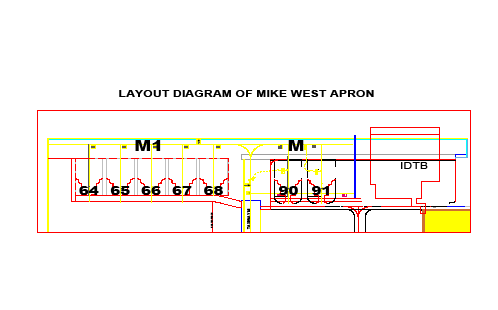
Note 1 (Stand 64-68):


i. Stands 64-68 are facing south.

ii. Stands are remote parking with power-in and push-back facing east.

iii. Fuelling done through bowsers.

iv. VDGS and FEPGU not available.

v. Only one push back is allowed from these stands at a time.

vi. Pilot to use minimum throttle to avoid jet blast effect on opposite apron.

vii. Aircraft to hold on Taxilane M1 short of TWY M-M1 junction to accommodate arrival on stand 90, 91 and otherwise, aircraft to hold East of TWY M-M1 junction short of TWY M to accommodate arrival on stand 64-68.

viii. Slope of aircraft stands is within 1%.

ix. Except stand 64 & 65, any pushback from stand 66 to 68, aircraft shall hold clear off adjacent stand located towards nose of aircraft on Taxilane M1 (e.g. Aircraft pushing back facing East from stand 66 shall stay clear of stand 67 after pushback to accommodate arrival).

x. There shall be only one movement, either departure or arrival to Mike West apron at any given time, as the Mike West apron is served by only one taxilane.


Note 2 (Stand C1-C10):


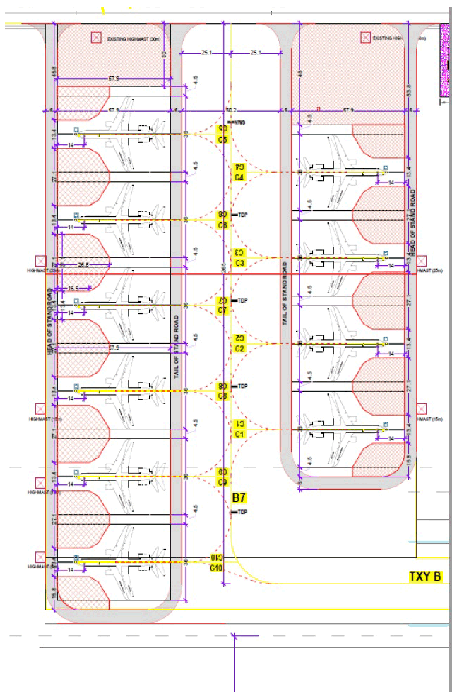
Stand C1, C2, C3 and C4 are facing east and stand C5, C6, C7, C8, C9 and C10 are facing west.

i. Stands are remote parking with power-in and pushback.

ii. Fueling will be done through bowsers.

iii. VDGS and FEPGU not available.

iv. Any pushback from these stands on Taxilane B7 shall hold clear of stand to accommodate arriving aircraft.

v. Aircraft to taxi on minimum throttle to avoid jet blast effect on opposite stands.

vi. During Secondary RWY operations (09L-27R), stand C9 and C10 will be kept vacant.

vii. Intermediate holding position marking is provided on Taxilane B7 abeam stand C9 at a perpendicular distance of 60 m from TWY B. Only during Secondary Runway operations, aircraft will hold on intermediate holding position and only with positive clearance from ATC aircraft shall taxi up to RWY holding position for departure on Taxiway B6. Aircraft on cargo Apron to accommodate delay during secondary runway operations.

viii. Engine ground Run-up shall be accommodated on cargo apron on TWY B facing east or west, only if stand C9 and C10 are kept vacant and also when secondary runway is not active.

ix. There shall be only one movement, either departure or arrival to cargo apron at any given time, as the cargo apron is served by only one taxiway.

x. The Cargo Apron would be used for Aircraft Arrival phase during Night and Aircraft Departure phase during the Day. However, in a rare scenario of clash of Arrivals & Departures at the same time, Airside operations shall co-ordinate the same with ATC.

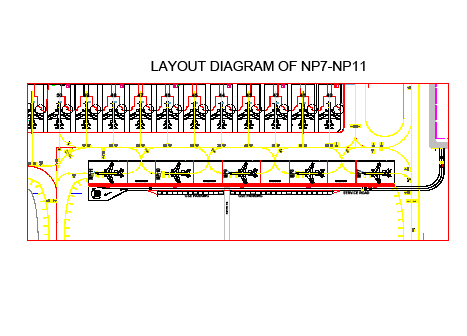
Note 3 (NP7-NP11) :


i. Stands are remote parking with power-in and power-out facility.

ii. Nose wheel marking is provided on each stand facing west.

iii. Fuelling done through bowsers.

iv. VDGS not available.

v. Pilot shall taxi at speed of 15 KTs on Taxilane E1. Aircraft on stand NP7-NP11 shall power in and power out with minimum throttle.

vi. These stands are exclusively used for night halt arrangement between 1900 Hrs. IST to next day 0900 Hrs. IST for base parking and morning departures.

vii. Power in/out operations from stand NP7 to NP11 shall restrict pushback from stand 40 to 49, Conditional clearance for NP-7 to NP-11 subject to availability of taxilane E1 shall be implemented to ensure safe operations.

viii. Pilots shall obtain positive clearance from ground engineer for Engine start- up to commence power out maneuver and shall taxi with minimum throttle to avoid jet blast on adjacent stand user.


Size of South Apron (Stand 40 to 59) : 1083 X 84M

Size of North West Apron (Stand 90 to 91) : 108 X 58M

Size of North East Apron (Stand 03 to 12) : 435 X 58M

Size of Cargo Apron : 190 X 113M


2A. PUSHBACK / PULL FORWARD PROCEDURE FOR STANDS:


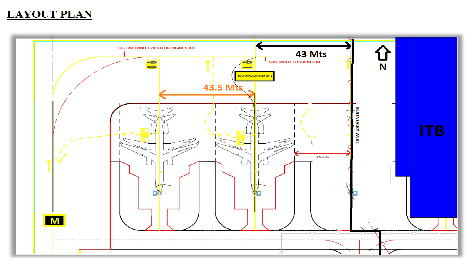
i. Aircraft on Stand NR. 03-12 shall pushback facing East. Aircraft on Stand NR. 03, 04 and 05 shall pull forward till limit line marked abeam Stand NR. 06 due safety reasons i.e. to avoid JET BLAST effect on perimeter wall.

ii. Aircraft on Stand NR. 90 and 91 shall pushback facing West. Aircraft on Stand NR. 91 shall pull forward till limit line marked abeam Stand NR. 90 due safety reasons.

iii. Stand NR 03 and 91 AVBL for Code C ACFT. PUSHBACK limit lines marked for Stand NR. 03 and 91. PUSHBACK LIMIT LINES are marked with WHITE LINE.

iv. Aircraft on stand 3 shall push pack straight abeam stand till pushback limit line marked in white and then pull forward abeam stand 06 for engine start-up.

v. Additional marking available for POWER IN/ POWER OUT. On Stand NR. 90 for Aircraft up to code B, on Stand NR. 91 for Aircraft up to wing span of 20M.

vi. ACFT on Stand Number NP7, NP8, NP9, NP10 and NP11 are power-in and power out.

vii. PUSHBACK limit lines marked for Stand Number 64. PUSHBACK LIMIT LINES are marked with WHITE LINE

viii. ACFT on Stand Number 40-49 shall push back on Taxilane E1. However, ACFT Pushing back from stand 50 & 51 facing west shall deep push back and join E1 for startup.

ix. PUSHBACK limit lines marked for Stand NR. C-4 and C-5. PUSHBACK LIMIT LINES are marked with WHITE LINE.

x. Additional marking available for Power-in/Power-out on Stand C-1 for ACFT upto code B with max wing span of 20M.

Tug disconnect points (TDP) are marked on TWY B7 at Cargo Apron:


S. No.
TDP Position
Aircraft Pushback
1
TDP 1
C-3, C-4, C-5, C-6
2
TDP 2
C-2, C-7
3
TDP 3
C-1, C-8
4
TDP 4
C-9, C-10

Size of South Apron (Stand 40 to 59) : 1083 X 84M

Size of North West Apron (Stand 90 to 94) : 241 X 58M

Size of North East Apron (Stand 01 to 12) : 545 X 58M

Size of Cargo Apron : 190 X 113M

2B. Power-in and power-out procedures for 05 stands NP7/NP8/NP9/ NP10/N P11:


1. Taxi Procedure:


1.1 Arrival RWY 09R


Vacate via A5 - Cross RWY 27R - B3 - NP7

or

Vacate via A4 - RWY 27R - B3 - NP7


Vacate via A4 - Cross RWY 27R - B3 - Taxilane E1 - NP8/NP9/NP10/NP11

or

Vacate via A4 - RWY 27R - Cross RWY 27R - B3 - Taxilane E1 - NP8/NP9/NP10/NP11


1.2 Departure RWY 09R


NP11 - B4 - RWY 27R - holding position RWY 09 R

NP7/NP8/NP9/NP10 - power out facing west on Taxilane E1 - B4 - RWY 27R - holding position RWY 09 R

or

NP7/NP8/NP9/NP10 - power out facing east on Taxilane E1 - B3 - RWY 27R - holding position RWY 09 R


1.3 Arrival RWY 27L


Vacate via A6/A7 - RWY 09L - B3 - NP7

or

Vacate via A6/A7 - RWY 09L - B3 - Taxilane E1 - NP8/NP9/NP10/NP11


1.4 Departure RWY 27L


NP7/NP8/NP9/NP10 - power out facing west on Taxilane E1 - B4 - RWY 09L - holding position RWY 27L

or

NP7/NP8/NP9/NP10 - power out facing east on Taxilane E1 - B3 - RWY 09L - holding position RWY 27L

Note:

i. The stand 203L is compatible to serve aircraft up to Code-F category.

ii. Cargo stands 201 and 203L are provided with Fixed Electrical Ground Power (FEGP) units. Number and capacity of FEGP - 2 each with the capacity of 90 KVA.

NP11 - B4 - RWY 09L - holding position RWY 27L

2. PUSHBACK / PULL FORWARD PROCEDURE FOR STAND NR 01-12 AND 90-94:

i. Aircraft on Stand NR. 01-12 shall pushback facing East. Aircraft on Stand NR. 01, 02 and 03 shall pull forward till limit line marked abeam Stand NR. 04 due safety reasons i.e. to avoid JET BLAST effect on perimeter wall.

ii. Aircraft on Stand NR. 90-94 shall pushback facing West. Aircraft on Stand NR. 92, 93 and 94 shall pull forward till limit line marked abeam Stand NR. 91 due safety reasons.

iii. Stand NR. 01 & 94 available for Code C Aircraft. Pushback limit lines marked for Stand NR. 01 & 94. Pushback limit lines are marked with White Line.

iv. Additional marking available for POWER IN/ POWER OUT. On Stand NR. 90 for Aircraft up to code B, on Stand NR. 91 & 92 for Aircraft up to wing span of 20M.

3. TAXIWAY:

3. TAXIWAY:

Designation

Length/Width (M)

PCN

Coordinates

Remarks

A1

427/25

77/F/B/W/T

171348.40N 0782711.41E


A2

225/25

77/F/B/W/T

171348.22N 0782657.31E


A3

225/25

77/F/B/W/T

171347.94N 0782634.91E


A4

499/25

77/F/B/W/T

171347.81N 0782624.67E

RET

A5

499/25

77/F/B/W/T

171347.58N 0782606.83E

RET

A6

482/25

77/F/B/W/T

171347.30N 0782544.68E

RET

A7

482/25

77/F/B/W/T

171347.10N 0782529.43E

RET

A8

225/25

77/F/B/W/T

171346.99N 0782520.50E


A9

225/25

77/F/B/W/T

171346.57N 0782448.05E


A10

282/25

77/F/B/W/T

171346.53N 0782444.76E


B

300/25

77/F/B/W/T

171356.25N 0782514.97E

Cargo Apron

B1

82/25

69/F/B/W/T

171353.76N 0782701.30E

Isolation Bay

B2

165/23

69/F/B/W/T

171357.22N 0782657.19E

MRO Apron

B3

272/25

77/F/B/W/T

171357.19N 0782613.05E

Passenger Terminal Apron

B4

272/25

77/F/B/W/T

171355.51N 0782553.79E

Passenger Terminal Apron

B5

272/25

77/F/B/W/T

171355.31N 0782538.22E

Passenger Terminal Apron

B6

175/25

77/F/B/W/T

171353.49N 0782520.41E

Cargo Apron

E

1130/25

77/F/B/W/T

171400.95N 0782552.49E

Passenger Terminal Apron

K

365/25

77/F/B/W/T

171405.79N 0782612.92E

Passenger Terminal Apron

K1

365/18.6

73/F/B/W/T

171405.75N 0782610.13E

Passenger Terminal Apron

Suitable for Acft with Max wing span up to 36M and Max outer Main Wheel gear span up to 9.6M

K2

646/18

73/F/B/W/T

171410.90N 0782601.06E

Passenger Terminal Apron

K3

586/18

73/F/B/W/T

171412.34N 0782601.04E

Passenger Terminal Apron

M

596/18

73/F/B/W/T

171410.34N 0782532.28E

Passenger Terminal Apron

A10

282/25

77/F/B/W/T

171346.53N 0782444.76E


B

231.1/25

77/F/B/W/T

171356.25N 0782514.97E

Cargo Apron

B1

82/25

69/F/B/W/T

171353.76N 0782701.30E

Isolation Bay

B2

165/23

69/F/B/W/T

171357.22N 0782657.19E

MRO Apron

B3

304/25

77/F/B/W/T

171357.19 N 0782613.05 E

Suitable for aircraft with max wing span up to 36m and max outer main wheel gear span up to 9.6m

B4

272/25

77/F/B/W/T

171355.51N 0782553.79E

Passenger Terminal Apron

B5

272/25

77/F/B/W/T

171355.31N 0782538.22E

Passenger Terminal Apron

B6

175/25

77/F/B/W/T

171353.49N 0782520.41E

Cargo Apron

Taxilane B7

265.0/18.6

77/F/B/W/T

(146.5M)

114/R/B/W/T

(118.5M)

171359.39N 0782512.29E


E

652/25

77/F/B/W/T

171359.91 N 0782542.77 E

Passenger Terminal Apron

Taxilane E1

569.7/18.6

77/F/B/W/T

171401.17 N 0782601.87 E

Suitable for aircraft with max wing span up to

36m and max outer main wheel gear span up to

9.6m

K

347.0/25

77/F/B/W/T

171405.79 N 0782612.92 E

Suitable for aircraft with max wing span up to 36m and max outer main wheel gear span up to 9.6m

K1

347.0/18.6

73/F/B/W/T

171405.75 N 0782610.13 E

Suitable for aircraft with max wing span up to 36m and max outer main wheel gear span up to 9.6m

K2

547.5/18

73/F/B/W/T

171410.90N 0782601.06E

Passenger Terminal Apron

K3

501.0/18

73/F/B/W/T

171412.34N 0782601.04E

Passenger Terminal Apron

M

468/18.6

73/F/B/W/T

171408.39N 0782531.62E

Passenger Terminal Apron

Taxilane M1

268.80/18.6

60/F/B/W/T

171410.61 N 0782529.93 E

Edge Light, Colour and

Spacing:

Blue, 60M


Designation

Length/Width (M)

PCN

Coordinates

Remarks

A1

427/25

77/F/B/W/T

171348.40N 0782711.41E


A2

225/25

77/F/B/W/T

171348.22N 0782657.31E


A3

225/25

77/F/B/W/T

171347.94N 0782634.91E


A4

499/25

77/F/B/W/T

171347.81N 0782624.67E

RET

A5

499/25

77/F/B/W/T

171347.58N 0782606.83E

RET

A6

482/25

77/F/B/W/T

171347.30N 0782544.68E

RET

A7

482/25

77/F/B/W/T

171347.10N 0782529.43E

RET

A8

225/25

77/F/B/W/T

171346.99N 0782520.50E


A9

225/25

77/F/B/W/T

171346.57N 0782448.05E


A10

282/25

77/F/B/W/T

171346.53N 0782444.76E


B

300/25

77/F/B/W/T

171356.25N 0782514.97E

Cargo Apron

B1

82/25

69/F/B/W/T

171353.76N 0782701.30E

Isolation Bay

B2

165/23

69/F/B/W/T

171357.22N 0782657.19E

MRO Apron

B3

272/25

77/F/B/W/T

171357.19N 0782613.05E

Passenger Terminal Apron

B4

272/25

77/F/B/W/T

171355.51N 0782553.79E

Passenger Terminal Apron

B5

272/25

77/F/B/W/T

171355.31N 0782538.22E

Passenger Terminal Apron

B6

175/25

77/F/B/W/T

171353.49N 0782520.41E

Cargo Apron

E

1130/25

77/F/B/W/T

171400.95N 0782552.49E

Passenger Terminal Apron

K

365/25

77/F/B/W/T

171405.79N 0782612.92E

Passenger Terminal Apron

K1

365/18.6

73/F/B/W/T

171405.75N 0782610.13E

Passenger Terminal Apron

Suitable for Acft with Max wing span up to 36M and Max outer Main Wheel gear span up to 9.6M

K2

646/18

73/F/B/W/T

171410.90N 0782601.06E

Passenger Terminal Apron

K3

586/18

73/F/B/W/T

171412.34N 0782601.04E

Passenger Terminal Apron

M

596/18

73/F/B/W/T

171410.34N 0782532.28E

Passenger Terminal Apron

4. TWY A1, A2, A3, A8, A9, A10, CL LGT Available only at visibility conditions of RVR 1000m or less.

5. Rapid exit TWY CL LGT corresponding to the RWY in use Available during the time of OPS of aeronautical ground

LGT.

6. VFR training FLTs north of Nadirgul AD in a radius of 2NM. Lower limit: GND Upper limit: 2600FT AMSL.

7. Storm Water Drain on either side of RWY 27L/09R DIST from CL 105m, Shape trapezoid, Width at the top 10m, Width

at the bottom 2m to 3m, Depth 2m to 3m.

8. High Mast Antenna installed with Obstruction LGT SW of VOR HIA at location 171332.118N 0782406.066E. RDL and

DIST from VOR HIA 241/0.2 NM HGT of the antenna 27.20m AGL pilots to EXER CTN

9. TWY edge lights with spacing of 60m available on RWY 09L/27R when used exclusively for taxiing purpose.

10.TWY B additional details are as follows:

Shoulders: 17.5M

Edge LGTS Colour / Spacing: Blue (elevated) 60 M maximum

VOHS

AD 2.24

CHARTS RELATED TO AN AERODROME

1. Aerodrome Chart

2. Aerodrome Chart- Hot Spot

3. Aircraft Parking/Docking Chart (Passenger Terminal Apron)

4. Aircraft Parking/Docking Chart (Cargo Apron)

5. Aerodrome Obstacle Chart-Type A (Operating Limitations) RWY 09/27

6. Precision Approach Terrain Chart RWY 09

7. Precision Approach Terrain Chart RWY 27

8. TORA from Different Runway Intersections - Departure RWY 09R

9. TORA from Different Runway Intersections - Departure RWY 27L

10. Locations of Different Exit Taxiways from Threshold - Arrival 09R

11. Locations of Different Exit Taxiways from Threshold - Arrival 27L

12. Isolation Bay Chart

13. ILS Procedure RWY 09R

14. ILS Procedure RWY 27L

15. VOR Procedure RWY 09R

16. VOR Procedure RWY 27L

17. VOR Procedure RWY 09L

18. VOR Procedure RWY 27R