1.
Introduction
1.1.
Aircraft in flight or operating on the maneuvering area of an aerodrome shall comply with the general flight rules applicable to the operation of aircraft (Annex 2). Additionally, aircraft in flight shall comply with the Instrument Flight Rules (IFR) or the Visual Flight Rules (VFR), as applicable.
2.
Flights on ATS routes
2.1.
2.1.1.
Area of responsibility for the control of flights on ATS routes and the units providing this service are shown in subsection ENR 2.1.
2.1.2.
2.1.2.1.
2.1.2.2.
2.1.3.
As position reports are most commonly used it is important for estimates to be revised and notified to ACC, if more than 3 minutes in error.
2.1.4.
The pilot-in-command shall maintain a continuous listening watch on the appropriate air/ground frequency.
2.1.5.
While operating in controlled airspace, only direct controller-pilot communication is permitted. Radio-telephony communication through interpreter shall not be permitted.
2.2.
2.2.1.
The pilot-in-command shall fly in accordance with the route specified by ATC. Deviation from the specified route may be permitted by ATC, if traffic conditions permit. Cruising levels below the lower limit of ATS route will not be assigned.
2.3.
2.3.1
Essential traffic is that controlled traffic to which the provision of separation by ATC is applicable, but which in relation to a particular controlled traffic, does not have the required minimum separation.
2.3.2.
Essential traffic information shall be issued to controlled flights concerned, whenever they constitute essential traffic to each other.
NOTE
This information will inevitably relate to controlled flights which are cleared subject to maintaining own separation and remaining in visual meteorological conditions.
2.3.3.
2.3.3.1.
2.3.3.2..
2.3.3.3.
Cruising level of the aircraft concerned and estimated time over the reporting point nearest to where the level will be crossed.
2.4.
2.4.1.
ATC clearance for approach to an aerodrome or holding point will be issued to an arriving aircraft on initial contact with the appropriate ATC unit.
The clearance will specify - the clearance limit & the route and level to be flown. An Expected Approach Time will be issued in a non-radar environment, if it is anticipated that the arriving aircraft will be required to hold.
2.5.
Speed control procedures applicable under Non ATS surveillance environment:
2.5.1
All aircraft (including arrivals and departures) operating below 10,000 Ft to fly IAS not greater than 250 Kt.
2.5.2
All arriving aircraft operating below 10,000 Ft within 15NM radius of the VOR/DME serving the aerodrome to fly IAS not greater than 220 Kt.
2.5.3
Additional speed restrictions may be imposed for arriving and en-route aircraft by ATC whenever traffic conditions so require.
2.5.4
ATC may suspend speed control by using the phrase ‘NO SPEED RESTRICTIONS’ when traffic conditions permit.
2.6.
2.6.1.
Wind-shear experienced by pilots shall be reported to ATC as soon as possible.
2.6.2.
When reporting wind-shear on radio-telephony, the information should be transmitted in the following order:
2.6.2.1.
2.6.2.2.
2.6.2.3.
2.6.2.4.
2.6.2.5.
2.6.3.
On receipt of wind-shear report from an aircraft, ATC will -
2.6.3.1.
Advise other aircraft in the vicinity, which are likely to be affected by the phenomena. Following phraseology will be used: ‘WIND-SHEAR WARNING-ARRIVING (or DEPARTING)....(Type of aircraft) REPORTED ...(LIGHT or MODERATE or SEVERE) WIND-SHEAR IN THE APPROACH (or DEPARTURE) RUNWAY ...(Number) AT.... (Time) HEIGHT OF WINDSHEAR LAYER .... (Feet)’.
2.6.3.2.
2.6.3.3.
Broadcast in the ATIS for the next half-hour, unless, subsequent reports indicate that wind-shear no longer exists.
2.7.
An in-flight request to cross/join an ATS Route shall include the following information:-
The selected crossing or joining point should, where ever possible be associated with a radio facility to assist accurate navigation.
2.8.
2.8.1.
VFR flights to cross ATS routes outside the Controlled airspace shall only cross them at an appropriate VFR level at right angle to the direction of the ATS route, or as close as possible to this angle.
2.9.
Temporary restricted areas or Temporary reserved areas affecting ATS routes/Controlled airspaces
2.9.1.
Military operations effecting ATS routes/controlled airspaces within the Indian FIRs will be promulgated by NOTAM giving the reference point, lateral and vertical limits and duration of the operations.
2.9.2.
Such areas will not be available for use by civil aircraft within the notified lateral and vertical limits.
3.
Air Traffic Advisory Service
3.1.
Air traffic advisory service is provided to aircraft operating outside controlled airspace on ATS routes classified “F”.
4.
Flight Information Service
4.1.
Flight information service (FIS) is provided to all flights, in addition to air traffic control/advisory service as applicable. However, only FIS is provided in airspace/ATS routes classified “G”.
4.2.
Provision of Flight Information Service - All VFR flights and IFR flights outside controlled airspace shall maintain watch on the frequency used by the unit providing flight information service and provide information as to their position with that unit.
5.
Aerodrome/Approach Control Service
5.1.
Aerodrome/Approach Control issue air traffic control clearances and information to aircraft to ensure a safe, orderly and expeditious flow of air traffic.
5.2.
Holding, instrument approach, arrival and departure procedures are specified in subsections ENR 1.5 and ENR 3.6.
5.3.
Radio communication shall be established with the appropriate Aerodrome/Approach Control Unit -
5.3.1.
5.3.2.
When intending to operate in a Class ‘C’ & Class “D” airspace.
5.3.3.
While operating in Class ‘C’ & Class ‘D’ airspace only direct controller-pilot communication is permitted. RTF communication through interpreter shall not be permitted.
5.4.
For IFR or VFR operation in Class ‘C’ & Class “D” airspace, aircraft shall be equipped with appropriate two-way VHF radio apparatus, and a radio compass.
5.5.
A pilot-in-command under IFR or VFR intending to enter, cross or operate within a CTR or ATZ shall request a Clearance from the Aerodrome/Approach Control on the appropriate radio frequency. He shall:-
5.5.1.
Pass the aircraft’s position, level, track and estimated time of crossing the airspace.
5.5.2.
Maintain a continuous listening watch on that frequency while the aircraft is within the airspace.
5.5.3.
Carry out any instructions received from Aerodrome /approach Control.
6.
Special VFR Flights
6.1.
When traffic conditions permit, special VFR flights may be authorized subject to the approval from the unit providing approach control service and the provisions of para 6.2, 6.3, 6.4 hereafter.
6.2.
Requests for such authorizations shall be handled individually.
6.3.
Separation shall be affected between all special VFR flights and between such flights and IFR flights in accordance with the separation minima applicable for IFR flights.
6.4.
When the ground visibility is not less than 1500 meters, special VFR flights may be authorized to enter a control zone for the purpose of landing, to take-off and depart from a control zone, to cross a control zone, or to operate locally within a control zone.
NOTE
Requirements for two way communications between controlled flights and the appropriate air traffic control unit are contained in Annex 2, para 3.6.5.
6.5.
Provided that performance Class I and performance Class II helicopters may be authorized to operate special VFR flights when the ground visibility is not less than 1000 meters.
6.6.
Pilot shall be responsible for meeting the criteria for performance Class I and performance Class II helicopters and should state this in field 18 of the Flight plan and report on RTF to appropriate ATC unit.
6.7.
Provided further that military helicopters may be authorised to operate special VFR flights when the ground visibility is not less than 1000 metres. Helicopters operating in less than 1500 metres visibility shall be manoeuvred at a speed that will give adequate opportunity to observe other traffic or any obstacles in time to avoid collision.
(A) Special VFR flights shall be operated only by pilots holding instrument rating, Assistant Fight Instructor
rating or Flight Instructor rating.
(B) The Pilot-in-Command shall ensure compliance with the provisions of the rating requirement.
7.
Special separation standard - Wake Turbulence
7.1.
The relevant wake turbulence separation minima contained in ICAO SARP PANS-ATM Doc 4444 are applied by ATC.
7.2.
All aircraft having maximum certified take-off mass of 136,000Kg or more shall include the word ‘HEAVY’ immediately after the aircraft call sign in the initial radiotelephony contact with Aerodrome Control Tower, Approach Control Office and Area Control Center.
8.
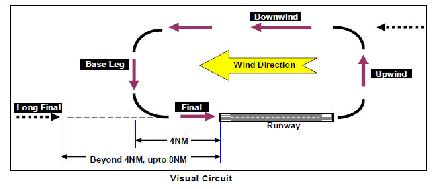
Visual circuit reporting procedure
8.1.
Downwind - Aircraft shall report ‘Downwind’ abeam the upwind end of the runway.
8.2.
Base Leg - Aircraft shall report ‘Base Leg’ on completion of the turn on to base leg.
8.3.
Final - Aircraft shall report ‘Final’ after completion of the turn on to final approach, not more than 4NM from the approach end of the runway.
8.4.
Long Final - Aircraft flying a straight-in approach shall report ‘Long Final’ 8NM from the approach end of the runway and shall report ‘Final’ when at 4NM from the approach end of the runway.
9.
Use of runway
9.1.
The Aerodrome Controller will nominate the runway direction according to prevailing wind conditions.
9.2.
Notwithstanding the runway direction nominated by ATC, the Pilot-in-Command of the aircraft shall ensure that there is sufficient length of runway and that the crosswind or downwind component is within its operational limits. If the nominated runway direction is not suitable for any reason, he may request for an alternative runway direction. ATC will grant the use of an alternative runway direction but the flight may be subject to delay because of other traffic.
9.3.
Unless prior permission has been obtained from ATC, the Pilot-in-Command shall not hold on the runway-in-use.
9.4.
Only one aircraft will be cleared to land on the runway-in-use at any one time except formation flight by military aircraft.
10.
Procedure for start-up and assignment of flight level to departing aircraft
10.1.
Before asking for startup or push back clearance, pilot of an aircraft must ensure that its step ladder or Aerobridge has been removed and doors are closed.
10.2.
Pilot shall intimate total number of persons on board including crew and security check completed to aerodrome control tower when requesting start-up clearance.
10.3.
The sequence of departure would be determined and intimated based on their taxiing sequence, sequence at holding point, except where a deviation is made to facilitate a VIP aircraft or change of order is resorted to for traffic reasons.
10.4.
Delays may be expected for the second aircraft to push-back when it is parked adjacent to another aircraft being pushed-back.
10.5.
Delay in take-off due to restrictions in the ATC clearance and over-flights-
10.5.1.
There may be delay in take-off for an aircraft when it is proceeding on the same track/level, or climbing through the level or to climb at higher rate of climb behind a preceding traffic in order to establish the prescribed separation.
10.5.2.
A departing aircraft requesting the same cruising level as an over-flying aircraft may have to accept an alternate level or may have to delay its departure in order to establish the prescribed separation.
10.6.
10.6.1.
The pilot-in-command shall not take-off or land without a clearance from the appropriate ATC unit.
10.6.2.
The pilot-in-command shall not run-up on the runway in use unless authorized by Aerodrome Control. Engine run ups in the holding pan or runway holding position clear of the runway in use may be carried out subject to approval by Aerodrome Control.
10.7.
To increase the runway capacity it is essential to minimize the runway occupancy time. The following procedure should be followed to ensure minimum runway occupancy time:-
10.7.1.
Pilot who require to back-track the runway for departure must notify ATC prior to commencement of taxi.
10.7.2.
As far as possible cockpit checks should be completed prior to lineup and any checks requiring completion while on the runway should be kept to the minimum required. Pilots should ensure that they are able to commence the take off run immediately after take off clearance is issued. Pilots not able to comply with this requirement must notify ATC prior to commencement of taxi.
10.7.3.
Pilots of arriving aircraft are reminded that rapid exits from the landing runway enable ATC to apply minimum spacing on final approach that will achieve maximum runway utilization.
10.8.
Cruise Climb is not permitted in Indian Flight Information Regions.
10.9.
Transonic and Supersonic phases of flight are not permitted over Indian airspace.
11.
Weather deviation procedures for Oceanic/Controlled airspace
11.1.
11.1.1.
The following procedures are intended to provide guidance for deviations around thunder-storms in the oceanic airspace. All possible circumstances can not be covered. The pilot’s judgment shall ultimately determine the sequence of action taken. ATC shall render all possible assistance.
11.1.2.
If the aircraft is required to deviate from track to avoid weather and prior clearance cannot be obtained, an ATC clearance shall be obtained at the earliest possible time. Until an ATC clearance is received, the aircraft shall follow the procedure detailed in para 8.6 11.6 below.
11.1.3.
The pilots shall inform ATC when weather deviation no longer required or when weather deviation has been completed and the aircraft can return to the centerline of its cleared routes.
11.2.
Obtaining priority from ATC when weather deviation is required-
11.2.1.
When pilot initiates communication with ATC, rapid response may be obtained by stating "WEATHER DEVIATION REQUIRED" to indicate that priority is desired on the frequency and for ATC response.
11.3.
Actions to be taken when controller-pilot communication is established
11.3.1.
The pilot notifies ATC and requests clearance to deviate from track, advising, when possible the extent of the deviation expected.
11.4.
11.4.1.
if there is no conflicting traffic in the horizontal plane, ATC, will issue clearance to deviate from the track; or
11.4.2.
if there is conflicting traffic in the horizontal plane, ATC, will separate the aircraft by establishing appropriate separation; or
11.4.3.
if there is conflicting traffic in the horizontal plane and ATC is unable to establish appropriate separation, ATC shall-
11.4.3.1.
advise the pilot of inability to issue clearance for the required deviation;
11.4.3.2.
11.4.3.3.
11.4.3.4.
Phraseology - ‘UNABLE (requested deviation), TRAFFIC IS (call-sign, position, level, direction), ADVISE INTENTIONS’
11.5.
11.5.1.
11.5.2.
11.5.3.
11.5.4.
If necessary, establish voice communication with ATC to expedite dialogue on the situation.
11.6.
Actions to be taken if a revised ATC clearance cannot be obtained
11.6.1.
The provisions of this section apply to situations where a pilot has the need to exercise the authority of a pilot-in-command under the provisions of Annex 2, Para 2.3.1.
11.6.2.
If a revised ATC clearance cannot be obtained and deviation from the track is required to avoid weather, the pilot shall take the following actions-
11.6.2.1
If possible, deviate away from the organized track on route systems.
11.6.2.2
Establish communication with and alert nearby aircraft, broadcasting at suitable intervals - aircraft identification, flight level, position, ATS route designator and intentions, on the frequency in use and on frequency 121.5 MHz (or as a back-up on the VHF inter-pilot air-to-air frequency 123.45 MHz).
11.6.2.3
Watch for conflicting traffic both visually and by reference to TCAS/ACAS.
11.6.2.4
Turn on all aircraft exterior lights (commensurate with appropriate operating limitations)
11.6.2.5
For deviation of less than 10 NM, aircraft should remain at a level assigned by ATC.
11.6.2.6
For deviation more greater than 10 NM, when the aircraft is approximately 10 NM from track, initiate a level change based on the following criteria-