AD 2 AERODROMES

VEAY

VEAY AD 2.1 AERODROME LOCATION INDICATOR AND NAME

VEAY - MAHARISHI VALMIKI INTERNATIONAL AIRPORT

AYODHYADHAM,AYODHYA

VEAY

AD 2.2

AERODROME GEOGRAPHICAL AND ADMINISTRATIVE DATA

1

Aerodrome reference point coordinates and its site

264514N 0820901E

304.82 DEG/292M from physical extremity of RWY 11.

2

Direction and distance of aerodrome reference point from the centre of the city or town which the aerodrome serves

Airport is located 8 KM south of Ayodhya Junction Railway station and 3 KM

Northeast of Ayodhya Cantt. Railway station.

3

Aerodrome elevation and reference temperature

329 FT / 42.8 DEG C

4

Magnetic variation, date of information and annual change

0.25 DEG E (2010) /0.0167 DEG E

5


Name of aerodrome operator, address, telephone, telefax, e-mail address, AFS address, website (if available)

Airport Director

Airport Authority of India

Maharishi Valmiki international airport,

Ayodhyadham

Ayodhya-224001,


Telephone:

(91) 9336677127

Fax:


AFS:

VEAYZTZX

Email:

apdayodhya@aai.aero

6

Types of traffic permitted (IFR/VFR)

IFR/VFR

7

Remarks

Gravity Model: EGM08

VEAY

AD 2.3

OPERATIONAL HOURS

1

Aerodrome Operator

Airports Authority of India

MON TO FRI: 0400 to 1230 UTC

(0930 to 1800 IST)

SAT, SUN, HOLIDAY-NIL.

2

Custom and immigration

NIL

3

Health and sanitation

Provided by municipal corporation and health department.

4

AIS briefing office

As ATS

5

ATS reporting office (ARO)

As ATS

6

MET Briefing office

As ATS

7

Air Traffic Service

Consult Current NOTAM for ATS HR.

8

Fuelling

Provided by HPCL and IOCL.

9

Handling

Provided by approved handler.

10

Security

Provided by CISF

11

De-icing

NIL

12


Remarks

NIL

VEAY

AD 2.4

HANDLING SERVICES AND FACILITIES

1

Cargo-handling facilities

No exclusive facilities. Cargo is handled by the concerned operator.

2

Fuel and Oil types

ATF

3

Fuelling facilities and capacity

HPCL: 01 Bowsers 15KL,

HPCL-JET A1 as per ATS watch Hrs

IOCL: 01 Bowsers 15 KL

IOCL-JET A1 as per ATS watch Hrs

4

De-icing facilities

NIL

5

Hangar space for visiting aircraft

NIL

6

Repair facilities for visiting aircraft

On Apron (On Request).

7

Remarks

NIL

VEAY

AD 2.5

PASSENGER FACILITIES

1

Hotel(s) at or in the vicinity of aerodrome

In nearby townships within 5 Km.

2

Restaurant(s) at or in the vicinity of aerodrome

In nearby townships within 5 Km.

3

Transportation possibilities

Hired Cars.

4

Medical Facilities

First Aid in the terminal building and basic

facilities at PHC Hospital located within 2 KM.

For serious & critical cases, District

Hospital located in Ayodhya City about 5

KM from the airport.

5

Bank and post office at or in the vicinity of

aerodrome

Banks: Within 2 KM from Ayodhya Airport

Post office: Within 2 KM from Ayodhya Airport

6

Tourist office

Available within 5 KM (U.P. Tourism)

7

Remarks

NIL

VEAY

AD 2.6

RESCUE AND FIRE FIGHTING SERVICES

1

Aerodrome category for fire fighting

Within ATS HR: CAT-7

2

Rescue equipment

Ambulance 03, CFT 02

3

Capability for removal of disabled aircraft

1. The critical aircraft for the airport is A321

2. Primary responsibility for removal of

disabled aircraft rests with the concerned airline.

3. The airlines may contact ‘Aerodrome Coordinator for Disabled Aircraft

Removal Operations’ for coordinating with the agencies having Disabled

Aircraft Recovery Kit.

4. Contact Details of Aerodrome Coordinator for Disabled Aircraft

Removal Operations:

Airport Director,

Tel/Mob. +91-9336677127

Email: apdayodhya@aai.aero

4

Remarks

NIL

VEAY

AD 2.7

SEASONAL AVAILABILITY CLEARING

1

Type(s) of clearing equipment

NIL

2

Clearance priorities

NIL

3

Remarks

NIL

VEAY

AD 2.8

APRONS, TAXIWAYS AND CHECK LOCATIONS/POSITIONS DATA

1

Designation, surface and strength of aprons

Refer Aircraft Parking Docking Chart

2

Designation, width, surface and strength of

taxiways

Refer Aircraft Parking Docking Chart

3

Location and elevation of altimeter checkpoints

Location: On Apron

Elevation: 329.06824 FT

4

Location of VOR checkpoints

AT RWY HOLDING POSITION OF TAXI A & B

5

Position of INS checkpoints

NIL

6

Remarks

1. Coordinates and Elevation of Runway Holding Positions:

TWY Coordinates Elevation(Ft)

TWY A 264505.62N 0820908.65E 327.76

TWY B 264503.93N 0820912.81E 327.43

TWY M 264508.19N 0820920.27E 327.44

2. Coordinates and Elevations of RWY/TWY Intersection

Points:

RWY/TWY Coordinates Elevation(Ft)

RWY/TWY A 264508.35N 0820910.02E 329.40

RWY/TWY B 264506.66N 0820914.18E 329.07

RWY/TWY M 264504.84E 0820918.69E 328.41

3. Gravity Model: EGM 08

VEAY

AD 2.9

SURFACE MOVEMENT GUIDANCE AND CONTROL SYSTEM AND MARKINGS

1

Use of aircraft stand identification signs, taxiway guidelines and visual docking/parking guidance system at aircraft stands

Taxing guidance signs at all intersections with

TWY and RWY and at all holding position,

Gridlines at apron. Taxiing guidance provided on

R/T also.

2

Runway and taxiway markings and lights

RWY

Markings: Designation, THR, TDZ,

Aiming Point, Centre line, RWY Edge.

Lights: THR light, RWY edge light, RWY End Light

TWY

Marking: Centre line, Edge, Runway holding positions at TWY A, TWY B and TWY M

Lights:TWY edge light

3

Stop bars (if any)

TWY A, TWY B and TWY M

4

Remarks

TWY A, TWY B and TWY M

VEAY

AD 2.10

AERODROME OBSTACLES

In Approach/Take-off/Circling Area and at AD

1

2

3

4

5

6

RWY/Area affected

Obstacle type

Coordinates

Elevation

(EGM-08)

Marking/LGT

Remarks

In circling area and at AD

OTHER

264540.3N

0820825.6E

448

LGTD

Cell Phone Mast Top

In circling area and at AD

OTHER

264508.8N

0820925.9E

399

LGTD

Antenna on Micture P

(Micture Plant Top 116.9m)

In circling area and at AD

OTHER

264537.8N

0820707.2E

479

LGTD

Cell Phone Mast Top

In circling area and at AD

OTHER

264700.9N

0820843.7E

536

LGTD

Cell Phone Mast Top

In circling area and at AD

ANTENNA

264652.9N

0820850.4E

480

LGTD

Communication Antenna Top

In circling area and at AD

OTHER

264640.4N

0820806.3E

620

LGTD

Cell Phone Mast Top

In circling area and at AD

OTHER

264628.5N

0820759.1E

536

LGTD

Cell Phone Mast Top

In circling area and at AD

OTHER

264609.1N

0820905.2E

500

LGTD

Cell Phone Mast Top

In circling area and at AD

OTHER

264601.5N

0820833.3E

485

LGTD

Cell Phone Mast Top

In circling area and at AD

BUILDING

264557.8N

0820840.2E

516

NIL

Mosque Top

In circling area and at AD

OTHER

264545.2N

0820842.5E

495

LGTD

Cell Phone Mast Top

In circling area and at AD

OTHER

264543.4N

0820848.5E

480

LGTD

Cell Phone Mast Top

In circling area and at AD

OTHER

264550.5N

0821111.7E

491

LGTD

Cell Phone Mast Top

In circling area and at AD

OTHERTOWER

264454264729.3N7N

08208350820840.3E5E

497 589

LGTD

Cell Phone Mast TopAll India Radio Tower

In circling area and at AD

TOWEROTHER

264729264454.7N3N

08208400820835.5E3E

589 497

LGTD

All India Radio TowerCell Phone Mast Top

VEAY

AD 2.11

METEOROLOGICAL INFORMATION PROVIDED

1

Name of the associated meteorological office

AMO, Ayodhya

2

Hours of service and, where applicable, the designation of the responsible meteorological office outside these hours

As per ATS watch Hours

3

Office responsible for preparation of TAFs and periods of validity and interval of issuance of the forecasts

M.C. Lucknow

Interval 3 Hours

4

Availability of the trend forecast for the aerodrome and interval of issuance

Available When required

5

Information on how briefing and/or consultation is provided

Available on request


6

Types of flight documentation supplied and language(s) used in flight documentation

METAR, SPECI Language: English

7

Charts and other information displayed or available for briefing or consultation

Available on request

8

Supplementary equipment available for providing information on meteorological conditions, e.g. weather radar and receiver for satellite images;

Not available


9

The air traffic services unit(s) provided with meteorological information

Ayodhya ATS

10

Additional information, e.g. concerning any limitation of service.

NIL

VEAY

AD 2.12

RUNWAY PHYSICAL CHARACTERISTICS

Designations


TRUE Bearings

Dimensions of RWY (M)

Strength of pavement

(PCN) and associated

data) and surface of runway and associated stopways

Geographical

coordinates for

threshold and

runway end

1

2

3

4

5

11

114.03 DEG

2200 x 45 M

68/R/C/W/T

Concrete

THR:

264508.50N

0820909.65E

RWY END:

264439.10N

0821022.22E

29

294.03 DEG

2200 x 45 M

68/R/C/W/T

Concrete

THR:

264439.10N

0821022.22E

RWY END:

264508.50N

0820909.65E

THR elevation

and highest

elevation of

TDZ of

precision APP

RWY

Slope of

runway and

associated

stopway

Dimensions of

stopway

(M)

Dimensions of

clearway

(M)

Dimensions of

strips

(M)

6

7

8

9

10

THR: 329.0FT

TDZ: 329.0FT


NIL

NIL

2320 x 280 M

THR: 328.0FT

TDZ: 328.0FT


NIL

NIL

2320 x 280 M

Dimensions of

runway end

safety areas

Location and

description of

arresting system

(if any)

Existence of an

obstacle-free

zone

Remarks.

11

12

13

14

150M x 90M

NA

AVBL

Gravity Model: EGM 08

150M x 90M

NA

AVBL

Gravity Model: EGM 08

VEAY

AD 2.13

DECLARED DISTANCES

RWY Designator

Take-off

run

available

TORA

(M)

Take-off

distance

available

TODA

(M)

Accelerate

distance

available

ASDA

(M)

Landing

distance

available

LDA

(M)

Remarks

(including runway

entry or start point

where alternative

reduced declared

distances have

been declared)

1

2

3

4

5

6

11

2200

2200

2200

2200


29

2200

2200

2200

2200


VEAY

AD 2.14

APPROACH AND RUNWAY LIGHTING

Runway

Designator

Type, length and

intensity of

approach lighting

system

Runway threshold

lights, colour and

wing bars

Type of visual

slope indicator

system

Length of runway

touchdown zone

lights

1

2

3

4

5

11

SALS

420 M

LIH

Green

Wingbars: AVBL

PAPI

LEFT/3.00 DEG

NIL

29

CAT I

900 M

LIH

Green

Wingbars: AVBL

PAPI

LEFT/3.00 DEG

NIL

Length, spacing,

colour and

intensity of

runway centre line

lights

Length, spacing,

colour and

intensity of

runway edge lights

Colour of runway

end lights and

wing bars

Length and colour

of stopway lights

Remarks

6

7

8

9

10


NIL

2200 M

60 M

White

LIH

Red

NIL

i. Colour of last 600 M of edge lights is Yellow.


NIL

2200 M

60 M

White

LIH

Red

NIL

Colour of last 600 M of edge lights is Yellow.

VEAY

AD 2.15

OTHER LIGHTING, SECONDARY POWER SUPPLY

1


Location, characteristics and hours of operation of aerodrome beacon/identification beacon (if any)

ABN

FLG W&G EV 2SEC AVBL ATC TOWER

IBN

NIL

2


Location and lighting (if any) of anemometer/landing direction indicator;

LDI

AVBL

Anemometer

North of RWY

3


Taxiway edge and taxiway centre line lights;

Edge

Available

Centre Line

NIL

4

Secondary power supply including switch-over time;

3 DG Set 500 KVA each - 2 Working & 1 Stand - by. Switch over time is less than 15 Seconds.

5

Remarks

NIL

VEAY

AD 2.16

HELICOPTER LANDING AREA

1

Geographical coordinates of the geometric centre of touchdown and lift-off (TLOF) or of each threshold of final approach and take-off (FATO) area

Not established

2

TLOF and/or FATO area elevation:

Not established

3

TLOF and FATO area dimensions to the nearest metre or foot, surface type, bearing strength and marking;

Not established

4

True bearings of FATO;

Not established

5

Declared distances available

Not established

6

Approach and FATO lighting;

Not established

7

Remarks

NIL

VEAY

AD 2.17

AIR TRAFFIC SERVICE AIRSPACE

1

Airspace designation, geographical

coordinates and lateral limits

CTR: a) Area bounded by coordinates 264053N 0814711E then along clockwise arc of 20 NM radius centred at 264500N 0820917E to 264519N 0823125E to the point of origin. Upper Limit: FL105 b) Area bounded by coordinates 264053N 0814711E to

264519N 0823125E to 264011N 0823058E to 263852N 0821806E then along clockwise arc of 10 NM radius centered at 264500N 0820917E to 263721N 0820239E to

263557N 0814922E to the point of origin. Upper Limit: FL55

2

Vertical limits


3

Airspace classification

D

4

Call sign and language(s) of the air

traffic services unit providing service;

Ayodhya Tower / Ayodhya ApproachTower, English

5

Transition altitude

4000 FT

6

Hours of applicability

HO

7

Remarks

NIL

VEAY

AD 2.18

AIR TRAFFIC SERVICES COMMUNICATION FACILITIES

Service Designation


Call sign


Channel(s)


SATVOICE Number(s),

if available


1

2

3

4

APP

Ayodhya ApproachTower

119.200 MHZ


APP

Ayodhya ApproachTower

124.075 MHZ


TWR

Ayodhya Tower


119.200 MHZ


TWR

Ayodhya Tower


124.075 MHZ


Logon

address, as

appropriate

Hours of operation


Remarks


5

6

7


HO

1. Main Freq

2. Functions of Approach combined with Tower


HO

1. Backup Freq

2. Functions of Approach combined with Tower


HO

1. Main Freq

2. Functions of Approach combined with Tower


HO

1. Backup Freq

2. Functions of Approach combined with Tower

VEAY

AD 2.19

RADIO NAVIGATION AND LANDING AIDS

Type of aids, magnetic variation and type of supported operation for ILS/MLS, basic GNSS, SBAS and

GBAS, and for

VOR/ILS/MLS station

used for technical lineup of the aid

Identification

Frequency(ies),

Channel number(s),

Service provider, and

reference path

identifier(s) (RPI), as

appropriate

Hours of operation, as

appropriate;

1

2

3

4

LOC 29

CAT I

IAYD

108.500 MHz

As ATS

GP 29

IAYD

329.090 MHz

As ATS

DME ILS 29

IAYD

CH22X

As ATS

DVOR/DME

AYD

116.000 MHz

CH107X

AS ATS

Geographical

coordinates of the

position of the

transmitting

antenna

Elevation of

transmitting

antenna of

DME/

elevation of

GBAS

reference point

Service volume radius

from the GBAS

reference point

Remarks

5

6

7

8

264512.8N

0820859.1E


264447.3N

0821012.8E


Glide Angle 3 DEG


264447.4N

0821012.9E

346 FT


i. Gravity Model: EGM 08

ii. DME Co-located with GP


264447.9N

0821021.6E

362 FT


i. Gravity Model: EGM 08

ii. DME Co-located with DVOR


VEAY

AD 2.20

LOCAL AERODROME REGULATIONS

NIL

VEAY

AD 2.21

NOISE ABATEMENT PROCEDURES

NIL

VEAY

AD 2.22

FLIGHT PROCEDURES

LOW VISIBILITY PROCEDURES:

1.PURPOSE

The Purpose of this SOP is to set out process and procedures to ensure added safety measures during bad weather/poor visibility conditions, to ensure smooth, safe and efficient conduct of aircraft operations, by establishing:

a) Conditions for implementation of LVP.

b) Safeguarding procedure (SP) for implementation of LVP.

c) Procedure for termination of LVP

2. SCOPE

Maharishi Valmiki International Airport, Ayodhyadham, Ayodhya is certified ILS CAT I aerodrome with a prescribed landing minima of 550 m RVR for RWY 29. The DGCA CAR on All Weather Operations mandates the establishment of Low Visibility Procedures for continuing operations below RVR values of 550 m. Accordingly Low Visibility Procedures have been established at Maharishi Valmiki International Airport, Ayodhyadham, Ayodhya to enhance and ensure safety during low visibility / bad weather conditions

3. DEFINITIONS & ABBREVIATIONS DEFINITIONS:

RVR: Runway visual range (RVR)-The range over which the pilot of an aircraft on the centre line of a runway can see the runway surface markings or the lights delineating the runway or identifying its centre line.

Touchdown zone-The portion of a runway, beyond the threshold, where it is intended that landing aero planes first contact the runway.

Obstacle Free Zone: The airspace above the inner approach surface, inner transitional surface and balked landing surface and that portion of the strip bounded by these surfaces, which is not penetrated by any fixed obstacle other than of low mass and frangible mounting, required for air navigation purposes.

Safeguarding Procedures: Safeguarding Procedures (SP) are instructions for relevant airport departments and airside operators to prepare ground services and facilities for low visibility operations, in order that when LVP are implemented all SP are complete and airport is configured for Low Visibility Procedures and Low Visibility Take-offs.


ABBREVIATIONS

AAI - Airports Authority of India

AGL - Aeronautical Ground Lighting ATC - Air Traffic Control

DGCA - Director General Civil Aviation FOD - Foreign Object Debris

LVP - Low Visibility Procedure

NOTAM - Notice to Airmen

PDP - Pre-Determined Position RWY - Runway

SMC - Surface Movement Control

SP - Safeguarding Procedure

TWY - Taxiway


SL
NO
PROCESS STEPS
DETAILED ACTIVITY STEPS
RESPONSIBILITY
4.1
Condition for Safeguarding Procedures
At Maharishi Valmiki International Airport, Ayodhyadham, Ayodhya Safeguarding Procedures shall be initiated when:
a) The Visibility/RVR is less than 1200 m and visibility/RVR is forecast to deteriorate to 800m or less; and/or
b) The cloud ceiling is 400 ft. and forecast to fall to 200 ft. or less.


4.2


Safeguarding Procedures (SP)
Safeguarding Procedures are the necessary actions to prepare the airport for Low Visibility Procedures. They include:
a) Carry out Runway, Taxiway, Road Holding, emergency access road and Apron inspection to ensure serviceability of visual aids and Ground Lights.
b) Stop all maintenance works on the manoeuvring area and vacate all men, Material and equipment from the manoeuvring area.
c) Termination of all work in progress in the localizer and glide path sensitive area.
d) Removal of all equipment/material from localizer and glide path sensitive area.
e) Restrictions on the movement of vehicles on the manoeuvring area and aprons. Limit the number of vehicles in the manoeuvring area to bare minimum. To meet any inescapable operational needs, vehicles may be escorted by Follow Me under intimation to ATC.
f) Barricade provided at road holding point of service road leading to runway and other manoeuvring area is in closed condition except fire station approach road to runway. If traffic lights are provided at road holding point the same should be in ON condition.
g) Ensuring availability of secondary power supply for changeover, with switchover time of maximum 1 second for RWY Edge, RWY End and Threshold lights supported by UPS.
h) Initiate action for Manual RVR in coordination with IMD, if RVR equipment is unserviceable.


ATC/ARFF/MET
 
 
i) Ops In-charge will co-coordinate with all the concerned agencies for implementation of Low Visibility Procedures.
j) Ops In-charge will inspect Movement area, AGL System and Associated Roads with all the concerned HOD as per Check List
Note-1: RWY Edge, Threshold lights and RWY End lights may continue to operate on main power supply during safeguarding Procedures. Whenever LVP is to be implemented the RWY Edge, Threshold lights and RWY End lights shall be put on Standby Power Supply (DG set or UPS). This operation needs to be completed before LVP is implemented.
Note-2: As UPS is available at Maharishi Valmiki International Airport, Ayodhyadham, Ayodhya capable of maintaining the required AGL system with one second of Switchover time, the main supply can continue to be the primary source of supply, and the Generator Supply can be kept as Standby Power supply. In case UPS is unserviceable, Generator supply shall be the primary source of power supply and Main power supply shall act as standby power supply.)
 
4.3
Implementation of SP
When meteorological conditions meet the criteria for initiation of SP as stipulated in Sl. No 4.1, the duty officer tower will inform Ops In-charge. Ops In-charge will coordinate with IC Electrical, Civil, Fire and MT.
NOTE: Action to be taken by various agencies is attached as Annexure 1.
Ops Inimplementation of SP check list must be completed.
When all the concerned agencies have completed their necessary actions, they shall report to DUTY OFFICER TOWER (ATC) that their Safeguarding Procedure (SP) is completed, and the airport is safeguarded for LVP operations.
ATC/ARFF
4.4
Condition for Low Visibility Procedures
Low Visibility Procedures shall be implemented when -
a) Visibility is less than 800 m; and/or Cloud ceiling is less than 200 ft.; AND
b) Safeguarding Procedures (SP) have been completed, and the airport is safeguarded.
 
4.5
Low Visibility Procedures (LVP
a) Low Visibility Procedures are the actions to ensure the safe operation of aircraft during periods of reduced visibility or low cloud base.
b) LVP shall only be implemented when Safeguarding Procedures (SP) has been completed, and the airport is configured for low visibility operations.
(Note: Though LVP is implemented when RVR is less than 800m, ILS CAT I operation will continue till Visibility/RVR is not less than 550m)
ATC/ARFF
4.6
Implementation of
LVP
When meteorological conditions meet the criteria for LVP as stipulated in Sl. No. 4.4
Duty Officer Tower (ATC) implements Low Visibility Procedure, and the following action shall be followed:
a) ATC shall declare LVP in force, and intimate In-charge- Airside Operations / ARFF. This information will also be included in the DATIS
b) ARFF shall ensure positioning of 1 CFT at the predetermined position Grid Location C4, immediately on implementation of LVP.
c) In-charge Airside Operations on receiving the information shall inform concerned stakeholders (ARFF, MET, E&M, CSO & Airlines/GHA) of enforcement of LVP.
d) All maintenance work on the apron shall be stopped. However, any maintenance work of urgent nature may be carried out under strict monitoring of Follow Me in coordination with ATC.
e) Records of all vehicles operating on the manoeuvring area during LVP shall be maintained by In-charge- Airside Operations and the record be made available to ATC.
f) In-charge- Airside Operations shall in coordination with ATC, implement Mandatory Follow Me’ service for all aircraft on apron, if the visibility conditions so demand.
g) ATC shall permit only one pushback at a time on apron and one aircraft on the manoeuvring area.
h) No towing of aircraft shall be permitted during LVP. However, in case of urgent requirement, towing may be permitted under mandatory ‘Follow Me’ guidance.
i) High Power Engine Ground Run (HPEGR) will not be permitted during LVP. If any HPEGR is already in progress, aircraft will be advised to stop engine run and proceed to allocated stand
 
ATC/ARFF/MET
 
 
j) If RVR equipment is unserviceable, manual RVR shall be obtained and provided for all departing aircraft.
k) Suspend operations if RVR drops below 400 m.
l) The presence of a Met Officer shall be ensured in ATC Tower during the time of LVP for assisting the ATC Controller with updated met reports.
In-charge, Airside Operations shall be responsible for carrying out the following actions:
a) Carry out inspection of manoeuvring and movement areas as part of Safeguarding Procedures.
b) Coordinate with engineering departments to ensure availability of backup power system before implementation of LVP.
c) Coordinate with ATC and IMD for manual RVR, if the RVR equipment is reported to be unserviceable.
d) Ensure that the Safeguarding Procedures are completed prior to implementation of LVP and report the same to ATC.
e) Strictly restrict/regulate vehicular traffic on the manoeuvring area. Record of all vehicles operating on the manoeuvring area during LVP shall be maintained and the record be made available to ATC.
f) Stop all works within the manoeuvring area.
g) Report any unserviceability of AGL which is essential for the implementation of LVP (RWY edge lights, RWY end lights and RWY threshold lights) and advise ATC not to implement LVP or if
already in force, advise on termination.
h) Ensure that Runway lights are inspected every 2 hours after implementation of LVP during its continuance.
 
4.7
TERMINATION OF LVP
a) When visibility/RVR improves to 800 m or more and/or cloud ceiling is 200 feet or higher and upward trend is forecasted by the Met Officer.
b) ATC shall inform In-charge, Airside Operations regarding the termination of LVP He shall inform all concerned departments about termination of LVP.
c) If SP are initiated and Low Visibility Procedures are not subsequently implemented and the visibility/RVR improves and is more than 1200 m and/or the cloud ceiling is 400 ft. or higher and both are forecast to remain above the required SP criteria, ATC may cancel SP.
ATC/ARFF/MET
Sl.
No
Criteria
Escalation by
Escalation to
1.
Any impact on ACFT operation due to LVP
Duty ATCO
ATC In-charge/APD
Sl.
No
Input
Output
1.
Visibility/RVR 1200m
Implementation/Termination of SP
Sl.
No
Parameter
Target
Responsibility
Frequency
Review Mechanism
1.
Initiation of LVP
RVR 800m
Duty Officer Tower
As and when vis reduces
--
Sl.
No
Report Name
Circulation to
Frequency
1.
Nil
 
 
S. No
Description
Serviceability
Status
Remarks
1.
Work progress in movement and manoeuvring area
 
 
2.
Power supply for Runway
Circuit on UPS
 
 
3.
Taxiways
1.Taxiways Guard Light
2.Taxiway Edge light
3.Stop Bar
 
 
4.
Runway
1.Runway Edge Light
2.Runway End Light
3.Runway Threshold Light
 
 
5.
Runway Approach Light
 
 
6.
Apron
1.Mast Light
2.Apron Safety Light
 
 
7.
Barricade Service Road towards Runway
 
 
8.
ILS Critical and Sensitive Area
 
 
9.
CFT Position at PDP
 
 
10.
Obstacle / anti-collision lights on vehicle operating in movement and manoeuvring area


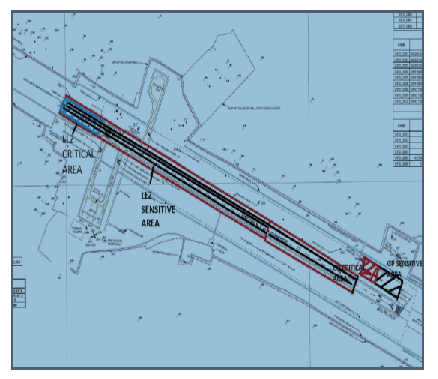
ILS CRITICAL AND SENSITIVE AREA CHART


VEAY

AD 2.23

ADDITIONAL INFORMATION

NIL

VEAY

AD 2.24

CHARTS RELATED TO AN AERODROME

1

Aerodrome Chart (7 August 2025)

2

Aircraft Parking / Docking Chart (7 August 2025)

3

Aerodrome Obstacle Chart Type-A (Operating Limitations) RWY 11 (7 August 2025)

4

Aerodrome Obstacle Chart Type-A (Operating Limitations) RWY 29 (7 August 2025)

5

Aerodrome Obstacle Chart Type B Chart (7 August 2025)

6

Instrument Approach Chart - ILS Z RWY 29 (CAT A/B/C)

7

Instrument Approach Chart - ILS Y RWY 29 (CAT A/B/C)

8

Coding Table - ILS Y Procedure RWY 29

9

Instrument Approach Chart - VOR RWY 11 (CAT A/B/C)

10

Instrument Approach Chart - VOR RWY 29 (CAT A/B/C)

11

Instrument Approach Chart - RNP Procedure RWY 11 (CAT A/B/C) (13 June 2024)

12

Tabular Description - RNP Procedure RWY 11 (13 June 2024)

13

FAS Data Block Table - RNP Procedure RWY 11 (13 June 2024)

14

Instrument Approach Chart - RNP Procedure RWY 29 (CAT A/B/C) (13 June 2024)

15

Tabular Description - RNP Procedure RWY 29 (13 June 2024)

16

FAS Data Block Table - RNP Procedure RWY 29 (13 June 2024)

VEAY

AD 2.25

VISUAL SEGMENT SURFACE (VSS) PENETRATION

Procedure

Procedure Minima

VSS Penetration

1

2

3