1.
1.1
Air Traffic Flow Management (ATFM) is a service established in order to contribute to a safe, orderly and expeditious air traffic movement, ensuring that air traffic volume is compatible with capacities declared by the ATS authority.
1.2
ATFM is primarily meant to address the balancing of demand against the capacity to achieve optimum utilization of the major resources viz., Airport, Airspace and aircraft at every Indian airport where there is a capacity constraint.
1.3
The function of balancing demand and capacity consists of evaluating the air traffic flows and taking timely and appropriate measures for reducing the effects of limitations of the ATM system to a minimum. A process of collaboration is adopted for efficient management of system-wide air traffic flows through timely information sharing on air traffic, the weather conditions and other resources available among all stakeholders.
1.4
By creating optimum balance between demand and capacity, the ATFM system enables airspace users to participate in the ATM system in an optimal manner, mitigating at the same time constraints related to the airspace and aerodrome capacity. The collaborative decision-making process ensures greater equitable access and a more efficient use of the airport and airspace resources.
1.5
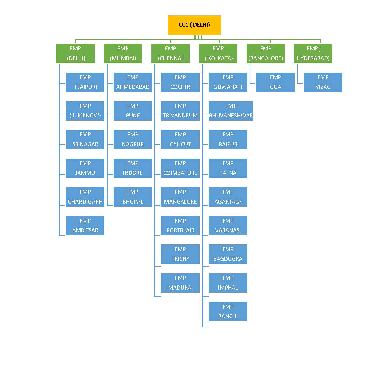
Airports Authority of India (AAI) has established a Central Air Traffic Flow Management (C-ATFM) system in India. The C-ATFM network consist of a Central Command Center (CCC) at Delhi supported by Flow Management Positions (FMPs) at major Area Control Centres (ACCs) and ATC towers across the country. The CCC provides ATFM service in conjunction with the FMPs.
2.
2.1
The C-ATFM system provides ATFM services covering all the four Indian FIRs including the oceanic airspace areas of Bay of Bengal, Indian Ocean and Arabian Sea, designated to India for the provision of ATS Services. This is called Indian Air Traffic Flow and Capacity Management (ATFCM) area.
The CCC Traffic Flow Manager, using the C-ATFM system, may apply
• Strategic/Pre-Tactical ATFM Measures to flights which depart and land within the Indian ATFCM area.
• Tactical ATFM measures to all flights operating within Indian ATFCM area.
3.
3.1
3.1.1
The functioning of C-ATFM involves ATFM community participation, which includes air space users, airport operators, military, regulator (DGCA) and Airports Authority of India.
3.1.2
Members of ATFM community participate and collaborate in the planning, development, use, regulation, operation and maintenance of the ATFM system, within the framework of the concept of Collaborative Decision Making (CDM), elucidated by ICAO in the Global Air Traffic Management Operational Concept (Doc. 9854 AN/458), Global Air Navigation Plan (Doc. 9750 AN/963) and Manual on Collaborative Air Traffic Flow Management (Doc 9971 AN/485).
3.1.3
The application of CDM will facilitate to reach an acceptable solution in which requirements of all participants and effective operation of ATM system will be considered.
3.2
3.2.1.
Airports Authority of India, in accordance with ICAO guidelines on PANS-ATM has established Central Air Traffic Flow Management system (C-ATFM) in India. Implementation of C-ATFM project is being undertaken in three phases. The system capabilities will be upgraded phase wise and at each milestone, some additional functionality will be added.
3.2.2.
Phase I has been implemented with the operationalization of 36 FMPs across India to provide support to Central Command Center (CCC). The FMPs will be operational as per the operational watch hours of the respective airport. The CATFM system provides AAI and Aircraft operators with significant capabilities to perform strategic, pre-tactical and tactical ATFM and CDM associated with departures from/arrivals into all Indian Airports.
3.2.3.
The Phase II capabilities include extending flow management capabilities to airspace elements. Airspace elements associated with ATFM measures can include sectors, terminal control area (TMAs), ad hoc volume of airspace, SUA, fixes, Nav-aids and Airways segment
3.2.4.
In Phase III, cross-border ATFM services between adjacent States is envisaged. .
3.2.5.
The C-ATFM system is designed for easy access through web based application. Authorized users are able to access the C-ATFM system through secured log in process and participate in the CDM process.
3.3.
3.3.1.
3.3.1.1.
The Jt. Director General, DGCA approves the summer and winter flight schedules for domestic/International scheduled airlines on bi-annual basis under the provision of Rule 140A of the Aircraft Rule 1937. The Summer Flight Schedule is valid for a period from last Sunday of the month of March to last Saturday of the month of October of every year whereas the Winter Flight Schedule is valid from last Sunday of the month of October to last Saturday of the month of March every year.
3.3.1.2.
A slot coordination meeting is convened by AAI, inviting all the stakeholder’s participation under the Chairmanship of DGCA. During the slot coordination meeting, filed slots for each airport by airlines are discussed in respect of runway closure and other safety concerns and in accordance with guidelines for slot allocation issued by Ministry of Civil Aviation & worldwide slot allocation guideline issued by IATA.
3.3.1.3.
Based on the deliberations during the meeting such as agreement on slot finalisation between airline and airport operators, redressal of call sign conflicts & block hour related issues, approval to the airline-wise flight schedule is accorded. The approved flight schedule forms the basis for strategic air traffic flow management planning.
3.3.2.
3.3.2.1.
With access to approved flight schedules, Flight Plans and operational flight data from AAI’s ATC automation system, strategic and pre-tactical demand predictions are provided by the C-ATFM (“SKYFLOW”) system to determine periods of excess demand compared to the Declared/ Practiced airport Capacity.
3.3.2.2.
C-ATFM operates on the principle of primarily making efforts towards efficient capacity management by application of ATFM measures.
3.3.2.3.
3.3.2.3 C-ATFM will, when necessary, apply ATFM measures (ATFM Solutions) such as Ground Delay Programs (GDP) and/or Ground Stop Programs (GSt), by issuance of “Calculated Take Off Time” (CTOT) to balance demand/capacity at an airport. ATFM Measures are collaborated with airspace users and airport operators as an integral part of the CDM process. Ground Delay Program & Ground Stop Program assign only ground delay to the affected flights.
3.3.2.4.
C-ATFM system has the capability of application of other Tactical ATFM measures such as Fix balancing program, Sector Balancing program, In-trail program, Sequencing Program, Re-routing program, Flight level adjustment program to an airspace element. All these ATFM measures assign air delay to the affected flights.However, some of the above referred measures are both pre-tactical and/or tactical ATFM measures, assigning ground delay to the flights, which are yet to depart & air delay to the airborne flights. Air delay is assigned by SKYFLOW by issuance of CTO (Calculated time over) a Fix/Nav-aid or CLDT (Calculated Landing Time) for a flight.
3.3.2.5.
Once an ATFM Measure is implemented, CCC will monitor updated demand predictions. Updated predictions are driven by tactical flight data updates from the automation systems as well as flight specific updates provided by aircraft operators.
3.3.2.6.
Airspace Users (AU)/Aircraft Operators (AO) are provided capabilities to monitor the SKYFLOW system and may request CCC for schedule management adjustments (e.g., slot substitutions) to optimize their operations consistent with the available capacity.
3.3.2.7.
A web portal access to the SKYFLOW system is provided via www.atfmaai.aero which is compatible with all the browsers. The SKYFLOW system provides the stakeholders a common situational awareness of the current ATFM status and information about ATFM measures in India. (A hyperlink to the ATFM system is provided on www.aai.aero). AU/AOs will be able to view flight details and their own slots during an ATFM Measure. ATS Units and aerodrome operators will also be able to view all flights arriving and departing from their aerodrome.
3.3.2.8.
C-ATFM system provides post operational reports to help AAI and their stakeholders to evaluate system performance and lessons learnt.
3.4.
3.4.1.
3.4.1 At times when air traffic demand exceeds available capacity or to apportion traffic into a manageable flow over an Airspace element, a regulation (ATFM measure) will be applied by C-ATFM system. Accordingly, based on the applied ATFM measures, SKYFLOW issues Calculated Take Off time (CTOT), Calculated Time Over (CTO) and Calculated Landing Time (CLDT). This is facilitated by the SKYFLOW automated system algorithm.
3.4.2.
The information about the CTOT, CTO & CLDT can be accessed through SKYFLOW log-in or through ATFM web portal. The information may also be sent to the aerodrome operator, FMPs/ATC and the Aircraft Operator as an e-mail message
3.4.3.
Recipients of the CTOT messages as above are required to comply with the issued departure slot time. The AUs shall arrange their flights so as to take-off within the slot tolerance window (-5 to +10 minutes of the CTOT). ATC shall ensure that the departures comply with the CTOT regulations so that excessive holdings and diversions are avoided.
3.4.4.
When applicable, ATC shall ensure that the CTOs are available with the crew for flight proceeding to a constrained airspace element & cross this element within a declared slot tolerance window (typically varies from -3/+3 minutes to -/+1 minute of the CTO). In case of an airspace element being a volume of airspace, CTO is to be
3.4.5.
When AUs are unable to meet the departure slot window, they shall inform respective ATC unit with a revised EOBT. ATC or/and the local FMP will in turn inform CCC about the revised EOBT and when possible will receive a revised CTOT to be passed on to the aircraft.
3.4.6
Full details of the ATFM regulation process and procedures related to Flight Planning and C-ATFM are published in the ATFM User’s Manual section of the C-ATFM Operations handbook.
4.
4.1.
All Airline Operators should adhere to Flight Planning requirements as stated below:
a) Flight plans shall be submitted at least 3 hours before the EOBT;
b) The window for filing FPL is between 3 Hours and 120 Hours (Five days) before the EOBT. Earlier filing of FPL will give a realistic demand data to the CCC and hence the requirement of ATFM measures can be identified early for better planning. Late filing of a flight plan will lead to inaccuracies in predicting the demand and may lead to undesirable delay;
c) All ATS messages such as FPL, CNL, DLA, CHG shall be addressed to VIDPCTFM also. All flights departing, arriving or overflying India subject to a change in an EOBT of more than 15 minutes shall notify the change to the
C-ATFM system through AFTN messages
d) It is in the best interest of Aircraft Operators to initiate prompt revisions or cancellations, thus permitting the ATFM system to maximize use of available capacity and minimize delay. The later the revision is made the greater is the probability of unwanted delay.
e) Originators of all NOTAM, AIS and MET messages pertaining to Indian airports/FIRs shall include VIDPCTFM additionally in the addressee list of such messages.
f) Full details of flight planning requirements are included in the ATFM User’s Manual section of C-ATFM Operations Handbook.
4.2.
4.2.1.
The following flights are exempted from the ATFM Measures:
a. Flights experiencing an emergency, including aircraft subjected to unlawful interference;
b. Flights in search and rescue or fire-fighting missions;
c. Urgent medical evacuation flights specifically declared by medical authorities where flight delays would put the life of the patients at risk;
d. Flights with “Head of State” status;
f. Other flights specifically identified by appropriate authorities.
Note: After medical flights have completed their mission, they shall be subject to ATFM measures. Scheduled passenger transfer flights are, by their nature, non-urgent and should not be given priority under normal operational situation.
4.2.2.
Flights exempted from ATFM measures shall indicate the exemption in their flight plan (Field 18 - STS/HEAD, STS/MEDEVAC etc.).
4.3.
4.3.1.
In order to comply with a CTOT, Aircraft Operators should plan its off-block time consistent with the CTOT, taking into account the taxi time;
4.3.2.
Any change to the EOBT of previously filed FPL or fortnightly flight data submitted (to CCC) shall be communicated to ATFM by appropriate message;
4.3.3.
If the original EOBT can no longer be met, then the AO shall communicate the new EOBT by use of a DLA or CHG message. When an AO submits an amendment message to ATC and ATFM, they must always give an EOBT which indicates the time the AO wants to be off-blocks;
4.3.4.
The procedure to be followed to modify the EOBT is as follows:
a) To amend the EOBT to a later time, a DLA or CHG message shall be sent to ATC and CATFM;
b) To amend the EOBT to an earlier time, a CNL message must be sent to ATC and CATFM which cancels the earlier FPL. It shall be followed five minutes later by a new flight plan with new EOBT.
4.3.5.
Whenever the EOBT of a flight is changed sufficiently in advance, the SKYFLOW system may allocate a revised CTOT. In any case, the CTOT of the flight will always be later than the new EOBT plus the taxi-time.
4.3.6.
However, if the EOBT is revised closer to the actual time of operations, ATFM system will not be in a position to issue a revised CTOT. In this case the flight is treated on its merits and may be subjected to tactical ATC delay in coordination with FMP/CCC.
4.4
Implementation Of Air Traffic Flow Management Procedures over bay of Bengal, South Asia and Pakistan through Kabul FIR
4.4.1
4.4.1.1
On 24 July 2006, the States of the ICAO Asia/Pacific Region within the Bay of Bengal, South Asia and Pakistan airspace implemented an operational trial of an automated Air Traffic Flow Management (ATFM) service under the auspices of the ICAO Bay of Bengal ATS Coordination Group - ATFM Task Force.Pursuant to comprehensive reviews of the performance of the operational trial by the ATFM Task Force, ATFM procedures were permanently implemented.Bay of Bengal cooperative ATFM system (BOBCAT), services were temporarily suspended since 08th September 2021, due to the absence of Enroute overflight Air Traffic Service (ATS) in Afghanistan airspace (Kabul FIR) and lack of traffic demand to operate through the Kabul FIR.
4.4.1.2
Pursuant to comprehensive reviews of the performance of the operational trial by the ATFM Task Force, ATFM procedures are permanently implemented in accordance with the provisions of this AIP Supplement.
The States of the ICAO Asia/Pacific Region, which have westbound night time flights operating through the Kabul FIR between 2000 UTC to 2359 UTC, are re-activating the integrated Air Traffic Flow Management (ATFM) service using the BOBCAT.
4.4.1.3
The Kabul FIR Contingency Coordination Team teleconference (23 April 2025) along with the BOBCAT Resumption Side Meeting during the Fifteenth Meeting of the Asia/Pacific Air Traffic Flow Management Steering Group (ATFM/SG/15, Bangkok, Thailand, from 28 April to 02 May 2025) agreed to the resumption of the BOBCAT procedures to support the ongoing Afghanistan contingency arrangement, to alleviate operational and environmental impact while enroute ATC service in Kabul FIR remained absent.Pursuant to comprehensive reviews, BOBCAT procedures are re-activated and implemented.
4.4.2
4.4.2.1
ATFM services are provided by Aeronautical Radio of Thailand LTD (AEROTHAI) from the Bangkok Air Traffic Flow Management Unit (ATFMU) at Bangkok ACC. ATFM services will be limited to calculation, promulgation and management of mandatory Allocated Wheels Up Time (AWUT) and Kabul FIR flight level, ATS route and entry fix time for each affected flight.
As one of the ATFM services provided, Bangkok ATFMU provides ATFM service for westbound flights intending to transit Kabul FIR between 2000 UTC and 2359 UTC daily. The service provided includes calculation, promulgation, and management of mandatory Calculated Take-Off Time (CTOT) and flight level, ATS route, and Calculated Time-Over (CTO) at entry waypoint, for entry into Kabul FIR for each affected flight.
4.4.2.2
Air Traffic Control shall Navigation Service Providers (ANSPs) retain responsibility for the tactical management of flights that are subject subjected to ATFMthis ATFM measure. In discharging tactical responsibilities, ATC ANSPs will manage non non-ATFM compliant flights using delayed pushback and start clearances, non-preferred routes and/or flight levels, enroute holding and/or diversion around Kabul FIR.
4.4.2.3
The Bangkok ATFMU utilises utilizes the automated, web web-based Bay of Bengal Cooperative BOBCAT in providing ATFM System (BOBCAT) system service in meeting its ATFM responsibilitiesthe Kabul FIR. These responsibilities will be managed in coordination with aircraft operators airspace users and ANSPs in the FIRs concerned.
4.4.2.4
The Bangkok ATFMU operates on a 24 24-hour basis and is responsible for westbound flights entering the Kabul FIR at specified times, flight levels and ATS routes in accordance with paragraph 3 of this AIP Supplementroutes. The objectives of these ATFM services are to:
a) Reduce ground and en-route delays;
b) Maximise capacity and optimize the flow of air traffic within the area;flow through Kabul FIR
c) Provide an informed choice of routing and flight level selection;
d) Alleviate unplanned in flight re-routing and technical stops; and
e) Assist regional ANSPs in planning for and managing future workload in the light of forecast handling increased air traffic flows within the areaflow through Kabul FIR.
4.4.3
ATFM BOBCAT- affected ATS routes, flight levels and applicable hoursperiod
4.4.3.1
All westbound flights intending to enter the Kabul FIR between 2000UTC and 2359UTC daily on ATS routes A466, L750, N644 from FL280 to FL390 inclusive and G792/V390from FL310 to FL390 inclusive flight levels in table 1 shall comply with the ATFM BOBCAT procedures contained here. This includes a mandatory requirement for all flights to obtain a specific ATFM slot allocation - CTOT, CTO at Kabul FIR entry waypoint, allocated flight level, and allocated ATS route- from the Bangkok ATFMU (including AWUT) for entry into the Kabul FIR during the period mentioned above.
Table 1: ATS route and flight levels requiring ATFM slot allocation
Flights who plan to enter Kabul FIR without an AWUT and entry slot (comprising flight level, ATS route and entry fix time) will be accommodated only after flights with slots have been processed. Such flights should expect delayed pushback and start clearances, non-preferred routes and/or flight levels, enroute holding and/or diversion around Kabul FIR.
Note: Flight Levels availability may be subject to change through amendments of the Kabul FIR Contingency Arrangement. In the interim, the BOBCAT system homepage would display the updated information, along with flight level
4.4.3.32
In order to ensure availability of slots for westbound departures from designated airports in northern India and Pakistan, departures from these airports are given priority for FL280 in the slot allocation. This does not preclude these flights from requesting higher flight levels with initial slot request.
Flights that plan to enter Kabul FIR without an ATFM slot allocation - CTOT, CTO at Kabul FIR entry waypoint, allocated flight level and allocated ATS route will be accommodated only after flights with slots have been processed. Such flights should expect delayed pushback and start clearances, non-preferred routes and/or flight levels, enroute holding and/or diversion around Kabul FIR.
4.4.4
4.4.4.1
The following flights are exempted from the ATFM procedures in this AIP Supplement:BOBCAT procedures:
a) Humanitarian or medical flights
b) State aircraft with Head of State onboard
a) Flights experiencing an emergency, including aircraft subject to unlawful interference;
b) Flights on search and rescue (SAR) or rescue and firefighting (RFF) missions;
c) Urgent medical evacuation flights specifically declared by medical authorities where flight delays would put the life of patients at risk;
d) Flights with “Head of State” status; or,
e) Other flights specifically identified by State authorities.
Note: After medical flights have completed their mission; they should be subject to ATFM measures. Scheduled patient transfer flights are, by nature, non-urgent and should not be given priority under normal operational situation
4.4.4.2
Flights exempted from ATFM procedures shall indicate the exemption in their flight plan (Field 18 - STS-BOB ATFM EXMP/ATFMX ).
Airspace users uncertain whether their flights should be exempted should contact Bangkok ATFMU for clarification.
4.4.4.35
Relevant ATC Units shall forward the flight plan information to the ATFMU at AFTN address VTBBZDZX.
4.4.5 5.1
Mandatory AWUT and Kabul FIR Slot allocation
Affected flights shall obtain the mandatory Kabul FIR slot allocation- CTOT, CTO at KABUL FIR entry waypoint, allocated flight level and ATS route from the BOBCAT system. The Kabul FIR slot allocation will enable ANSPs to tactically control westbound flights transiting the Kabul FIR at specified times by assigning minimum spacing requirements at specified FIR boundary waypoints of the Kabul FIR.
4.4.5.12
Affected flights shall obtain the mandatory AWUT, Kabul FIR entry time, flight level and ATS route from the BOBCAT system. The AWUT and Kabul slot allocation will enable ANSPs to tactically control westbound flights transiting the Kabul FIR at specified times by assigning minimum spacing requirements at established gateway fix points in the vicinity of the eastern boundary of the Kabul FIR.
The application, calculation and distribution of CTOT and associated Kabul FIR entry waypoint slot allocations will be managed via internet access to the BOBCAT system in accordance with the ATFM operating procedures in paragraph 4.4.6.
4.4.5.2 6
The application, calculation and distribution of AWUT and Kabul FIR entry fix slot allocations will be managed via internet access to the BOBCAT system in accordance with the ATFM operating procedures in paragraph 4.4.6.
4.4.6 6.1
All affected flights are required to submit slot requests to the BOBCAT system by logging onto https://www.bobcat.aero between 0000 and 1159 UTC on day of flight and completing the electronic templates provided.
4.4.6.12
All affected flights are required to submit slot requests to the BOBCAT system by logging onto https://www.bobcat.aero between 0001 and 1200UTC on day of flight and completing the electronic templates provided.
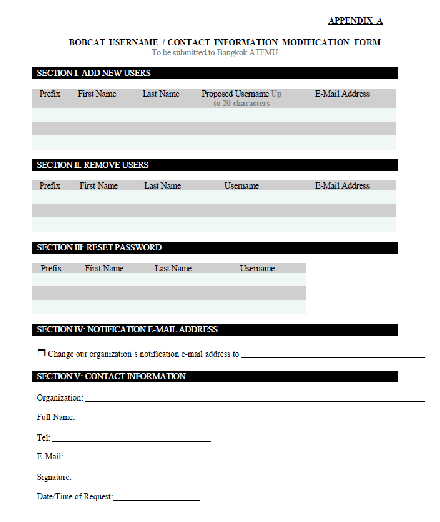
Affected operators who do not have dedicated BOBCAT username/password access should complete the attached application form in Appendix A and email the form to the Bangkok ATFMU as soon as possible.
4.4.6.3
4.4.6.3.1
The slot allocation process is divided into 3 phases, namely the slot request submission, initial slot allocation and finally slot distribution to aircraft operators airspace users and ANSPs
4.4.6.3.2
Slot requests including preferred ATS route, flight level and Maximum Acceptable Delay (MAD) should be lodged between 0001 0000 UTC and 1200 1159 UTC on the day of flight. Slot requests may subsequently be amended prior to cut off time of 1200 UTC, which is the cut-off time. Aircraft operators airspace users are encouraged to submit additional slot request options in case their first choice is not available. This may include variations to ATS route, flight level and MAD.
4.4.6.3.3
Slot requests shall be for flight parameters that are able to be met by the flight. For example, flights requesting a slot at FL390 FL360 must be able to transit enter Kabul FIR at FL390FL360. Flights subsequently unable to meet slot parameters (flight level, ATS route or CTO at Kabul FIR entry fix timewaypoint) should expect non-preferred routes and/or flight levels, enroute holding and/or diversion around Kabul FIR.
4.4.6.3.4
As BOBCAT will allocate FL280 on a priority basis to facilitate departures from northern India and Pakistan underneath over-flying traffic, flights departing these airports are encouraged to include FL280 as at least one slot request preference.
Flights that were not allocated a slot in the initial slot allocation or not satisfied with the allocated slot or did not submit a slot request should select slots from the listing of remaining unallocated slots available immediately after slot distribution has been completed
4.4.6.3.5
Flights that were not allocated a slot in the initial slot allocation, are not satisfied with the allocated slot or did not submit a slot request should select slots from the listing of remaining unallocated slots available immediately after slot distribution has been completed.
4.4.6.3.65
Slot allocation will commence at the cut-off time at 1200UTC. BOBCAT will process and generate the slot allocation based on the information submitted in the slot requests. Notification of slot allocation will be made not later than 1230UTC via the ATFMU BOBCAT website. Alternative arrangements for notification of slot distribution .and via AFTN using Slot Allocation Message (e.g. E-mail, Fax, TelephoneSAM) should be coordinated in accordance with the ATFMU.Asia/Pacific AFTN/AMHS-Based Interface Control Document.
4.4.6.3.76
After the slot allocation has been published at https://www.bobcat.aero. aircraft operators airspace users can:
a) Use the slot allocation result for ATS flight planning purposes,
b) Cancel the allocated slot and/or,
c) Change slot allocation to another available slot in the published list of unallocated slots.
4.4.6.3.87
ATC Units can also view the slot allocation results at https://www.bobcat.aero.
4.4.6.4
4.4.6.4.1
Once aircraft operators airspace users are in receipt of the slot allocation, they shall submit the ATS flight plan using the time, ATS route and flight level parameters of the BOBCAT allocated slot.
4.4.6.4.2
In addition to normal AFTN addressees, operators should also address flight plan (FPL) and related ATS messages (e.g. DLA, CNL, CHG) to the Bangkok ATFMU via AFTN address VTBBZDZX for all flights that have submitted a slot request.
4.4.7
Aircraft OperatorAirspace Users/Pilot in Command and ATC ANSP Responsibilities
4.4.7.1
In accordance with ICAO PANS ATM provisions, it is the responsibility of the Pilot in Command (PIC) and the aircraft operator airspace user to ensure that the aircraft is ready to taxi in time to meet any required departure time. PIC shall be kept informed by their operators of the AWUTCTOT, CTO, Kabul FIR entry fix times waypoint and flight parameters (route/,flight level) nominated allocated by BOBCAT.
4.4.7.2
The PIC, in collaboration with ATC, shall arrange take-off as close as possible to the
AWUT in order to meet the Kabul FIR slot time.
The PIC, in collaboration with ATC, shall arrange take-off as close as possible to the CTOT in order to meet the allocated CTO at Kabul FIR entry waypoint.
4.4.7.3
For flights (with CTOTs from BOBCAT) operating out of an A-CDM airport, where the CTOT is integrated into the A-CDM process, PIC are advised to comply with the local A-CDM procedure
4.4.7.3
In accordance with ICAO PANS ATM provisions, flights with an ATFM slot allocation should be given priority for take off to facilitate compliance with AWUT.
4.4.7.4
AWUT shall be included as part of the initial ATC clearance. In collaboration with PIC, Relevant ATC Units shall ensure that every opportunity and assistance is granted to a flight to meet AWUT and allocated entry fix times at Kabul FIR.
In accordance with ICAO PANS ATM provisions, flights with an ATFM slot allocation should be given priority for take-off to facilitate compliance with CTOT.
Note: CTOT compliance windows are provided for ATC at the departure airport to accord operational flexibility in handling airport traffic conditions. CTOT compliance windows are defined for constrained airspace volumes as: -5/+5 minutes for CTOTs assigned
4.4.8 7.5
Coordination between Aircraft Operator/Pilot in Command, Air Traffic Control and Bangkok ATFMU
CTOT shall be included as part of the initial ATC clearance. In collaboration with PIC, Aerodrome control shall ensure that every opportunity and assistance is granted to a flight to meet CTOT and allocated CTO at Kabul FIR entry waypoint.
4.4.8.18
The PIC shall include the AWUT in the initial ATC clearance request.
Coordination procedure between Airspace Users/Pilot in Command,, ANSPs and Bangkok ATFMU
4.4.8.21
PIC shall adjust cruise flight to comply with slot parameters at the Kabul FIR entry fix, requesting appropriate ATC clearances including speed variations in accordance with published AIP requirements.
The Bangkok ATFMU (VTBBZDZX) shall be included in the list of AFTN addressees for NOTAMs regarding any planned activities that may affect slot availability (e.g. reservation of airspace/ closure of airspace, non-availability of routes, etc).
4.4.8.32
Prior to departure, in circumstances where it becomes obvious that the Kabul slot time will not be met, a new slot allocation should be obtained as soon as possible and via the most expeditious means (e.g. via coordination between flight dispatcher, PIC, relevant ATC Units and Bangkok ATFMU). Early advice that the Kabul slot time will be missed also enables the slots so vacated to be efficiently reassigned to other flights.
The Bangkok ATFMU (VTBBZDZX) shall be included in the list of AFTN addressees for ATS messages (e.g. FPL, DEP, DLA, CHG, CNL) relating to flights subject to ATFM procedures.
4.4.8.43
Prior to departure, in the event that the aircraft is unable to meet the Kabul slot time, when requested by the PIC after the aircraft has left the gate relevant ATC Units shall assist the PIC to coordinate with the ATFMU for a revised slot allocation.
Prior to departure,and before obtaining an airway clearance in circumstances where it becomes obvious that the allocated Kabul FIR slot parameters will not be met, a new slot allocation should be obtained as soon as possible to avoid frequency congestion, this should be obtained primarily via airspace users/flight dispatchers, otherwise ground control or clearance delivery may be asked for assistance in the coordination with Bangkok ATFMU as an alternative Early advice that the Kabul FIR slot parameters will be missed also enables the slots so vacated to be efficiently reassigned to other flights.
4.4.8.54
The ATFMU (VTBBZDZX) shall be included in the list of AFTN addressees for NOTAMs regarding any planned activities that may affect slot availability (e.g. reservation of airspace/ closure of airspace, non-availability of routes, etc).
The PIC shall include the CTOT in the initial ATC clearance request
4.4.8.65
The ATFMU (VTBBZDZX) shall be included in the list of AFTN addressees for ATS messages (e.g. FPL, DEP, DLA, CHG, CNL) relating to flights subject to ATFM procedures.
A missed slot results in considerable increase in coordination workload for ATC and PIC and should be avoided. To minimize coordination workload in obtaining a revised slot allocation, if the flight is still at the gate and an Airway Clearance has been obtained, PIC shall advice Ground Control of the missed slot and obtain new CTOT as specified in 4.4.8.3. If it becomes essential, the ATC Clearance may be cancelled.
4.4.8.76
A missed slot results in dramatically increased coordination workload for ATC and PIC and should be avoided. To minimize coordination workload in obtaining a revised slot allocation, the following procedures are recommended:
a) If the flight is still at the gate, coordination should take place via operators/flight dispatchers to ATFMU;
b) If the flight has left the gate, coordination to ATFMU may also take place via the ATS unit presently
communicating with the flight.
Prior to departure and after the aircraft has left the gate, in the event that the aircraft is unable to meet the allocated Kabul FIR slot parameters, when requested by the PIC, Aerodrome Control shall assist the PIC in coordination with Bangkok ACC and Bangkok ATFMU for a revised slot allocation.
4.4.9 8.7
PIC shall adjust cruise flight to comply with slot parameters at the Kabul FIR entry waypoint, requesting appropriate ATC clearances including speed variations in accordance with published AIP requirements.
4.4.9.1 9
Aircraft operators and concerned ATC Units are required to have computer equipment capable of connecting to the BOBCAT website https://www.bobcat.aero via the internet and satisfying the following minimum technical requirements:
a) A personal computer of any operating system with the following characteristics;
i) Processor: minimum CPU clock speed of 150 MHz;
ii) Operating System: Any that operates one of the following web browsers (i.e. Windows 2000/XP, Linux,
iii) Web Browser: Internet Explorer 5.5 or newer, Mozilla 1.0 or newer, Mozilla Firefox 1.0 or newer, Netscape
iv) RAM: 64 MB or larger (depending on operating system);
v) Hard Disk Space: minimum of 500 MB or larger (depending on operating system);
vi) Monitor Display Resolution: Minimum of 800 x 600 pixels; and
4.4.9.1
Airspace users and concerned ATC Units are required to have device capable of connecting to the BOBCAT website https://www.bobcat.aero via the internet using the following minimum web browser software (supported with security patches):
a) Microsoft edge version 129 or newer; or
4.4.10
4.4.10.1
Supporting documentation, including detailed information in respect of the ATFM BOBCAT operations described above and other pertinent information has been included in the Bay of Bengal and South Asia ATFM Handbook (the “ATFM Users Handbook”), available at https://www.bobcat.aero
4.4.10.2
ATC ANSPs and aircraft operators airspace users shall ensure that they are conversant with and able to apply the relevant procedures described in the ATFM Users Handbook.
4.4.11
4.4.11.1
In the event that an aircraft operator airspace users or ATC ATS unit is unable to access the ATFMU BOBCAT website, the Bangkok ATFMU shall be contacted via the alternative means (telephone, fax, ,AFTN) described in paragraph 4.4.13.1
4.4.11.2
Contingency procedures for submission of slot request, including activation of Contingency Slot Request Templates (CSRT), are included in the ATFM Users Handbook.
4.4.11.3
In the event of BOBCAT system failure of BOBCATfailure, Bangkok ATFMU shall notify all parties concerned and advise that ATFM BOBCAT slot allocation procedures are suspended. In this event, all parties concerned will revert to the existing ATM procedures as applicable outside the daily period of ATFM metering.
4.4.12
4.4.12.1
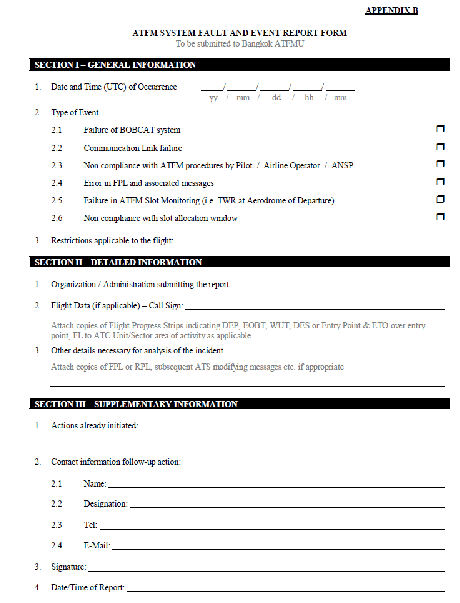
An ATFM system fault is defined as a significant occurrence affecting an ATS unit, an aircraft operator airspace users or ATFMU resulting from the application of ATFM procedures.
4.4.12.2
Aircraft operators Airspace users and relevant ATC ATS Units experiencing an ATFM system fault should complete an ATFM System Fault Report Form from the ATFM Users Handbook (see Appendix B) and forward it to the Bangkok ATFMU at the address indicated on the form. The Bangkok ATFMU will analyze all reports, make recommendations/suggestions as appropriate and provide feed back to the parties concerned to enable remedial action.
4.4.13
4.4.13.1
The Bangkok ATFMU may be contacted as follows;
• Telephone: +66-2-287-8024, +66-2-287-8025
5.
5.1.
Aircraft operators participate in the ATFM process by providing and updating flight intentions as well as participating in CDM process. Aircraft operators are essential stakeholders in the CDM process and shall
5.1.1.
Ensure that the latest schedule information and flight planning information are supplied to CCC;
5.1.2.
Provide flight details in respect of domestic scheduled operation every fortnight in a timely manner i.e. for the first fortnight (1st to 15th) by 25th of the previous month and for second fortnight (16th to last day of the month) by 10th of the same month;
5.1.3.
When applicable, ensure timely submission of Flight plan & other associated AFTN
5.1.4.
Ensure that the details given in the FPL are consistent with that of the approved Flight Schedules & flight data submitted to CCC every fortnight;
5.1.5.
5.1.6.
5.1.7.
Ensure ATFM information such as ATFM measures (CTOT, CTO) is distributed to each affected flight;
5.1.8.
5.1.9.
Comply with the provisions of filing of flight plans and for amending of EOBT; and
5.1.10.
6.
6.1.
Flow Management positon (FMP) is a position that monitors traffic flows and implements or requests ATFM measures to be implemented. Each FMP shall:
6.1.1.
Liaise with the ATS units within their area of responsibility to understand the current and anticipated capacity conditions;
6.1.2.
Collect and ensure the distribution of all relevant information such as significant meteorological conditions, capacity constraints (planned or unplanned), infrastructure outages, runway closure, automated system outages etc. to CCC and other appropriate stakeholders;
6.1.3.
Coordinate with CCC for any contingency events affecting Aerodrome capacity or an event leading to airspace congestion, which may entail application of ATFM measures;
6.1.4.
Identify the airspace element which needs to be regulated, the duration of the applicable ATFM measures & the other associated parameters;
6.1.5.
Assist CCC in preparation of ATFM Daily Plan (ADP) by sharing essential information regarding In-operability, active NOTAMS, VVIP movement for the next day;
6.1.6.
6.1.7.
Disseminate CTOTs/CTOs/CLDTs to the concerned ATS unit in a timely manner;
6.1.8.
Execute, manage, continuously monitor ATFM measures in real time, in coordination with the relevant ATS units and access C-ATFM system (SKYFLOW) for the same.;
6.1.9.
6.1.10.
Participate in CDM process for effective implementation of ATFM & post-operations analysis of the applied ATFM measures;
6.1.11.
In case of withdrawal of ATFM measures, inform all concerned;
6.1.12.
Document, in real time, a complete description of all ATFM measures (for example, ground delay programmes, miles-in-trail) in a designated log.
7.
7.1.
ATS units providing ATC services play a central role in ATFM. Though each unit controls flights at different moments, the roles and responsibilities of ATS units are similar within their specific area of responsibility (Aerodrome, Approach, Area). Concerned ATS unit shall:
7.1.1.
7.1.2.
Provide input regarding capacity and configuration for their area of responsibility;
7.1.3.
Provide strategic/pre-tactical/tactical input into capacity/demand scenarios;
7.1.4.
Deliver aircraft as per applied ATFM measures, ensuring compliance with ATFM measures i.e. facilitate CTOT/CTO/CLDT compliance;
7.1.5.
Coordinate with the respective FMPs for revisions to EOBT when flights are unable to adhere to their slot;
7.1.6.
Keep FMP informed about any changes or occurrences that can affect the capacity of the aerodrome/airspace or flights are unable to comply with CTOs due contingency;
7.1.7.
As far as practicable, preference should be accorded to aircraft subject to ATFM measures to ensure compliance of CTOT/CTO/CLDT;
7.1.8.
8.
8.1.
8.1.1
Provide input to the strategic capacity declaration of airports;
8.1.2
Provide, at the earliest opportunity, but at least 14 days in advance, details of any event that may lead to an hourly increase in demand, e.g. sports event, trade fair, Government/Public meeting, air show etc.;
8.1.3
Send such Event-related information to: Email: ccc_catfm@aai.aero / Fax: + 91-11-26135290;
8.1.4
Coordinate with local ATC and FMP for allocation/revision of airport slots;
8.1.5
Notify CCC and concerned FMP of events/maintenance works etc., that may impact airport and/or airspace capacity;
8.1.6
Participate in the C-ATFM activities and CDM and;
a) Provide updated flight schedules to CCC for accurate demand predictions;
8.1.7
8.1.8
9.
9.1
C-ATFM operating concept envisages active civil-military coordination & cooperation on sharing of data and other resources, thus enabling an optimal use of ATM resources. Further it may be noted that, in case of exigencies, the Defence liaison at CCC will be the focal point of contact for all required coordination between CATFM and Defence.
9.2
Military ATC unit shall liaise with the respective airports/ concerned Defence authorities for information on Special User Airspace
10.
10.1
The roles and responsibilities of all stakeholders for the collaborative decision making of ATFM are being jointly developed and agreed upon. The applicable common rules will be published in a document called “Common Business Rules” (CBR).
11.
11.1
Specific C-ATFM procedures and information is available in the C-ATFM Operations Handbook published
by the ATFM Directorate of AAI and can be downloaded from: https://www.atfmaai.aero/portal or https://aim-india.aai.aero/aisdocument.
11.2
The C-ATFM Operations Handbook containing comprehensive information and procedures on ATFM includes:
11.2.1
General and C-ATFM Systems: this section contains details of the C-ATFM and CCC organization, area of responsibility of various stakeholders and a description of CATFM systems.
11.2.2
The ATFM User’s Manual: this is a self-contained user’s manual for aircraft operators and ATC units describing C-ATFM operating procedures in the context of the SKYFLOW system.
11.2.3
Flight Planning User’s Manual: this is a self-contained user’s manual describing operating procedures for flight plan filing in the context of ATFM.
12.
12.1
General ATFM enquiries should be addressed to:
Executive Director (Air Traffic Flow Management)
Airports Authority of India, Rajiv Gandhi Bhavan
13.
14.
14.1
14.1.1
Flexible Use of Airspace (FUA) is an airspace management concept based on the principle that airspace should not be designated purely as civil or military, but rather as a continuum in which all user requirements are accommodated to the greatest possible extent.
14.1.2
The Government of India approved implementation of Flexible Use of Airspace in India in March 2013.
14.2
a) Airspace Management Cell (AMC) is a joint civil/military cell responsible for the day-today management and temporary allocation of national airspace under the FUA concept.
b) Airspace Use Plan (AUP) is an ASM message notifying the daily decision of an Airspace Management Cell on the temporary allocation of the airspace within its jurisdiction for a specific time period, by means of a standard message format.
c) Approved Agency (AA) is a unit, which has been authorised by an Airspace User to deal with an Airspace Management Cell for airspace allocation and utilisation matters.
d) Centralised Airspace Data Function (CADF) is an ASM function performed by the National AMC (N-AMC) for consolidating the AUPs / UUPs published by the Regional AMCs (R-AMC) and publishing them on the ATFM portal.
e) Collaborative Decision-Making (CDM) is a process whereby all ATM decisions, except for tactical ATC decisions are based on the exchange of all relevant information for transit operations between civilian and military parties.
f) Conditional Route (CDR) is a non-permanent ATS route or part of it that can be planned and used under special conditions.
g) General Air Traffic (GAT) encompasses all flights conducted in accordance with the rules and procedures of ICAO and/or the national civil aviation regulations and legislation.
h) Operational Air Traffic (OAT) encompasses all flights which do not comply with the provisions stated for GAT and for which rules and procedures have been specified by appropriate authorities.
i) Prior Coordination Airspace (PCA) is a portion of airspace of defined dimensions within which individual GAT is permitted to fly “off-route” only after prior co-ordination initiated by GAT controllers with OAT controllers.
j) Reduced Coordination Airspace (RCA) is a portion of airspace of defined dimensions within which GAT is permitted to fly “off-route” without requiring coordination between controllers.
k) Special Use Airspace (SUA) is the term used for airspace wherein activities must be confined because of their nature, or wherein limitations are imposed on aircraft operations that are not a part of those activities, or both. SUA is a generic term used to refer to Restricted Areas, Danger Areas, Prohibited Areas, TRA and TSA.
l) Temporary Reserved Area (TRA) is an airspace temporarily reserved and allocated for the specific use of a particular user during a determined period of time, through which other flights may pass with permission from Air Traffic Control (ATC).
m) Temporary Segregated Area (TSA) is an airspace temporarily reserved and allocated for the exclusive use of a specific user during a determined period of time, through which no other flights may pass.
14.3
a) NHLAPB: Implementation of Flexible Use of Airspace is the responsibility of National High Level Airspace Policy Body (NHLAPB). NHLAPB is the high level body chaired by Secretary (Civil Aviation) and ex-officio members from Ministry of Defence (MoD), Indian Air Force (IAF), Indian Navy (IN), Indian Space Research Organization (ISRO), Directorate General of Civil Aviation (DGCA) and Airports Authority of India (AAI).
b) NAMAC: National Airspace Management Advisory Committee (NAMAC) is a national airspace management body that is constituted to provide assistance and advice to the NHLAPB in formulating the national ASM policy and carry out the necessary strategic planning work, taking into account the requirements of civil and military airspace users and ATS providers.
c) FUA Secretariat: FUA Secretariat is a working level body residing within Directorate of Airspace Management of AAI, which carries out necessary facilitation for implementation for FUA concept.
d) AMC: Airspace Management Cells (AMC) are joint civil-military cells responsible for the day-today management and temporary allocation of national airspace under the FUA concept. AMCs will be established at ATC centres across the country in a phased manner.
e) Airspace Users: Airspace Users include both civil and military users who coordinate with AMCs for pre-tactical and tactical allocation of flexible airspace structures (TSA, TRA and other AMC-manageable airspaces and conditional routes (CDR)).
14.4
14.4.1
The FUA Concept is based on three levels of Airspace Management, which correspond with the associated civil / military ATM coordination tasks. The three levels of ASM have specific timeframes matching with the availability of associated FUA structures.
14.4.2
a) Strategic ASM, also referred to as ASM Level 1,
14.4.3
Strategic ASM (ASM Level 1) consists of a joint civil-military process for formulating the national ASM policy and to carry out the necessary strategic planning work for conducting airspace management activities, taking into account national and international airspace users’ requirements, within the framework of national security requirements. Strategic ASM activities include periodic review of national airspace and creation of airspace structures such as TSA, TRA, AMC-manageable Restricted and Danger Areas and CDR. The procedures to be followed at pre-tactical and tactical ASM levels, the priority rules and the negotiation procedures for airspace allocation at these levels should be determined at the strategic level.
14.4.4
Pre-Tactical ASM (ASM Level 2) consists of the day-to-day management and temporary allocation of airspace by Regional and National AMCs. AMCs are joint civil-military ASM focal-points which have the authority to conduct ASM within the framework of the national airspace structures, priority rules and negotiation procedures as laid down by the NHLAPB. AMCs collect and analyse airspace requests from various airspace users. After coordination with stakeholders, the AMCs promulgate the airspace allocation as an Airspace Use Plan (AUP) and changes thereto as Updated Airspace Use Plan (UUP).
14.4.5
Tactical ASM (ASM Level 3) consists of the real-time activation, deactivation or real-time reallocation of the airspace allocated at ASM Level 2 and the resolution of specific airspace problems and/or traffic situations between civil and military ATS units and/or controlling military units and/or controllers, as appropriate.
14.5
14.5.1
The FUA concept uses airspace structures and procedures that are particularly suited for temporary allocation and/or utilization, such as Conditional Routes (CDR), Temporary Reserved Areas (TRA), Temporary Segregated Areas (TSA), Reduced Coordination Airspace (RCA) and Prior Coordination Airspace (PCA) and AMC-manageable Restricted and Danger Areas. The use of these airspace structures is enabled through specific processes and procedures described hereafter.
14.5.2
14.5.2.1
A Conditional Route (CDR) is an ATS route or a portion thereof which can be planned and/or used under certain specified conditions only. CDRs permit the definition of more direct and alternative routes by complementing and linking to the existing ATS route network.
14.5.2.2
CDRs can be established through Strategic ASM (ASM Level 1) processes:
a) through areas of potential temporary reservations (e.g. TRA, TSA or AMCmanageable Restricted and Danger Areas), with opening/ closure conditions resulting from associated military activities; and/or
b) to address specific ATC conditions (e.g. traffic restrictions or ATC sectorisation compatibility) with opening/closure conditions resulting from purely civil needs.
14.5.2.3
The properties of CDRs, including their categories, alignment and route designator, are published in AIP-India.
14.5.2.4
CDRs are divided into three categories according to their estimated period of availability and flight planning possibilities:
14.5.2.4.1
CDR1 - Permanently Plannable CDR
a) CDR1 are available for flight planning during periods published in the AIP.
b) When a CDR is expected to be available for most of the time, it should be declared as permanently plannable for stated periods and published as CDR1 in the AIP.
c) CDR1 can either be established on H24 basis or for fixed periods and/or at fixed flight level bands.
d) The closure of a CDR1, which requires re-filing of the affected flight plans, has to be published in the form of a NOTAM with appropriate advance notification, not less than 7 days. The closure information should also be included in the relevant AUP/UUP.
14.5.2.4.2
CDR2 - Non-Permanently Plannable CDR
a) CDR2 may be available for flight planning. Flights may only be planned on a CDR2 in accordance with conditions published in the appropriate AUP/UUP.
b) CDR2 form part of predefined routing scenarios depending on the allocation of associated AMC-Manageable Areas or for addressing specific ATC conditions.
c) CDR2 availability can be requested by the Flow Management Positions (FMPs) or ACCs to adjust traffic flow, when a capacity shortfall has been identified and after consideration of relevant ATC factors.
d) CDR2 when NOT available according to AUP/UUP publication may also be managed tactically, whenever conditions allow short-notice usage, subject to coordination between responsible ATS and/or controlling military units.
14.5.2.4.3
a) CDR3 are not available for flight planning. Flights must not be planned on these routes but ATC units may issue tactical clearances on such route segments, when made available.
b) CDR3 are those CDRs that are expected to be available at short notice when the pre-notified activity in the associated AMC-Manageable Areas has ceased, or for addressing specific ATC conditions.
c) After coordination with the associated military ATS unit or Controlling Authority of the associated AMC-Manageable Area(s), the controller responsible may offer an aircraft a short-notice routing through the area using a predefined CDR3.
d) CDR3 are published in AIPs as CDRs usable on ATC instructions only and are not subject to pre-tactical allocation by AMCs.
14.6
14.6.1
Temporary Airspace Allocation (TAA) process consists of the allocation of airspace of defined dimensions, either notified in AIP as “AMC Manageable” Areas (TRA / TSA / AMC-Manageable Danger/Restricted Areas) or published through NOTAM as user-defined temporary Danger or Restricted areas, which may also be AMC manageable. Airspaces designated as Permanent Restricted or Danger Areas are not AMC-manageable.
14.6.2
Temporary airspaces are established in response to the need for civil, military, R&D, training, test flights or activities of temporary nature, in accordance with national policy and allocated by AMCs for specific activities. Temporarily reserved airspaces, which are published in AIP, can be classified into the following two types, based on whether the airspace offers transit possibility to non-participating aircraft:
14.6.3
The fundamental difference between TRA and TSA lies is in the fact that, if, due to the nature of the activity, segregation is needed to protect participating and non-participating traffic, only TSA applies. Tactical crossing of the area should not be allowed when the TSA is activated. TRA allows tactical crossing of the active area in coordination with the Controlling Authority.
14.6.4
In the context of the FUA Concept, all TRAs and TSAs are airspace reservations subject to management and allocation at ASM Level 2 through AMCs.
14.7
14.7.1
The following general rules, as detailed below, shall apply in determining the order of priority of aircraft operations:
a) An aircraft which is known or believed to be in emergency compelling it to land without delay; e.g. aircraft experiencing engine failure, acute shortage of fuel or total communication failure.
b) Military fighter flights invariably experience shortage of fuel if not allowed to proceed as per the planned operations. Any alteration to their optimum flight profile (flight path/level) should be avoided / minimized in general. The ground time limitations of military fighter aircraft entail that the departures are accommodated from intended Civil/Military aerodromes without any delay.
c) An aircraft engaged in a live scramble.
d) An aircraft carrying sick or injured persons, requiring urgent medical attention or carrying out approved medical evacuation (Medical Flights).
e) An aircraft carrying VVIP as laid down in procedures for their handling.
f) An aircraft proceeding on Search and Rescue missions.
g) Military flight carrying out large integrated formations in military exercises.
h) Aircraft / Remotely Piloted Aircraft (RPA) in approved urgent operational military commitment which has been coordinated with appropriate ATC Centres.
i) Aircraft on large scale weather deviations.
j) Aircraft landing at alternate aerodromes after diversion due adverse operational or weather conditions at their intended destination.
14.8
14.8.1
Pre-Tactical ASM at ASM Level 2 consists of the day-to-day management and temporary allocation of airspace through National or Regional AMCs.
14.8.2
A National Airspace Management Cell (N-AMC) in Delhi and four Regional AMCs (R-AMCs) in the Area Control Centres at Chennai, Delhi, Kolkata and Mumbai respectively, established with adequate representation from civil and military ANSP/ATSP, DGCA (in NAMC only) and airlines shall act as the ASM Level 2 focal-points. The four R-AMCs will be established in a phased manner as explained in para 14.11.
14.8.3
RAMCs have been vested with the authority to conduct the ASM function within the framework of national airspace structures, priority rules and negotiation procedures approved by the NHLAPB. RAMCs (and NAMC, when required) have adequate authority to efficiently resolve conflicting airspace requests and minimize the necessity for referral to higher authorities.
14.8.4
NAMC shall oversee the functions of the RAMCs and shall act as the facilitator for any negotiation required between RAMCs and the civil / military airspace users. The NAMC is collocated with Central Command Centre (CCC) of the Central Air Traffic Flow Management (CATFM) system and performs Centralized Airspace Data Function (CADF).
14.8.5
RAMCs and NAMC shall engage in Collaborative Decision Making (CDM), within the framework of FUA and the powers vested in them, by the NHLAPB.
14.8.6
14.8.6.1
NAMC comprises of ATC officers from AAI, IAF & Indian Navy and representatives of airline operators, airport operators & DGCA.
14.8.6.2
NAMC is collocated with CATFM-CCC, presently located in ATFM Complex, Vasant Kunj, New Delhi.
14.8.7
14.8.7.1
RAMCs comprise of ATC officers from AAI, IAF & Indian Navy, and representatives of airline operators and airport operators.
14.8.7.2
RAMCs should be functionally integrated with the corresponding FMPs. The CDM process will take place between the members of each RAMC for arriving at decisions during pre-tactical activities, which will be communicated to the NAMC directly or through the respective FMPs.
14.9
14.9.1
14.9.1.1
Agencies responsible for airspace activities should submit their requests for the allocation of temporary airspaces and conditional routes ((TSA, TRA, AMC-Manageable Restricted & Danger Areas and CDR) to the appropriate RAMC in adherence with the conditions laid down for their activation and deactivation. Requests for allocation of temporary airspaces shall be submitted by the Approved Agencies (AA) on behalf of the Controlling Authorities of the concerned temporary airspaces. Similarly, request for allocation of CDRs shall be submitted by the concerned ACC or FMP.
14.9.1.2
After RAMC has received, evaluated and de-conflicted the airspace allocation requests, it will convey the allocation plan in advance by publishing an Airspace Use Plan (AUP) on a daily basis. Airspace Use Plan (AUP) activates Conditional Routes (CDRs) and allocate TSA / TRA / AMC-Manageable Restricted & Danger Areas for specific periods of time.
14.9.1.3
If necessary, changes to pre-tactical airspace allocation is effected by RAMCs through the publication of Updated Airspace Use Plan (UUP). This Plan notifies the changes to the airspace allocation on the day of operations. The Airspace Use Plan (AUP) and the Updated Airspace Use Plan (UUP) will be published in the prescribed format. The current UUP will completely replace the previously published AUP / UUP.
14.9.1.4
The AUPs published by the RAMCs are collected by the NAMC. The NAMC has been vested with the responsibility of the compilation of AUPs/UUPs published by the RAMCs and publishing them in the ATFM portal and also in the AIM India Portal
14.9.2
14.9.2.1
Units that represent airspace user entities (e.g. squadrons), which need to utilize TRA, TSA or AMC-Manageable Restricted & Danger areas are designated by the respective organisations such as IAF, Indian Navy and Indian Army. Such units are known as Approved Agencies (AA). AAs are permitted to negotiate with RAMCs for airspace allocation on behalf of the airspace user entities under their jurisdiction. The airspace user for whom the TSA or TRA has been created shall be considered as the priority user for that airspace. However, RAMC is vested with the authority to negotiate with the AA representing the airspace user entity for accommodating allocation request by another user, especially when the requirement of the latter is one of national importance. In general, the requirement of the highest national importance will be considered in case of any conflicting demands.
14.9.2.2
Approved Agencies are required to:
a) plan submission of airspace use activities in advance to be able to notify their needs for airspace to the RAMCs on the day before the activity;
b) submit to the RAMC, on the day before the proposed activity (D-1), request for airspace utilization and allocation;
c) inform RAMC of any change in the proposed activity, including cancellations, for the promulgation of UUP;
d) submit a new request for airspace allocation to the RAMC in case of urgent military requirements, for the promulgation of UUP; and
e) ensure, on the day of the activity, that the airspace usage is in accordance with the airspace allocation.
14.9.3
14.9.3.1
Requests for allocation of CDRs are based on capacity needs identified by the ACCs and FMPs, in coordination with ATFM CCC in the pre-tactical ATFM phase. ACC/FMP should forward the requests for allocation of specific CDR2 routes to the appropriate RAMC in the pre-tactical stage (D-1).
14.9.4
14.9.4.1
The agencies (military or non-military) for which TSA/TRA have been created will be considered as priority users consequent to receipt of their requests.
14.9.4.2
The requests for airspace allocation may also contain the priority of a mission-critical exercise from the military authorities and the AMCs shall handle such request by assigning them a suitably high level of priority owing to national security.
14.9.4.3
RAMCs shall also collect and analyse all airspace requests which may require temporary airspace segregation, including airspace allocation decisions taken at ASM Level 1 in respect of major military exercises, air shows etc.
14.9.4.4
RAMCs shall also analyse the CDR availability requests together with the traffic demand, anticipated ATC capacity problems and expected delay information received from the FMP(s).
14.9.4.5
RAMCs shall resolve conflicting requests for TSA, TRA, AMC-manageable Restricted & Danger Areas and CDRs utilizing all relevant information, and in general, according priority to national requirements
14.9.4.6
RAMCs shall respond to any additional request for assistance by the CCC for Flow Management, the ACC/FMPs and Approved Agencies or matters arising from major ATS routes inconsistencies or unexpected events.
14.9.4.7
The AMCs are suitably represented by the military airspace users and the decisions made are collective and collaborative.
14.9.4.8
NAMC and RAMCs act as ASM Level 2 national and regional ASM focal points, improve civil-military coordination and manage the airspace to ensure its flexible use.
14.9.4.9
AMCs conduct Pre-Tactical ASM Level 2 airspace allocation and management operations in a decisive, timely and efficient manner and resolve conflicting airspace requests and ASM Level 2 problems.
14.9.4.10
After the RAMC has completed the allocation process through the promulgation of the AUP, modification of the airspace allocation might be necessary. Modifications of the airspace allocation are effected by the RAMC through an Updated AUP (UUP). UUP will consist of any cancellations or changes within the allocated lateral and vertical limits and the time slot. RAMC may also consider new requests for allocation, if it does not affect the use of any previous allocated airspace or CDR.
14.9.4.11
The RAMCs should be provided with communications equipment required to facilitate communication/coordination with all appropriate partners (AAs, FMPs, NAMC/CCC and other RAMCs). This is possible through the colocation of the RAMCs in the ATC Centres, which are already equipped with a communication network. The communication channels to be used shall be on mutually agreed terms between the agencies involved.
14.9.5
14.9.5.1
To take advantage of available CDRs, AOs are required to submit their flight plans taking into account the latest available information. Flight plans should include route changes and the use of CDRs appropriate to a particular flight.
14.9.5.2
AOs shall have suitable and adequate means of internal distribution of the revised flight plan to all units, especially the pilot-in-command.
14.9.5.3
14.9.5.3.1
CDR1 are plannable as permanent ATS routes subject to the conditions published in AIP.
14.9.5.3.2
Any CDR1 closure which requires re-filing of flight plan is published through NOTAM at least 7 days in advance. For safety reasons, closure of CDR1 is also published in AUP/UUP. In such case, any flight plan which uses the CDR1 portion during the affected period is to be cancelled or changed in accordance with the procedures laid down in the AOs’ Operations Manual.
14.9.5.3.3
In case a CDR1 closure is cancelled, a new NOTAM is required to cancel/ replace the existing one. The current AUP / UUP will also indicate the cancellation of the CDR1 closure.
14.9.5.3.4
In the unlikely event of a short notice non-availability of a CDR1, flights will be instructed by ATC to use alternative routes. Operators should consider the implications of the possible use of the alternate ATS routes published for each CDR1 in the AIP.
14.9.5.4
14.9.5.4.1
Flights on CDR2 can only be planned when the CDRs are made available through AUP/UUP. In this respect, the UUP could also notify the closure of CDR2 declared available in AUP and/or previous UUPs. The closure is notified by deleting the (available) CDR2 from the previous AUP/UUP. AOs should also refer to the NOTAMs and ATFM Daily Plan (ADP) for additional information regarding the specific utilization of available CDR2.
14.9.5.4.2
Whenever an operator wishes to take advantage of particular available CDR2 or is required by the Civil ATS unit to use particular CDR2, an individual flight plan should be submitted. It should contain in Item 15 the available CDR2 to be followed. Under these circumstances, any associated RPL shall be cancelled or changed in accordance with the procedures laid down in the AO’s Operations Manual.
14.9.5.5
14.9.5.5.1
CDR3 are published in AIP as CDRs that are usable on ATC instructions only. Therefore, flights cannot be planned on CDR3.
14.10
14.10.1
14.10.1.1
14.10.1.1.1
The effective application of FUA concept requires ASM Level 2 airspace allocation decisions to be promulgated daily in an efficient, timely and accurate manner by each RAMC through Airspace Use Plan messages (AUP).
14.10.1.1.2
RAMCs will publish the AUP in the form of a NOTAM as soon as possible and not later than 0930 UTC (1500 IST) to cover the 24 hour time period between 0000 to 2359 UTC of the next day (0530 IST of the next day to 0529 IST the day after). Several AUPs can be sent in one sequence on the last day before the closure of the RAMC to cover each day of a weekend or a public holiday, if required, but with a maximum of seven consecutive days.
14.10.1.1.3
AUP can be accessed online from the following links:
14.10.1.2
14.10.1.2.1
After RAMC has completed the allocation process, modification of the airspace allocation might be necessary in order to take advantage of any cancellation or modification of previously allocated airspace structure(s). This may also have to be resorted to in case of sudden and unexpected requirements of military for additional activation of TRA/TSA and/or increased timings for already activated TRA/TSA which may lead to the closure of certain routes or portions of routes already allocated. Changes to the airspace allocation will be effected by the RAMC through UUP.
14.10.1.2.2
UUPs will replace the current AUP and previous UUP according to the validity time described in the procedure. It reflects the new plan to improve ATC capacity and reduce aircraft delays through the more efficient use of airspace and also for accommodating tactical military requirements. However, UUP is not published when there are no alterations to the current AUP/UUP.
14.10.1.2.3
UUP is published in the form of a NOTAM in the same format of the AUP. UUP information published by RAMCs will be used by NAMC to publish UUP online. UUP can be accessed online from the ATFM Portal (https://www.atfmaai.aero/portal) and also from AIM India Portal (https://aim-india.aai.aero).
14.10.1.2.4
NAMC should communicate the AUP/UUP through at least one alternate means (FAX / Email) to AAs, FMPs, ACCs, other RAMCs and AOs, preferably after publication of the last UUP.
14.10.1.2.5
RAMCs must be informed of any proposed activation of Danger (D) and Restricted (R) Areas within Indian airspace. If the proposed activation has been promulgated through a NOTAM, the RAMC should consider the NOTAM while carrying out the airspace allocation process in pre-tactical and tactical stages (for issue of UUPs on D day, if required).
14.10.2
14.10.2.1
14.10.2.1.1
Up to 48 hours in advance of the day of operations, RAMCs, through the associated FMPs/ACCs and in coordination with the CCC, should assess the expected traffic forecast for the particular day, identify and highlight capacity shortfalls, and agree on the traffic flow adjustment requirements that will be requested on the particular day of operations.
14.10.2.2
14.10.2.2.1
Before 0530 UTC (1100 IST) on the Day before Operations:
a) FMPs, along with the concerned ACCs, should compare the CATFM-CCC operational requirements for traffic flow adjustment with relevant ACC factors such as sector handling capability, equipment constraints, staff availability and operational factors, and determine the corresponding CDR2 and/or for specific airspace configuration requirements;
b) ACCs/FMPs should send the CDR2 allocation request and/or specific airspace configuration requests to the RAMCs, with details of traffic forecasts, capacity shortfalls and delay predictions;
c) AAs should collect all airspace user requirements for TRAs/TSAs and AMC-manageable Restricted and Danger Areas, for the 24-hour period of the day of operations (0530 IST on D to 0529 IST on the next day) and submit them as the civil/military Airspace Requests to the respective RAMCs; and
d) Controlling Authorities of designated Restricted and Danger Areas should advise the RAMCs of the details of any reduced utilization of these areas.
14.10.2.2.2
Before 0930 UTC (1500 IST) on the Day before Operations:
a) RAMCs should collect, collate and analyse all airspace requests, resolve conflicts through negotiation and coordination, respond to any additional requests to resolve route inconsistencies, and decide on allocation of CDRs, TSA and TRA and other AMC-manageable airspaces in accordance with priority rules established by NHLAPB;
b) RAMCs should compose draft AUPs after effecting coordination with other RAMCs, if required. The RAMCs should forward their draft UUP to NAMC by 0730 UTC (1300 IST) at the latest. Between 0730 and 0830 UTC (1300 and 1400 IST), the NAMC should evaluate the impact on the network of the “draft” airspace allocation in close coordination with FMPs and RAMCs concerned, identify optimal scenarios and forward proposals to relevant RAMCs and FMPs. A scenario may contain recommendations on change in CDRs/TRA/TSA/AMC-Manageable R/D Area availability details (e.g. flight level band, availability time), sector reconfiguration, etc.;
c) between 0830 and 0930 UTC (1400 and 1500 IST), RAMCs should consider the advice/alternatives proposed by the NAMC and coordinate proposed changes with the Approved Agencies (AAs) that requested airspace reservations, if required. The final airspace allocation decision remains the responsibility of the RAMC concerned;
d) by 0930 UTC (1500 IST), RAMCs should issue the AUP for the 24-hour period from 0000 to 2359 UTC on the day of operations (0530 IST D to 0529 IST the next day) and communicate the AUPs to NAMC for uploading in the online Portals; and
14.10.2.2.3
Before 1030 UTC (1600 IST) on the Day before Operations:
a) NAMC should consolidate the AUP information received from various RAMCs and ensure that it is published in the ATFM portal and in AIM India Portal.
14.10.2.2.4
After 1030 UTC (1600 IST) on the Day before Operations:
a) AOs should file or re-file their FPLs according to the airspace situation promulgated through AUP.
14.10.3
14.10.3.1
Airspace Users that have requested airspace allocations should advise the RAMC about any change in the previously submitted airspace allocation request through the respective AAs. This will enable the associated CDR to be available for additional period(s) than that planned in the earlier AUP.
14.10.3.2
When required, the RAMC should inform the FMP/ACC and the NAMC about the new airspace opportunities through a UUP:
a) as from the AUP publication (0930 UTC/1500 IST), the Airspace Users that requested airspace allocations should advise the respective AAs, which in turn will inform the respective RAMC before 1200 UTC (1730 IST), about changes in their planning for the next day, if any (e.g. activity to be completed earlier than planned, cancelled or reduced in time or volume, etc.);
b) upon reception of a such information, the RAMCs should check if the airspace is needed by another user;
c) when required, and if there is no requirement for use of that volume of airspace from other users, RAMCs should inform NAMC regarding the intention to lift/decrease airspace segregations (in time and/or space) via the promulgation of UUPs at 1130 UTC (1700 IST) and / or 1230 UTC (1800 IST), as per requirement, to inform stakeholders of the opportunity of additional CDR availability; and
d) UUPs provide information on the changes starting from 0000 to 2359 UTC on the day of operations (0530 IST D to 0529 IST the next day). Any UUP promulgated by RAMC should contain full information on airspace allocation, completely replacing the previously issued AUP / UUP.
e) NAMC should communicate the AUP/UUP through at least one alternate means (FAX / Email) to AAs, FMPs, ACCs, other RAMCs and AOs, preferably after publication of the last UUP.
14.10.4
14.10.4.1
On the day of operations the following actions are applicable:
a) Airspace users should utilize the TRAs, TSAs and other AMC-manageable airspaces in accordance with the latest AUP/UUP promulgated on D-1 or anytime thereafter; and
b) ACCs should utilize the CDR1 and CDR2 in accordance with the latest AUP/UUP. AOs should flight plan the CDR1 in accordance with AIP /NOTAM and CDRs2 according to the latest AUPs/UUPs.
14.10.4.2
On the Day of Operation (D), Airspace Users who had requested for airspace allocation should advise the AAs about any change in their planned activities (e.g. activity completed earlier than planned, cancelled or reduced in time or volume, etc.) or in exceptional circumstances, any additional requirements in terms of time/airspace. AAs will, in turn, inform the corresponding RAMCs if functional, or the affected ACC/FMP, regarding the change. This would facilitate the associated CDR to be available for additional period(s) than that planned in the AUP/UUP.
a) Upon reception of such information, the concerned RAMC should check if airspace is needed by another user(s); and
b) The RAMC will inform FMP and NAMC about the new airspace opportunities and publish additional UUPs, if required, from 0330 UTC (0900 IST) every hour up to 1230 UTC (1800 IST). Each UUP promulgated by RAMC completely supersedes the previous one(s) for the particular day of operation.
14.11
14.11.1
One of the major objectives of AMC is pre-tactical allocation of temporary FUA structures such as TRA, TSA, other AMC-manageable airspaces and CDR. The allocation of FUA structures within each FIR will be carried out by the respective RAMCs in coordination with the NAMC.
14.11.2
It is planned to establish RAMCs in a phased manner depending on the number of flexible airspace structures made available for pre-tactical allocation.
14.11.3
RAMCS are established at Chennai Airport and Delhi Airport. RAMC-Chennai is responsible for managing allocation of flexible airspace structures in Chennai and Kolkata FIRS. RAMC-Delhi handles allocation of flexible structures in Delhi and Mumbai FIRS
14.11.4
NAMC is established in the CATFM facility at Vasant Kunj, New Delhi. AUP and UUP applicable to the concerned FIRS are issued by RAMCS in coordination with NAMC. NAMC publishes the AUPS/UUPS in ATFM portal and AIM portal as per the notified timelines.
14.11.5
NAMC, RAMC-Chennai and RAMC-Delhi are operational from 0230 to 1330 UTC (0800 TO 1900 IST) on all days except Saturdays, Sundays and public holidays.
14.11.6
NAMC/ RAMC-Delhi and RAMC-Chennai are operational from 0230 to 1330 UTC (0800 to 1900 IST) on all days except Saturdays, Sundays and Public Holidays.
15.
REDUCED VERTICAL SEPARATION MINIMUM (RVSM) - Policy and Procedures in Chennai, Delhi, Kolkata and Mumbai FIR.
15.1
15.1.1.
The International Civil Aviation Organization (ICAO) Third Asia/Pacific Regional Air Navigation Meeting recommended that Reduced Vertical Separation Minimum (RVSM) should be introduced in the Asia/Pacific region. The Pacific and South China Sea RVSM implementation programs are complete, and application of RVSM will now expand west to the Bay of Bengal States and adjacent FIR. Aircraft operators and air traffic services (ATS) providers may gain significant benefits.
15.1.2.
ICAO Doc 9574 - Manual on Implementation of a 300M (1000Ft) Vertical Separation Minimum between FL290 and FL410 (both inclusive) contains explanation of RVSM.
15.1.3.
ii) Improved utilization of airspace for ATC conflict resolution;
iii) Fuel savings of ≅ 1% for flight closer to optimum cruise altitude; and
15.2.
vi. Special Procedures for In-flight Contingencies in Oceanic Airspace
vii. In-flight Contingency Procedures for Subsonic Aircraft Requiring Rapid Descent, Turn-back or Diversion in Oceanic Airspace
ix. Special Procedures to Mitigate Wake Turbulence Encounters and Distracting Aircraft System Alerts in the Oceanic Airspace
xii. Procedures for Operation of Non-RVSM approved Aircraft in Non-exclusive RVSM Airspace
xiii. Procedures for Operation of Non-RVSM approved Aircraft in climbing or descending through Exclusive RVSM airspace
xiv. Special coordination procedures for cruise operation of NON-RVSM approved aircraft in Exclusive- RVSM airspace
xv. Delivery Flights for Aircraft that are RVSM approved on delivery
xvii. Guidance for Pilot and Controller for Actions in Event of Aircraft System Malfunction or Turbulence Greater than Moderate
15.3.
Exclusive airspace - Airspace in Indian FIRs in which aircraft that are NONRVSM approved are not permitted to flight plan or operate-in unless the provisions of section 14 of this document apply. In regard to the application of RVSM procedures in Indian FIRs aircraft shall be categorized as follows:
i. RVSM Approved - Aircraft, which have gained a RVSM approval from the State of Registry or State of the Operator.
ii. Non-RVSM Approved - Aircraft which do not have a RVSM approval, or was RVSM approved but has become non-approved due to equipment failure.
iii. Approved Non-RVSM - Aircraft which have gained an approval to flight plan in exclusive RVSM airspace, as per special coordination procedures.
15.4.
Identification of RVSM airspace in Indian FIR and the Trasition plan.
15.4.1.
RVSM airspace is prescribed within the Chennai, Delhi, Kolkata and Mumbai FIR within controlled airspace between FL290 and FL410 (both inclusive).
15.4.2.
RVSM airspace in the Indian FIR will be designated as follows-
ii. Exclusive RVSM airspace over Arabian Sea in Mumbai FIR as described in Attachment D
iii. Non-Exclusive RVSM airspace as described in Attachment D
15.4.3.
The Flight Level Allocation Scheme (FLAS) for the Bay of Bengal Airspace, the Indian Continental airspace and Arabian Sea airspace are detailed below. Flight Level Allocation by ATC shall be in accordance with these tables. In addition, operators shall flight plan in accordance with these tables.
