1.
General
1.1.
All aircraft operating into/from across India shall follow the prescribed route.
1.2.
Aircraft shall obtain ATC clearance from the appropriate ATS unit at least 10 minutes. Prior to entering controlled airspace.
1.3.
Aircraft shall not join or cross ATS routes without prior approval/ATC clearance from the ATS units concerned. This approval/clearance shall be obtained at least 10 minutes prior to entry into ATS routes if in direct contact on VHF and at least 20 minutes prior to such entry if contact is through en-route radio frequency.
1.4.
All aircraft transiting from one FIR to another FIR shall forward estimates for FIR boundary including flight level to the ATS unit responsible for providing flight information service in the FIR to be entered, at least 10 minutes prior to the entry.
NOTE
These provisions will not apply to aircraft transiting from one Indian FIR to another Indian FIR. Provisions will continue to apply to all aircraft, when transiting from a foreign FIR into Indian FIR except where specifically indicated otherwise against an ATS route.
1.5.
Aircraft will join or cross ATS routes at or close to a designated reporting point. Aircraft crossing that route shall do so at the angle of 90 degree to the direction of the route and at a level appropriate to the magnetic track.
1.6.
Position reports to the appropriate ATS units shall be made in accordance with ENR 1..7
1.7.
The lateral and vertical limits of the ATS routes have been indicated in the appropriate columns.
1.8.
Minimum flight altitudes providing 1,000ft clearance from the highest obstacle within the route width are indicated in the appropriate column.
1.9.
Reference to latest Notam (G-Series) and AIP supplement may be made for any modification to ATS routes.
1.10.
All aircraft are forbidden to operate within 15NM of the international border of India unless specifically permitted or except when following the ATS route or operating to and from any aerodrome situated within 15NM of the international border of India.
1.11.
ATS route with 'W' designators are available for domestic operators. However, scheduled international flights are permitted to flight plan using domestic ATS routes segments to/from destination, departure and approved alternate airports in India which are not connected by international ATS Routes.
1.12.
Traffic Service is provided to aircraft as indicated against ATS routes.
1.13.
Flying outside of ATS routes is prohibited within Indian FIRs, unless otherwise authorised by ATC.
1.14.
A longitudinal separation minimum of 15 (fifteen) minutes shall be applicable between the aircraft flying on same track, at the same level, climbing or descending through the level of another aircraft, flying in the same direction unless otherwise specified in the remarks column of relevant ATS route.
1.15.
Unless otherwise specified longitudinal separation minimum based on time for aircraft flying on crossing tracks whether at the same cruising level or climbing/descending through the level of another aircraft shall be 15 (fifteen) minutes if the tracks are not crossing over navigational aids.
1.16.
A longitudinal separation minimum of 80 NM RNAV or 10 (Ten) minutes based on Mach No. Technique (MNT) is applicable between the aircraft flying on the same track, at the same level, climbing or descending through the level of another aircraft flying in the same direction on all EMARSSH routes namely L301, L301A, L333, L507, L645, L759, L759N, L759S, M300, M770, M770A, M638, N519, N563, N571, N877, N895, N895E, N895W, P318N, P323, P570, P574, P628, P646 and P762.
2.
IMPLEMENTATION OF RNP10 OPERATIONS (50 NM LONGITUDINAL SEPARATION) ON ATS ROUTES N571 & P762
2.1
2.1.1
With effect from AIRAC Date 30 JUN 2011, RNP 10 based 50NM longitudinal separation may be applied to aircraft which are approved for RNP10 operation on ATS routes N571 and P762.
2.1.2
Operating restrictions applicable within Chennai, Mumbai, Kolkata and Delhi FIRs are detailed in appropriate paragraphs below.
2.2
2.2.1
ATC will apply 50NM longitudinal separation minima between suitably equipped aircraft which are approved for RNP10 operations on those segments of the routes which fall within the Chennai, Mumbai, Kolkata and Delhi FIRs.
A) N571 - East bound (between PARAR and IDASO) N571 - West bound (between IGOGU and PARAR)
2.2.2
Pilots are to advise ATC of any deterioration or failure of navigation system below the navigation requirements for RNP10. ATC shall then provide alternate separation and/or alternative routing.
2.2.3
Pilots of aircraft meeting RNP10 navigation requirements are to indicate 'R' in Item 10 of the ICAO Flight Plan.
2.3
2.3.1
10 minutes or 80 NM RNAV distance based separation based on Mach Number Technique (MNT) between RNP 10 equipped aircraft shall be applied between aircraft
2.3.2
50 NM longitudinal separation will be applied between RNP 10 approved aircraft which either LOGON to CPDLC or are within VHF range i.e., direct controller pilot communication exists (DCPC).
2.3.3
Differential Mach Number Technique (MNT) separation minima shall not be applied for RNAV distance based 80/ 50 NM
2.3.4
The mixed mode of 80 NM and 50 NM RNAV distance based longitudinal separation and 10 minutes time based separation minima shall be in practice until such time the DCPC requirements are fully met in the area under consideration.
2.3.5
15 minutes time based separation shall be applicable between aircraft on crossing tracks.
2.4
2.4.1
An aircraft that is unable to meet the minimum navigational requirements for RNP 10 must file flight plan at or below minimum flight level of the route. However operations of these aircraft will be subject to ATC approval, in accordance with the provisions of paragraph 5.2, if not approved will be required to file a flight plan to operate via alternate route.
2.4.2
ATC units receiving a request for a non-RNP 10 approved aircraft to operate on ATS routes specified in paragraph 3.1(a) at or above FL 280 and 3.1 (b) at or above FL260, will co-ordinate with adjacent ATC units affected by the flight. In deciding whether or not to approve the flight, each ATC unit will take into consideration:
ii. Communications, including the non-availability of normal communication facilities;
iii. Weather conditions en-route;
2.5
2.5.1
Monitoring of aircraft navigation performance is a joint responsibility between Operators, States of Registry or States of Operators (as applicable), regulatory authorities and the ATS providers. The detection and reporting of non-conformance with the navigation requirements against the following parameters will rely primarily on monitoring by ATC units
2.5.2
Large Lateral Deviation (LLD): LLD is classified as any deviation of 15 NM or more to the left or right of the current flight-plan track. Large Longitudinal error (LLE)
2.5.3
Large Longitudinal Error (LLE): Any unexpected change in longitudinal separation between an aircraft pair, or for an individual aircraft the difference between an estimate for a given fix and the actual time of arrival over that fix, as applicable, in accordance with the criteria set out below:
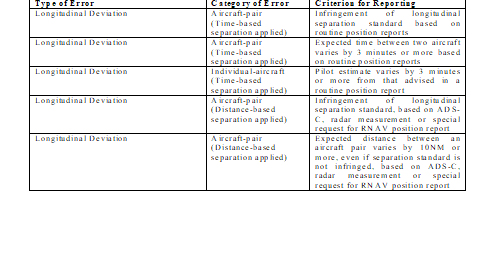
2.5.4
ATC will advise the pilot-in-command when such deviations are observed and implement the required investigation procedures in conjunction with the aircraft operator and State of Registry, or the State of the Operator, as applicable.
2.6
2.6.1
The operator shall ensure that in-flight procedures, crew manuals and training programmes are established in accordance with RNP 10 navigation requirements
2.7
2.7.1
Special procedures for in flight contingencies, in oceanic airspace of Chennai, Kolkata and Mumbai FIR given in AIP India, ENR 1.9 shall be applicable.
2.7.2
Weather deviation procedure- Procedures given in AIP India ENR 1.9 shall be applicable.
3
Establishment of Change over points (COP)
3.1.
COP at the midpoint of route segments defined with reference to VOR in the case of straight routes segments or at the intersection of radials in the case of route segments which change direction between the VOR established, except when
ii) The COPs are otherwise published for the route segments or
iii) Aircraft is not receiving the VOR to which change was intended or
iv) Aircraft has been cleared by ATC to maintain a particular radial from a VOR located on the route segments.
3.2.
1) To cross Bay of Bengal or Arabian sea airspace in Indian FIRs, international operators shall flight-plan one ATS Route only.
2) Unless specifically permitted by the concerned ATS units, route change in oceanic airspace of Chennai/Mumbai/Kolkata FIR is not permitted.
3) Flight-Plan change of ATS routes is permitted over the Indian continental airspace only.
4.
Application of Data Link Services within Chennai, Mumbai, Delhi and Kolkata FIR
4.1.
4.1.1.
Controller Pilot Data link communications (CPDLC) Automatic Dependent Surveillance (ADS) are operational within Chennai, Mumbai, Delhi and Kolkata FIR.
4.1.2.
Data-link services are available to all FANS 1/A equipped aircraft operating in the Chennai, Mumbai, Delhi and Kolkata FIR on H24 basis.
4.1.3.
If no contact on VHF/HF all ADS-C/CPDLC equipped aircraft entering Indian FIR are required to LOGON to appropriate ATS unit at least ten minutes prior to the estimated time before entering Chennai or Delhi or Mumbai or Kolkata FIR. For ADS and CPDLC established aircraft, ADS will be the primary means of Surveillance and CPDLC will be the primary means of communication outside Terminal Control area. VHF/HF will be back up for communication and position reporting.
4.1.4.
The procedures described below are applicable to aircraft utilizing ADS/CPDLC services within Chennai, Mumbai, Delhi and Kolkata FIR. The use of data link services will not affect current procedures for non-data link equipped aircraft operating in the same airspace.
4.2
4.2.1
Controller Pilot Data Link Communications (CPDLC) and Automatic Dependent Surveillance (ADS) data link applications will be used to provide services to FANS 1 (or other format compatible to FANS1) equipped aircraft, over the Bay of Bengal & Arabian Sea oceanic airspace and in particular on ATS rotes B466E, N877, P628, P762, P574, N571, N563, L759, P646, L507, N895, G472, L301, L896, M770/770A and L645 & P518, M300, P570, UL425, UM551, P323, G450, G424, B459, G465, N628, A474 respectively.
4.3
4.3.1
ii) Pilot to Controller down link of position reports and clearance requests
iii) Controller to Pilot up link of ATC clearances and instructions; and
iv) Free text as a supplement to pre-formatted message elements.
4.3.2
Automatic Dependent Surveillance (ADS) supports automatic reporting by the Aircraft Flight Management System (FMS) of aircraft position, intent Information and Meteorological Information (Spot wind and Temperature). The FMS reports the required information in accordance with parameters selected by the ground system. Messages will be transferred by VHF and satellite data links.
4.3.3
4.3.3.1
4.3.3.2
4.3.3.3
4.3.3.4
4.3.4
ADS/CPDLC is integrated with Flight Data Processing system (FDPS) at Chennai, Mumbai, Delhi and Kolkata. To avoid mismatch of data, the flight identification number Used by the pilot in the LOGON process must be identical to the flight Identification number filed in the flight plan.
4.3.5
A LOGON must be received from the aircraft before any data link connection can be initiated by the ground system. This is achieved via the ATS Facility Identification (AFTN) LOGON process to be initiated by the pilot. All ADS-C/CPDLC equipped aircraft entering Indian FIR in oceanic airspace are required to LOGON to VOMF or VABF or VECF ten minutes prior to the estimated time for entering Chennai or Mumbai or Kolkata FIR.
4.3.6
Data Link equipped aircraft departing from aerodromes within the Chennai, Mumbai, Delhi or Kolkata FIR and equipped with Data Link may Logon to appropriate ATS Unit prior to leaving controlled airspace. Pilots unable to establish a Data Link connection are to inform ATC on VHF or HF RTF.
4.3.7
Chennai Area Control Centre frequencies are 118.9MHz/125.7MHz, Chennai Oceanic Control 126.15MHz/ 125.7MHz Chennai Oceanic Control 126.15MHz. HF RTF frequencies are 3470KHz, 6655KHz, 11285KHz, 117907KHz,13318KHz and one VHF frequency124.100Mhz (Chennai Radio).
4.3.8
Kolkata Area Control Centre frequencies are 132.45MHz/120.7MHz/ 120.1 MHz/126.1 MHz/125.9 MHz. HF RTF frequencies are 2947KHz, 10066KHz, 2872KHz, 5580KHz, 6583KHz, 6556KHz, 8861KHz, 8909KHz, 2923KHz, 6484KHz, 3491KHz and 10051KHz.
4.3.9
1) Mumbai Area Control FREQ AVBL 132.7 MHz, 125.35 MHz, 133.85 MHz,133.3 MHz, 120.5 MHz, 133.425 MHz, 133.925 MHz, 127.15 MHz.
2) In Oceanic Airspace of Mumbai FIR, VHF 135.75 MHz AVBL on RTE N519, M638, P518, on RTE L639 upto RITPO, on RTE L301 upto ANKOX and on RTE N571 upto DOGET.
3) In Oceanic Airspace of Mumbai FIR, HF/RT MWARA FREQ AVBL 2872 KHZ, 3467 KHZ, 3476 KHZ, 4675 KHZ, 5601 KHZ, 5658 KHZ, 6661 KHZ, 8879 KHZ, 10018 KHZ, 10084 KHZ and 13288 KHZ.
4) IN Oceanic Airspace of Mumbai FIR, HF / RT RDARA FREQ AVBL 6655 KHZ, 8948 KHZ and 8909 KHZ
4.3.10
All flights entering into Delhi FIR (Excluding Flights from Mumbai or Kolkata FIR) shall forward estimates for FIR boundary including flight level and SSR code atleast 10 minutes prior to entry by use of VHF or HF or ADS-CPDLC. Frequencies of Delhi RADIO are:
1. 10018 KHZ Primary Frequency during day.
2. 5658 KHZ Primary Frequency during night and secondary frequency during day.
4.4
4.4.1
Aircraft that have established data link communications may transmit their Position reports by CPDLC instead of HF RTF. However, SELCAL check is required to verify HFRT connectivity.
4.4.2
In Chennai FIR Remote Controlled Air Ground (RCAG126.15MHz) will be used as primary back up frequency for CPDLC on routes P762 (between LULDA and BIKEN), N571 (Between LAGOG and BIKEN), P628 (Between IGREX and VATLA) and N877 (Between LAGOG and MANPU), Primary and Secondary HF frequencies shall continue to be back up communication for the entire airspace.
4.4.3
In Kolkata FIR Remote controlled Air Ground (RCAG132.45MHz) will be used as primary back up frequency for CPDLC on routes L759 (between LEMEX and LIBDI), N895/G472 (Between “BBS” and SAGOD), P628 (Between LARIK and VATLA) and N877 (Between VVZ and MANPU), L301 (Between VVZ and RINDA), P646 (Between DOPID and IBITA) , M770/770A (Between BUBKO and MEPEL) and L507 (Between ESDOT and TEBOV) Primary and Secondary HF frequencies shall continue to be back up communication for the entire airspace.
4.4.4
In Mumbai FIR Primary and Secondary HF frequencies shall continue to be backup communication for CPDLC.
4.4.5
To ensure the correct synchronization of messages, Controller/pilot dialogues opened by voice must be closed by voice.
4.4.6
Due to inherent integrity checks and a coded reference to any preceding related Message contained within CPDLC messages, a clearance issued by CPDLC requires only the appropriate CPDLC response, not a read back as would be required if the clearance had been issued by voice.
4.4.7
The down link response “WILCO” indicates that the pilot accepts the full terms of the whole up link message.
4.4.8
A down link Response: AFFIRM” is not an acceptable acknowledgement or reply to a CLEARENCE issued by CPDLC.
4.4.9
To avoid ambiguity in message handling and response, a CPDLC down link message should not contain more than one clearance request.
4.4.10
If multiple clearance requests are contained in a single down-link message and the controller cannot approve all requests, the up-link message element “UNABLE” will be sent as a response to the entire message. A separate message containing a response to those requests that can be complied with will be sent by the controller.
4.4.11
If any ambiguity exists as to the intent of a particular message, clarification must be sought by voice.
4.4.12
Standard pre-formatted message elements must be used whenever possible. Free text message should be used only when an appropriate pre-formatted message element does not exist or to supplement the pre/formatted message element. The use of free text should be kept to a minimum.
4.4.13
When CPDLC connection is established, aircraft will be instructed to transfer from voice to CPDLC.
4.4.14
TRANSFER TO CHENNAI Oceanic Control ON DATA LINK (position) MONITOR (VHF 126.15 ALTERATE HF Primary/secondary (Frequencies) Pilots should then down-link a CPDLC POSITION REPORT
TRANSFER TO KOLKATA Control ON DATA LINK (position);
MONITOR (VHF 132.45 / 120.7 ALTERATE HF Primary/secondary (Frequencies) Pilots should then down-link a CPDLC POSITION REPORT
TRANSFER TO MUMBAI Oceanic Control ON DATA LINK (position) MONITOR (HF Primary/secondary (Frequencies))
4.4.15
4.4.15.1
In keeping with the policy "best equipped- best served", Chennai/Mumbai Oceanic Control Centres will accord priority to FANS1-A aircraft logging on to Chennai/Mumbai ADS-C/CPDLC over other aircraft in allocation of preferred cruising level on ATS Routes UL425, M300, N571, P570 and P574.
4.4.15.2
Aircraft equipped with ADS-C/CPDLC are encouraged to LOG-ON while operating on the above mentioned ATS Routes for optimum use of airspace in the bay of Bengal and Arabian sea region.
4.5
4.5.1
For aircraft Inbound to Chennai/Mumbai / Kolkata Terminal Control area (TMA), pilot should disconnect CPDLC after positive VHF voice communication is established with Chennai/Kolkata ACC.
4.5.2
For aircraft existing Chennai FIR, Next Data Authority (NAD) will be notified via CPDLC 30 minutes prior to crossing FIR boundary. Transfer of communication shall be completed at the FIR boundary.
4.5.3
For aircraft existing Chennai FIR, Next Data Authority (NAD) will be notified via CPDLC 20 minutes prior to crossing FIR boundary. Transfer of communication shall be completed at the FIR boundary.
4.5.4
In case the next FIR does not have data link services, CPDLC connections will be terminated at the FIR boundary position.
4.5.5
The CONTACT (unit name) (frequency) message and the END SERVICE message will be sent as separate messages. The END SERVICE message will be send as soon as possible after receipt of the WILCO response to the CONTACT message.
4.6
4.6.1
ADS Periodic contacts will be established automatically on receipt of a LOGON. The periodic reporting rate is 27 minutes.
4.6.2
Aircraft logged on to ADS need not give position report on CPDLC F/VHF outside TMA except at the boundary points.
4.6.3
ADS contracts will be manually terminated by ATC at the FIR boundary.
4.7
4.7.1
Pilots recognizing a failure of a CPDLC connection must immediately establish communications on the appropriate voice frequency. When voice communications have been established, voice must continue to be used as the primary medium until a CPDLC connection has been re-established and the controller has authorized the return to data link.
4.7.2
In the event of an expected CPDLC shutdown, the controller will immediately advise all data link connected aircraft of the failure by voice. Instructions will continue to be issued by voice until the return of the data link system. The return of the system to an operational state will require a new AFN LOGON from the affected aircraft.
4.8
4.8.1
Aircraft planning to utilize data link communications must annotate their ICAO flight plan as follows:
4.8.2
Data Link capability must be notified by inserting the designator “J” in Item 10 (Communication and Navigation Equipment).
4.8.3
The Data Link equipment carried must be notified in item 18 by the use of Prefix “DAT/” followed by one or more letters as follows:
Aircraft registration must be inserted in Item 18 as the ground system uses the information during the AFN LOGON.
4.8.4
Serviceable ADS equipment carried must be annotated on the flight plan by adding the letter “D” to the SSR equipment carried.
4.8.5
For ADS/CPDLC in KOLKATA FIR, all messages to be addressed to VECFZQZX, VECCZPZX, VECCZRZX and should include SSR code assigned to them.
4.8.6
All west bound flights on L301/L301A, N571 and P574 must report PSN at NOBAT, SUGID and BISET respectively to Mumbai Radio in addition to Mumbai Area Control.
4.9
4.9.1
When a system shutdown of the communications network or the CPDLC Ground System is planned, a NOTAM shall be published to inform all affected parties of the shutdown period and if necessary, the details of the voice communication frequencies to be used.
4.9.2
Aircraft currently in communication with the ATC unit shall be informed by voice or CPDLC of any imminent loss of CPDLC service.
4.9.3
The controller and pilot shall be provided with the capability to abort CPDLC.
5.
Application of Strategic Lateral Offset Procedures (SLOP) in Oceanic airspace of Chennai, Kolkata and Mumbai FIR.
5.1
5.1.1
ICAO separation minima, including lateral route spacing, are based on the assumption that aircraft operate on the centreline of a route. In general, unauthorized deviations from this requirement could compromise safety. However, the use of highly accurate navigation systems [such as Global Navigation Satellite System (GNSS)] reduces the magnitude of lateral deviations from the route centreline and consequently increases the probability of a collision if a loss of vertical separation between aircraft on the same route occurs.
5.1.2
By using offsets to provide lateral spacing between aircraft, the effect of reduction in the magnitude of random lateral deviations (which is, of course, due to the increased capability of flights to adhere to the centreline of ATS Routes) can be mitigated, thereby reducing the risk of collision. These guidelines provide information on how such a strategic lateral offset procedure should be implemented.
5.1.3
The Strategic Lateral Offset Procedures [SLOP], as described below are applicable in oceanic airspace in Chennai, Kolkata, and Mumbai FIRs on route segments mentioned in part 3 below. The application of Strategic Lateral Offset Procedures is intended to reduce the risk of collision due to a loss of planned vertical separation.
5.1.4
The Strategic Lateral Offset Procedures described hereunder are being implemented simultaneously by all the States in the Asia / Pacific region to provide for seamless navigational procedures to the airlines.
5.2
5.2.1
The following basic requirements apply to the use of the Strategic Lateral Offset Procedures (SLOP)
i) Strategic Lateral Offset Procedures shall be applied only by aircraft with automatic offset tracking capability.
ii) The decision to apply a strategic lateral offset is the responsibility of the flight crew.
iii) The offset shall be established at a distance of one or two nautical miles to the RIGHT of the centerline of the ATS route relative to the direction of flight.
iv) The offsets shall not exceed 2 NM right of centerline of the ATS route.
v) The strategic lateral offset procedure has been designed to include offsets to mitigate the effects of wake turbulence of preceding aircraft. If wake turbulence needs to be avoided, one of the three available options (centerline, 1NM or 2NM right offset) shall be used.
vi) In airspace where the use of lateral offsets has been authorized, pilots are not required to inform Air Traffic Control (ATC) that an offset is being applied.
vii) Aircraft transiting areas of radar coverage in airspace where offset tracking is permitted may initiate or continue an offset.
viii) Aircraft without automatic offset tracking capability must fly the centerline of the ATS Route being flown.
5.3.
ATS Route segments in Oceanic airspace where SLOP is applied
5.3.1.
The segments of ATS Routes in Bay of Bengal and Arabian Sea area, where Strategic Lateral OffsetProcedure is applicable are identified below. However for Air Traffic Control purposes the appropriate ATC unit may cancel the offset.