1.
|
Introduction
|
1.1.
|
Surveillance control procedures will be used by ATC in preference to non-surveillance control procedures whenever ATS or the aircraft served will gain operational advantage
|
|
|
1.2.
|
GENERAL PROVISIONS
|
|
ATS surveillance systems, such as
|
|
-primary surveillance radar (PSR),
|
|
-secondary surveillance radar (SSR),
|
|
-ADS-B and
|
|
-MLAT
|
|
system may be used either alone or in combination in the provision of air traffic services, including in the provision of separation between aircraft, provided:
|
|
a) reliable coverage exists in the area;
|
|
b) The probability of detection, the accuracy and the integrity of the ATS surveillance system(s) are satisfactory; and
|
|
c) In the case of ADS-B, the availability of data from participating aircraft is adequate.
|
1.3.
|
The following types of surveillance services may be provided to aircraft operating within reliable surveillance coverage
|
|
i) surveillance control service - for aircraft operating within Class D and E airspace
|
|
ii) surveillance advisory service - for aircraft operating within Class F airspace
|
|
iii) surveillance flight information service - for identified aircraft operating in any part of FIR
|
1.4.
|
The provision of any of the above types of surveillance service requires that aircraft remain in direct two-way communication with the unit providing the service. However, radar separation may be provided between two radar identified aircraft even when only one of the aircraft is in direct communication with the surveillance unit.
|
|
|
1.5.
|
In the event of an aircraft in or appearing to be in, any form of emergency ATC will provide all possible assistance, including the provisions of surveillance service to the extent possible.
|
|
|
2.
|
Use of surveillance system in air traffic control service
|
2.1.
|
The information presented on a surveillance display may be used to perform the following functions in the provision of air traffic control service.
|
2.1.1.
|
Provide of surveillance service to
|
|
i) Improve airspace utilization
|
|
ii) Reduce delays
|
|
iii) Enhance safety
|
|
|
2.1.2.
|
Provide surveillance vectoring to
|
|
i) Departing aircraft for expeditious and efficient departure flow and expediting climb to cruising level
|
|
ii) Arriving aircraft for the purpose of expediting descent from cruising level and establishing an expeditious and efficient approach sequence
|
|
iii) Aircraft for the purpose of resolving potential conflict
|
|
iv) Assist pilot in their navigation
|
2.1.3.
|
Provide separation and maintain normal flow when an aircraft is experiencing communication failure is within area of surveillance coverage
|
2.1.4.
|
Maintain surveillance monitoring of traffic
|
2.1.5.
|
Monitor the progress of air traffic in order to
|
|
i) Obtain improved position information regarding aircraft under control
|
|
ii) Obtain supplementary information regarding other traffic
|
|
iii) Detect significant deviations by aircraft from their assigned routings or level.
|
|
NOTE
|
|
To be considered ‘significant’ an aircraft’s track deviations should be sufficient to take it beyond the boundary of the route being followed or be assessed by the radar controller as liable to take it beyond the edge of the protected airspace of the route being flown.
|
3.
|
Use of SSR without primary radar
|
3.1.
|
Secondary Surveillance Radar (SSR) information may be used alone in the provision of separation between aircraft provided; aircraft identification is established and maintained by use of discrete SSR codes.
|
|
|
3.2.
|
Non-radar separation will be applied between transponder equipped aircraft and an aircraft without SSR transponder or with a non-functioning SSR transponder.
|
|
|
3.3.
|
In the event of an aircraft transponder failure or ATC determining that transponder does not meet serviceability requirements, the aircraft (for whom carriage of transponder is mandatory) will normally be permitted to continue to operate to the next point of landing.
|
|
|
3.4.
|
An aircraft (for whom carriage of transponder is mandatory) whose transponder failure is detected before departure may be specifically authorised by ATC to operate without serviceable transponder provided; a request is included in the flight plan.
|
|
|
4.
|
Identification of Aircraft
|
4.1.
|
Before providing surveillance service to an aircraft, identification shall be established by one of the method in Doc 4444-PANS-ATM, Chapter 4 and the pilot so informed. If identification is subsequently lost, the pilot shall be informed accordingly and instructions will be issued so as to restore non-surveillance separation.
|
|
|
5.
|
Terrain clearance
|
5.1.
|
When vectoring IFR flights, the radar controller shall ensure adequate terrain clearance until the aircraft reaches the point when the pilot resumes his own navigation.
|
|
|
5.2
|
When ATC provides surveillance vectors to a VFR flight, the pilot retains responsibility for terrain clearance.
|
|
|
6.
|
Information regarding adverse weather
|
6.1.
|
Modern ATC radar sensors and processors are normally designed to suppress weather clutter. Even the most active areas of adverse weather may not show on radar display. An aircraft’s weather radar will normally provide better detection and definition of adverse weather the radar sensors in use by ATC.
|
|
|
6.2.
|
If, however, weather is observed that appears likely to affect the flight, the surveillance controller may pass this information to the pilot.
|
|
|
6.3.
|
If an aircraft is equipped with weather radar and the pilot intends to circumnavigate the adverse weather area observed on his radar display, he should intimate and obtain clearance from radar controller for his proposed action. This is necessary to ensure that separation which the radar controller may be providing to any other aircraft is not jeopardized.
|
|
|
7.
|
Separation minima based on ATS surveillance systems
|
7.1.
|
Separation based on the use of ADS-B, SSR and/or MLAT, and/or PSR position symbol shall be applied so that the distance between the centres of the position symbols representing the positions of the aircraft concerned, is never less than a prescribed minimum
|
7.2.
|
Traffic separation will be based to a large degree on surveillance separation within the airspace under surveillance coverage
|
7.3.
|
In the event that the controller has been notified of a controlled flight entering or about to enter the airspace within which separation minima specified in 7.5 is applied, but has not identified the aircraft, the controller may continue to provide ATS surveillance service to identified aircraft provided that:
|
7.3.1.
|
Reasonable assurance exists that the unidentified controlled flight will be identified using SSR and/or ADS-B and/or MLAT or the flight is being operated by an aircraft of a type which may be expected to give an adequate return on primary radar in the airspace within which the separation is applied; and
|
7.3.2.
|
The separation is maintained between identified flights and any other observed ATS surveillance position indications until either the unidentified controlled flight has been identified or procedural separation has been established
|
7.4.
|
Procedural separation minima will be applied
|
|
i) In the event of surveillance failure
|
|
ii) In the area outside the surveillance coverage
|
|
iii) To aircraft leaving surveillance coverage or entering adjacent FIR except where surveillance transfer is effected.
|
|
|
7.5.
|
The following horizontal separation minima based on Radar and/or ADS-B and/or MLAT systems shall be applied as follows:
|
7.5.1.
|
Five nautical miles (5 NM) within airspace under surveillance coverage.
|
7.5.2.
|
Three nautical miles (3 NM) within airspace, specifically authorized, as follows:
|
7.5.2.1..
|
Delhi Radar
Three Nautical Miles (3 NM) surveillance based separation at or below FL 140 within 60 NM of DPN subject to availability of ASR. In case ASR is not available, the separation minima shall be 5 NM.
|
7.5.2.2.
|
Mumbai Radar
Radar separation minima of three Nautical Miles (3 NM) applicable within 40 NM of Mumbai ASR/MSSR head. Lower Limit: GND
Upper Limit: F140.
|
|
7.5.2.3.
|
Bengaluru Radar
Radar Separation Minima Of Three Nautical Miles (3 NM) applicable within 30 NM of Bengaluru ASR/MSSR head.
Lower Limit: GND,
Upper Limit: F140
|
7.5.2.4.
|
Shamshabad Radar
Radar Separation Minima Of Three Nautical Miles (3 NM) applicable within 40 NM of Shamshabad ASR/MSSR Head.
Lower Limit: GND
Upper Limit: F 140.
|
7.5.2.5.
|
Kolkata Radar
Three Nautical Miles (3 NM) surveillance based separation within 30 NM of KOLKATA ARP (223914N0882648E) subject to availability of follows:
1. ELDIS PSR/MSSR radar at Kolkata
2. INDRA MSSR Radar at Badu or ADS-B at Kolkata.
Lower Limit: GND
Upper Limit: F140
|
7.5.2.6
|
Chennai Radar
Radar Separation Minima Of Three Nautical Miles (3 NM) applicable within 40 NM of Chennai Radar Head.
Lower Limit: GND
Upper Limit: F 140.
|
7.5.3.
|
Where ADS-B and /or MLAT is/are used in combination with Radar the horizontal separation minima applicable will be same as applicable to the separation based on RADAR.
|
7.5.4.
|
Where MLAT is used alone the horizontal separation minima applicable will be as notified/prescribed before its implementation.
|
7.6.
|
Wake turbulence Radar separation minima shall be applied to aircraft in the approach and departure phases of flight as prescribed in Doc 4444-PANS-ATM, Chapter 8.
The distance based wake turbulence separation minima as given in Table (below) shall be applied to aircraft being provided with an ATS surveillance service in the approach and departure phases of flight in the following circumstances
|
|
i) an aircraft is operating directly behind another aircraft at the same altitude or less than 1000 ft below; or
|
|
ii) both aircraft are using the same runway, or parallel runways separated by less
than 760 m or
|
|
iii) an aircraft is crossing behind another aircraft, at the same altitude or less than
1000 ft below.
|
|
|
7.7.
|
Separation minima specified in 7.5 shall not be applied between aircraft holding over the same holding points. When applying Radar separation between holding aircraft and other flights, the controller shall maintain identity of the holding aircraft for the provision of separation minima based on radar and/or ADS-B and/or MLAT to other flights. No doubt shall exist about the identity of holding aircraft for any reason when such separation is applied. The controller shall also keep in mind the likely maneuvers of the holding aircraft during application of such separation.
|
|
|
8.
|
Speed control procedures
|
8.1.
|
In order to facilitate safe and orderly flow of arriving air traffic within terminal area where surveillance based approach control service have been established, aircraft shall follow the speed in specified manner as provided in Annexure-I.
|
|
|
8.2.
|
The speed control is applied for ATC separation purposes and is mandatory in the interest of acquiring accurate spacing.
|
|
|
8.3.
|
Speed control is also necessary to achieve the desired separation minimum or spacing between the successive arrivals. This in turn would improve the utilization of airspace and enhance the runway capacity to handle more number of aircraft.
|
|
|
8.4.
|
The flight crew should be aware of the provisions specified in Annexure-I and plan the aircraft speed accordingly.
|
|
|
8.5.
|
All the speed restrictions shall be complied with as promptly as feasible and flown as accurately as possible within the limits of operational constraints.
|
|
|
8.6.
|
Aircraft unable to comply with the specified speeds must inform ATC and report minimum speed it is able to follow. In such cases controller shall apply the alternative method to achieve the desired spacing between aircraft concerned.
|
|
|
8.7.
|
The speeds specified in Annexure-I are within the limits of turboprops and turbojets aircraft performance based on the ICAO recommendations and best international practices and therefore should be acceptable. However, it is the pilot’s responsibility and prerogative to refuse speed restrictions that are considered excessive or contrary to the aircraft operating specifications.
|
|
|
8.8.
|
Radar controller may remove an aircraft from the sequence for repositioning if it is observed that aircraft concerned is not following the speed restrictions in the specified manner and closingin with preceding aircraft or slowing down unnecessarily thus disrupting the traffic flow.
|
|
|
8.9.
|
Speed control shall not be applicable to aircraft:
|
|
i. entering or established in holding pattern;
|
|
ii. encountering the turbulent weather;
|
|
iii. conducting the Cat II/III operations and within 20NM from touch-down;
|
|
iv. within 5NM from touch-down;
|
|
v. executing the published instrument approach procedure until interception of final approach track;
|
|
vi. carrying VVIP and
|
|
vii. conducting priority/emergency landing.
|
|
|
8.10.
|
Aircraft shall be advised as and when speed control restriction is not applicable or no longer required.
|
|
|
8.11.
|
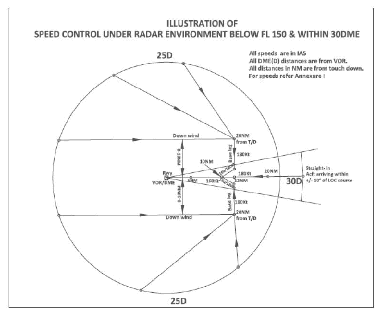
Pictorial depiction of speed specifications within 30DME and below FL150 is provided at Annexure-II.
|
|
|
8.12.
|
While applying the speed control, the following information is provided as an additional information for controllers and pilots:
|
|
i. Speed adjustments are not achieved instantaneously. Aircraft configurations, altitude and speed determine the time and distance to accomplish the adjustments.
|
|
ii. Speed control shall not be assigned to an aircraft at or above FL 390 without pilot’s consent.
|
|
iii. Speed control should be expressed in multiples of 10 kt based on indicated airspeed (IAS). At or above F250 the adjustments should be expressed in multiples of 0.01 Mach.
|
|
iv. For the same indicated air speed (IAS), the true speed of aircraft will vary with altitude. A table representing indicated air speed vs. true air speed at different altitude is provided at Annexure-III. Radar controllers must be aware of speed differentials between IAS and TAS.
|
|
v. Simultaneous speed reduction and descent can be extremely difficult, particularly for turbojet aircraft. It may be necessary for the pilot to level off temporarily and reduce speed prior to descending below 10000 ft AMSL.
|
|
vi. Arriving aircraft would prefer to fly in clean configuration for as long as circumstances permit.Below 10000 ft AMSL, speed not less than 210Kt IAS is considered as minimum speed of turbojet aircraft in clean configuration.
|
|
vii. Speed adjustments requiring alternate decrease and increase shall be avoided particularly after the aircraft has reduced the speed below 210kt. In such cases the Phraseology”, No ATC speed restriction”, or “Resume normal speed” shall only be used.
|
|
|
8.13.
|
Speed Minima:
|
|
Refer Annexure-I & Annexure-II.
|
|
|
8.14.
|
Runway Occupancy: The spacing provided between aircraft is designed to achieve maximum runway utilization within the parameters of safe separation minima (including wake turbulence separation) and runway occupancy. It is important that runway occupancy time is kept to a minimum, consistent with the prevailing conditions, for the validity of the separations provided and to achieve optimum runway capacity.
|
|
|
|
Following Table may be considered as updated on SSR code assignment
|
9.
|
Termination of surveillance service
|
9.1.
|
An aircraft which has been informed that it is provided with radar service should be informed immediately when for any reason radar service is interrupted or terminated.
|
|
|
9.2.
|
Surveillance service is automatically terminated when an arriving aircraft receiving radar service has been instructed to contact tower frequency. Position of aircraft from touchdown should be given to the aircraft before changing over the aircraft to tower.
|
|
|
10.
|
Collision hazard
|
10.1.
|
Identified controlled flight in controlled airspace
|
10.2.
|
Identified IFR flight outside controlled airspace
|
10.2.1.
|
When an identified IFR flight operating outside controlled airspace is observed to be on a conflicting path with another aircraft, the identified aircraft will be advised of the need for collision avoidance. If so requested by the pilot or if in the opinion of the radar controller the situation warrants, a course of avoiding action will be suggested.
|
10.2.2.
|
The pilot shall be notified when the conflict no longer exists.
|
10.3.
|
In both the cases mentioned in para 10.2.1 and 10.2.2 above, the decision whether to comply with ATC suggestion or not rests solely with the pilot.
|
|
|
11.
|
ATS surveillance system failure
|
11.1.
|
In the event of ATS surveillance system failure, instructions will be issued to restore non-surveillance separation.
|
|
|
11.2.
|
If non-surveillance separation cannot be provided immediately, an emergency separation of half the applicable
vertical separation minimum may be used, i.e. 500 Ft between aircraft in airspace where a vertical separation of 1000 Ft is applied and 1000 Ft between aircraft in airspace where a 2000 Ft vertical separation minimum is applied.
|
|
|
12.
|
Communication failure procedure
|
12.1.
|
If two-way communication is lost with an aircraft, the surveillance controller will try to determine whether or not the aircraft’s receiver is functioning by
|
|
i) Instructing the aircraft to acknowledge by making specific maneuver(s)
|
|
ii) Instructing the aircraft to operate SPI feature (i.e. Squawk Ident) or to make SSR mode A3 code changes
|
|
NOTE
|
|
A transponder equipped aircraft experiencing radio communication failure should operate its transponder on mode A3 code 7600.
|
|
|
12.2.
|
If it is established that the aircraft’s radio receiver is functioning, the controller shall continue to provide radar service to the aircraft.
|
|
|
12.3.
|
In the event of complete radio communication failure, radar separation shall continue to be applied between other aircraft under radar control and RCF aircraft.
|
|
|
13.
|
Procedures for operation of SSR transponder codes
|
13.1.
|
All aircraft carrying serviceable transponder shall operate the transponder at all times during flight within Chennai, Delhi, Guwahati, Kolkata and Mumbai FIR regardless of whether the aircraft is within or outside airspace where SSR is used for ATS.
|
|
|
13.2.
|
Operating procedures
|
13.2.1.
|
Except as provided in para 13.3,13.4 and 13.5 below, pilots shall operate transponders and select modes and codes in accordance with the following procedures
|
|
i) Aircraft departing from an aerodrome located in Chennai, Delhi, Kolkata and Mumbai FIR shall be assigned an appropriate SSR code on departure. This SSR code setting shall continue unless instructed otherwise.
|
|
ii) Aircraft engaged in international flight, entering Chennai, Delhi, Kolkata and Mumbai FIR shall continue to maintain SSR code being squawked in the adjacent FIR. This SSR code setting shall be included in the first position report prior to entering the FIR.
|
|
iii) Aircraft engaged in domestic flight shall operate the transponder on the last assigned code.
|
|
iv) Flight crew of aircraft equipped with mode S having an aircraft Identification feature shall set the aircraft identification in the transponder. This setting shall correspond to the aircraft identification specified in item 7 of the ICAO flight plan, or, if no flight plan has been filed, the aircraft registration.
|
13.3.
|
Emergency procedure
|
13.3.1.
|
An aircraft encountering a state of emergency may continue to operate the transponder on the previously assigned code, until otherwise advised. Alternatively the transponder shall be set to mode A3 code 7700/ transmit appropriate ADS-B emergency and/or urgency mode
|
13.3.2.
|
Not withstanding the procedure in 13.2.1 above, a pilot may select mode A3 code 7700/transmit appropriate ADS-B emergency and/or urgency mode whenever the emergency is such that this appears to be the most suitable course of action.
|
13.4.
|
Radio communication failure
|
13.4.1.
|
In the event of an aircraft radio receiver failure, a pilot shall select mode A3 Code 7600/transmit appropriate ADS-B emergency and/or urgency mode and follow established procedure; subsequent control of aircraft will be based on those procedures.
|
|
|
13.5.
|
Unlawful interference
|
|
|
13.5.1.
|
Should an aircraft in flight be subjected to unlawful interference, the pilot shall endeavor to set the transponder
to mode A3 code 7500/ transmit appropriate ADS-B emergency and/or urgency mode and to give indication of the situation unless circumstances warrant the use of mode A3 code 7700/ transmit appropriate ADS-B emergency and/or urgency mode.
|
|
|
13.5.2.
|
When a pilot has selected mode A3 code 7500/ transmitted appropriate ADS-B emergency and/or urgency mode and subsequently requested to confirm his code by ATC he shall, according to circumstances either confirm this or not reply at all.
|
|
NOTE
|
|
The absence of a reply from the pilot will be taken by ATC as an indication that the use of code 7500 transmitted appropriate ADS-B emergency and/or urgency mode is not due to an inadvertent false code selection.
|
|
|
13.6.
|
Verification of accuracy of mode C derived level information/ADS-B altitude data transmission
|
|
|
13.6.1.
|
All aircraft must report the level/altitude maintaining/passing on first contact with a radar unit to facilitate verification of Mode C altitude information/ ADS-B altitude data transmission
|
|
|
13.6.2.
|
Verification of the accuracy of SSR derived altitude/ ADS-B altitude data transmission information displayed to the controller shall be effected at least once by each suitably equipped ATC unit on initial contact with the aircraft concerned or, if this is not feasible, as soon as possible thereafter. This verification shall be effected by simultaneous comparison with altimeter derived level information received from the specific aircraft by radio telephony. The pilot if the aircraft whose Mode C derived/ ADS-B altitude data transmission information is within the approved tolerance value will not be advised of such verification.
|
|
|
13.6.3.
|
If the displayed information is not within the approved tolerance value, or when a discrepancy in excess of the approved tolerance value is detected subsequent to verification, the pilot will be advised and requested to check his pressure setting and confirm his level.
|
|
|
13.6.4.
|
If, following confirmation of level and correct pressure setting, the discrepancy continues to exist the controller may request the pilot to stop his Mode C transmission. The phraseology used will be ‘Stop SQUAWK CHARLIE. WRONG INDICATION”/STOP ADS-B altitude data transmission (wrong indication)
|
|
|
13.7.
|
Code Assignment
|
13.7.1.
|
Aircraft operating in Indian airspace will be assigned codes as follows
|
|
i) Aircraft not assigned a SSR code shall operate transponder on mode A3 code 2000 before entry into Chennai, Delhi, Kolkata and Mumbai FIR and maintain that code setting until otherwise instructed.
|
|
|
|
Following Table may be considered as updated on SSR code assignment
|
|
14.3
|
Automatic Dependent Surveillance-Broadcast (ADS-B)
ADS-B are provided at the following locations with maximum range up to 250NM:
|
|
|
Jaipur
Amritsar
Jaisalmer
Lucknow
Mumbai
Mumbai (Space based)
Ahmedabad
Nagpur
Bhubaneswar
Bangalore
Shamshabad
Jabalpur
Bikaner
|
Patna
Varanasi
Agartala
Guwahati
Dibrugarh
Calicut
Cochin
Aurangabad
Kadapa
Raipur
Mopa Goa
Coimbatore
|
Mangalore
Thiruvananthapuram
Sri Vijaya Puram
Tiruchirappalli
Vijayawada
Indore
Mithapur
Kolkata
Kolkata (Space based
Ranchi
Kalaburagi
Chennai
Chennai (Space based)
|
|
|
|
15
|
AUTOMATIC DEPENDENT SURVEILLANCE - BROADCAST (ADS-B) OUT BASED ATS SURVEILLANCE SERVICES
|
|
15.1
|
INTRODUCTION
|
|
15.1.1
|
ADS-B avionics enables an aircraft to broadcast its position information derived from GNSS, its identity, velocity and other information with a high degree of accuracy and integrity. ADS-B ground stations receive the information transmitted by an ADS-B equipped aircraft and distributes the received ADS-B data to ATS Surveillance systems. The ADS-B data sent by the ground receivers are processed by ATS Surveillance systems and presented to the Air Traffic Controllers as exclusive ADS B information or as integrated surveillance information thereby providing enhanced situational awareness to the Air Traffic Controllers.
|
|
15.1.2
|
India recognizes the ADS-B avionics as an enabler of the global ATM concept bringing substantial safety & capacity benefits and supports the cost-effective early implementation of it in line with ICAO Asia Pacific Air Navigation Planning and Implementation Regional Group (APANPIRG) Conclusion 19/37 and Conclusion 21/39. India plans to introduce ADS-B for the provision of Air Traffic Services, including ‘radar-like’ separation in a phased manner. The Automatic Dependent Surveillance Broadcast “(ADS-B) OUT” transmissions on 1090MHz Extended Squitter data link will be used for provision of ATS surveillance services to eligible aircraft within notified portions of Indian airspace(s).
|
|
15.1.3
|
The ADS-B Out implementation in India is aimed at providing redundancy where Radar surveillance is already available. In addition, ADS-B Out enables the expansion of Air Traffic Control (ATC) surveillance services in remote & high terrain areas, oceanic airspace and also to fill the surveillance gap over the Continental airspace.
|
|
15.1.4
|
The combined surveillance information of ADS-B and RADARs provides continent wide line of sight surveillance coverage above 29000 feet and significant coverage at lower levels. In addition, reliable line of sight surveillance coverage up to 250NM from each of the ADS-B ground stations is available
|
|
15.1.5
|
The ADS-B ground receivers have two sensors at each ground station to provide redundancy and a higher level of availability.
|
|
15.1.6
|
The ATS Surveillance services to be provided by an ATC Center, within a notified volume of airspace under its control and jurisdiction, based on ADS-B surveillance information from the ADS-B ground stations certified by the regulator, shall be notified through G- Series NOTAM.
|
|
15.1.7
|
All aircraft flying on PBN Routes in Indian continental airspace with Designators L, M, N, P. Q, T and routes A201, A347, A465. A474, A791, B211, B466. G450, R457, R460, R461, W15, W19, W20, W29, W41, W43, W45, W47, W56S/N, W67, W111, W112, W114, W115, W118, W153, at or above Flight Level 290 must carry serviceable 1090 MHz ES ADS-B transmitting equipment that has been certified as meeting the requirements mentioned in paragraph 3.0.
|
|
15.1.8
|
Aircraft not equipped with ADS-B would be permitted to fly on these routes below Flight level 290
|
|
15.1.9
|
For all aircraft flying within the designated Indian continental airspace as referred at para 15.1.7, equipped with ADS-B equipages not complying with paragraph 15.2, the ADS-B equipages shall be:
i.deactivated, or
ii.Set to transmit only a value of zero for the Navigation Uncertainty Category (NUCp) or Navigation Integrity Category (NIC) or Navigation Accuracy Category (NAC) or Source Integrity Level (SIL)
|
|
15.2
|
ADS-B AVIONICS EQUIPAGE CERTIFICATION REQUIREMENTS AND AIRCRAFT OPERATIONAL APPROVAL
|
|
15.2.1
|
The aircraft must carry serviceable 1090 MHz ES ADS-B transmitting equipment that has been certified as meeting:
i.European Aviation Safety Agency - Certification Considerations for the Enhanced ATS in Non Radar Areas using ADS-B Surveillance (ADS-B-NRA) Application via 1090 MHZ Extended Squitter (AMC 20-24), or
ii.European Aviation Safety' Agency - Certification Specifications and Acceptable Means of Compliance for Airborne Communications, Navigation and Surveillance (CS-ACNS) Subpart D - Surveillance (SUR) (CS-ACNS.D.ADS-B), or
iii.Federal Aviation Administration - Advisory Circular No: 20-165A (or later versions) Airworthiness Approval of Automatic Dependent Surveillance - Broadcast (ADS-B) Out Systems, or
iv. The equipment configuration standards in Appendix XI of Civil Aviation Order 20.18 of the Civil Aviation Safety Authority of Australia.
(Note1: The avionics equipage certification requirements specified herein supersedes the specifications notified vide. Para 15.7.1 and DGCA operational Circular No. 17/2014.)
|
|
15.2.2
|
For Indian Operators, Airworthiness and Operational approval will be in accordance with the provisions of Civil Aviation Requirement Section 8 (Aircraft Operation), Series S, Part V, Issue 1, 25th Nov, 2014 and Operational Circular No. 17/2014.
|
|
15.2.3
|
Aircraft not complying with requirements specified in paragraph 15.2.1 will not be normally permitted to operate in the designated airspace and flight level assignments would be subjected to air traffic conditions.
|
|
15.3
|
FLIGHT PLANNING REQUIREMENTS
|
|
15.3.1
|
Aircraft operators complying with the requirement stipulated in paragraph 15.2.1 shall indicate the appropriate ADS-B designator in item 10 of the flight plan.
i. B1 ADS-B with dedicated 1090 MHz ADS-B "out" capability
ii. B2 ADS-B with dedicated 1090 MHz ADS-B "out" and "in" capability.
|
|
15.3.2
|
The aircraft identification (ACID) must be accurately recorded in item 7 of the ICAO Flight Plan form. The Aircraft Identification, not exceeding 7 characters, is to be entered both in item 7 of the flight plan and replicated exactly when set in the aircraft FMS (for transmission as Flight ID) in ADS-B transmissions as follows:
Either,
i. The ICAO three-letter designator for the aircraft operating agency followed by the flight identification (e.g. KLM511, BAW213, JAI25),
or,
ii. The registration marking of the aircraft (e.g. VTAKO, 4XBCD, OOTEK), when the call sign used in radiotelephony consists of the registration marking alone (e.g. VTAKO), or preceded by the ICAO telephony designator for the operating agency (e.g. AIR INDIA VTAKO),
Note 2: No zeros, hyphens, dashes or spaces are to be added when the Aircraft Identification consists of less than 7 characters.
|
|
15.4
|
IN-FLIGHT CONTINGENCIES
|
|
15.4.1
|
The pilot-in-command, upon being aware of an onboard ADS-B equipment failure, must inform ATC as soon as possible. ATC would then provide the necessary clearance to ensure separation with other flights operating on the specified ATS routes.
|
|
15.5
|
USE OF ADS-B IN THE PROVISION OF SURVEILLANCE SERVICES
|
|
15.5.1
|
ADS-B shall only be used for the provision of air traffic control service provided the quality of the information contained in the ADS-B message exceeds the values specified (p or greater) by the appropriate ATS Authority (PANS-ATM 8.1.10) and provided further:
i. reliable coverage exists in the area;
ii. the probability of detection, the accuracy and the integrity of the ATS surveillance system(s) are satisfactory; and
iii. the availability of ADS-B data from participating aircraft is adequate.
Note: In India, ADS-B information shall be used for the provision of Air Traffic Surveillance Services, provided the NUCp is equal to 5 or greater, subject to other conditions specified above.
|
|
15.5.2
|
ADS-B may be used exclusively in the provision of separation between aircraft provided:
i. identification of ADS-B i. equipped aircraft is established and maintained;
ii. the data integrity measure in the ADS-B message is adequate to support the separation minimum;
iii. there is no requirement for detection of aircraft not transmitting ADS-B; and
iv. there is no requirement for determination of aircraft position independent of the position determining elements of the aircraft navigation system.
|
|
15.6
|
surveillance separation minima
|
|
|
The horizontal separation minimum based on ADS-B shall be as is applicable in the case of radar
i. 5NM within 60 NM of ADS-B ground station i.e. in the terminal airspace served by the ADS-B receiver.
ii. 10NM beyond 60NM of ground station i.e. in the en route airspace
Note 1:An assessment of the use of ADS-B for the application of 9.3 km (5.0 NM) separation minimum has been performed based on a comparison of the technical characteristics of ADS-B and a single monopulse SSR. This comparison, including performance values, is contained in the Assessment of ADS-B to Support Air Traffic Services and Guidelines for Implementation (ICAO Cir 311/ICAO Cir 326).
Note 2:Local assessment(s) for integrity of data is being carried out at all ground stations prior to the application of the separation minimum based on ADS-B.
|
|
15.7
|
AIRCRAFT OPERATIONAL APPROVAL
|
|
15.7.1
|
ADS-B Out transmitting equipment should be of an approved type meeting the specifications contained in Annex 10 (Volume IV) to the convention on International Civil Aviation or that has been certified as meeting
i. the current version of FAA AC No. 20-165 - Airworthiness Approval of ADS-B or
ii. EASA AMC 20-24, or
iii. the equipment configuration standards in Appendix XI of Civil Aviation Order 20.18 of the Civil Aviation Safety Authority of Australia dated 23rd August 2012 and any amendment thereof.
|
|
15.7.2
|
The aircraft operator must have the relevant operational approval from the State of Registry.
|
|
15.8
|
FLIGHT PLANNING REQUIREMENTS
|
|
15.8.1
|
Surveillance Equipment
|
|
|
When an aircraft is equipped with a mode S transponder, that transmits ADS-B messages, an appropriate Mode S designator should be entered in field 10b; i.e.:
i. Either, E Transponder -- Mode S, including aircraft identification, pressure
altitude and extended Squitter (ADS-B) capability,
or
ii. L Transponder -- Mode S, including aircraft identification, pressure-altitude, extended Squitter (ADS-B) and enhanced surveillance capability.
An appropriate ADS-B designator shall be entered in section 10 of the flight plan to indicate that the flight is capable of transmitting ADS-B messages. For information, these include:
i. B1- ADS-B with dedicated 1090 MHz ADS-B “out” capability
ii. B2- ADS-B with dedicated 1090 MHz ADS-B “out” and “in” capability
Note: V DL Mode 4 and UAT not supported at present
|
|
15.8.2
|
Flight Identity
|
|
|
The aircraft identification (ACID) must be accurately recorded in section 7 of the ICAO Flight Plan form. Aircraft Identification, not exceeding 7 characters is to be enteredboth in item 7 of the flight plan and replicated exactly when set in the aircraft FMS (for transmission as Flight ID) in ADS-B transmissions as follows:
i. Either, the ICAO three-letter designator for the aircraft operating agency followed by the flight identification (e.g. AIC511, BAW213, and JAI25), when in radiotelephony the call sign used consists of the ICAO telephony designator
for the operating agency followed by the flight identification (e.g. AIR INDIA FIVE ONE ONE, SPEEDBIRD TWO ONE THREE, JET AIRWAYS TWO FIVE).
Or
ii. The registration marking of the aircraft (e.g. VTAKO, 4XBCD, OOTEK), when in radiotelephony the call sign used consists of the registration marking alone (e.g. VICTOR TANGO ALPHA KILO OSCAR), or preceded by the ICAO
telephony designator for the operating agency (e.g. AIR INDIA VICTOR TANGO ALPHA KILO OSCAR),
Note: No zeros, dashes or spaces are to be added when the Aircraft Identification consists of less than 7 characters.
|
|
15.8.3
|
Aircraft Address (24 Bit Code)
|
|
|
The aircraft address (in hexadecimal format) may, but is NOT required, to be recorded in field 18 of the ICAO flight plan as per the following example:
CODE/80039A
The Unique aircraft address expressed in Hexadecimal form provides a digital identification of the aircraft and facilitates Air Traffic System to correlate the ADS-B track data with flight plan data in the absence of down linked flight ID.
|
|
15.9
|
FLIGHT CREW PROCEDURES
|
|
15.9.1
|
The flight crew shall adhere to the regulatory requirements pertaining to ADS-B issued from time to time.
|
|
15.9.2
|
The flight crew, on initial radiotelephony contact, or through CPDLC, where appropriate, shall inform the status of the aircraft’s ADS-B operational approval to the ATC Unit(s) which have notified (Refer 15.1.6) the provision of ATS Surveillance Services, based on ADS-B information, in airspace(s) under their jurisdiction and control..
|
|
15.9.3
|
The flight crew shall be aware that since GNSS provides the position information element of ADS-B, the action of turning the GNSS receiver off, will result in the aircraft becoming invisible to ADS-B surveillance. ADS-B equipment can have various pilot interfaces, ranging from a simple on/off switch for the transmitter to a pilot control interface with advanced features such as a cockpit display of traffic information. It may also be combined with other systems, such as an SSR transponder, TCAS or Multifunction display (MFD). It is therefore important that the crew be aware that if
the SSR transponder controls are linked to the ADS-B transmitter, operating one system may only be possible by operating both systems.
|
|
15.9.4
|
If an aircraft operates within an Indian FIR where ADS-B based ATS Surveillance service is provided, and a. carries 1090 extended squitter ADS-B transmitting equipment which does not comply with one of the following:
i. EASA AMC 20-24; or
ii. the equipment configuration standards in Appendix XI of Civil Aviation Order 20.18 of the Civil Aviation Safety Authority of Australia dated 23rd August 2012 and any amendment thereof.; or
iii. with the current version of FAA AC No. 20-165 - Airworthiness Approval of ADS-B;
or
b. the aircraft ADS-B transmitting equipment becomes unserviceable resulting in the aircraft transmitting misleading information; then, except when specifically authorized by the appropriate ATS authority, the aircraft shall not fly unless the equipment is:
i. deactivated;
or
ii. transmits only a value of zero for any one of the following :
a. NUCp (Navigation Uncertainty Category - Position) or
b. NIC (Navigation Integrity Category)
(Refer DOC 7030- Regional Supplementary Procedures, Asia Pacific)
|
|
15.10
|
EMERGENCY PROCEDURES
|
|
15.10.1
|
To indicate that an aircraft is in a state of emergency or to transmit other urgent information, an aircraft equipped with ADS-B might operate the emergency and/or urgency mode as follows:
i. emergency;
ii. communication failure;
iii. unlawful interference;
iv. minimum fuel; and/or
v. medical emergencies.
Note: Some DO 260 compliant ADS-B avionics do not have the capability described above and only have the capability to transmit a general emergency alert regardless of the code selected by the pilot.
|
|
15.10.2
|
At present the ATC systems support only a general emergency alert regardless of the code/ Urgency Mode selected by the pilot. Hence wherever feasible the pilot has to inform the controller on RT and adopt the emergency procedures as in Procedural environment. The ATC Centres have developed SOPs for ADS-B operations which include the procedures to be followed and their training plan includes emphasis on obtaining voice reports on the nature of emergency as per procedures laid down in ICAO Annex/Documents.
|
|
15.10.3
|
AMC 20-24 lists the transmission of generic emergency code as a permissible deviation for initial implementations. It is stated therein that “instead of the required transmission of the discrete emergency codes 7500, 7600 and 7700 when selected by the flight crew, the transmission of only the generic emergency indicator can satisfy this requirement.
Such deviation from the above target requirement needs to be listed in the Aircraft Flight Manual: (refer to AMC 20-24 Sections 5.1.3, 8.8.2 & 9.3).
|
|
15.11
|
ATS SURVEILLANCE SYSTEM - SAFETY FEATURES
|
|
15.11.1
|
ATC surveillance systems provide for the display of safety-related alerts and warnings, including conflict alert, minimum safe altitude warning, conflict prediction and wrong aircraft identifications.
|
|
15.12
|
ATC PROCEDURES
|
|
15.12.1
|
The Air Traffic Controllers shall be presented, with either combined or standalone ADS-B surveillance processed information, in their ATS Surveillance System Situation Display, with well-defined symbology, and they shall use the information for the purpose of application of separation between eligible aircraft in accordance with the related provisions contained in DOC 4444, MATS, ATMC and/or Station level SOPs for the provision of ATS surveillance services.
|
|
15.12.2
|
The provisions, pertaining to an ADS-B “out of service” or ADS-B information being at a level lower than acceptable minimum values, shall be defined in the SOPs for the compliance of Air Traffic Controllers. Especially, the broadcast ADS-B data shall be discarded by the ATC system when NUCp or NIC = 0.
(Ref. 1. Amendments to Doc 7030- Regional Supplementary Procedures, Asia Pacific
2. ICAO Cicular 326 Appendix C provides guidance on the minimum accuracy & integrity standards for terminal and enroute ADS-B separation services)
|
|
15.13
|
PROVISION OF ATS SURVEILLANCE SERVICES TO ELIGIBLE AIRCRAFT
|
|
15.13.1
|
1In conformance with APANPIRG Conclusion 21/39 to mandate ADS-B through a prescribed standard format and APANPIRG Conclusion 22/8 to provide priority for access to such airspace for aircraft with operative ADS-B equipment over those aircraft not operating ADS-B equipment, ATS Surveillance Services will be provided to aircraft
equipped with operative ADS-B equipment on an opportunity basis for the optimum utilization of the airspace.
|
|
15.13.2
|
The provision of ATS Surveillance services to eligible aircraft shall be applicable in notified airspace or along notified ATS Routes. (Refer 15.1.6)
|
|
15.14
|
ADS-B OUT IMPLEMENTATION IN INDIA
|
|
15.14.1
|
The provision of ATS Surveillance services using ADS-B Out information, in terminal and en route airspace, to eligible aircraft, on an opportunity basis, is envisaged to continue until the DGCA (India) considers mandating the carriage of ADS-B Out equipment, from an appointed date.
|
|
15.14.2
|
There are important safety benefits of the ADS-B implementation. In addition, search and rescue activities can be improved both inside current radar coverage and outside of radar coverage. The last few ADS-B position reports are invaluable in helping rescuers locate a force landed aircraft.
|
|
15.15
|
ADS-B PHRASEOLOGY
|
|
15.15.1
|
1The ADS-B phraseology shall be similar to Radar phraseology and generic in nature wherever the commonality so demands, specific otherwise.
|